On eBird ↗
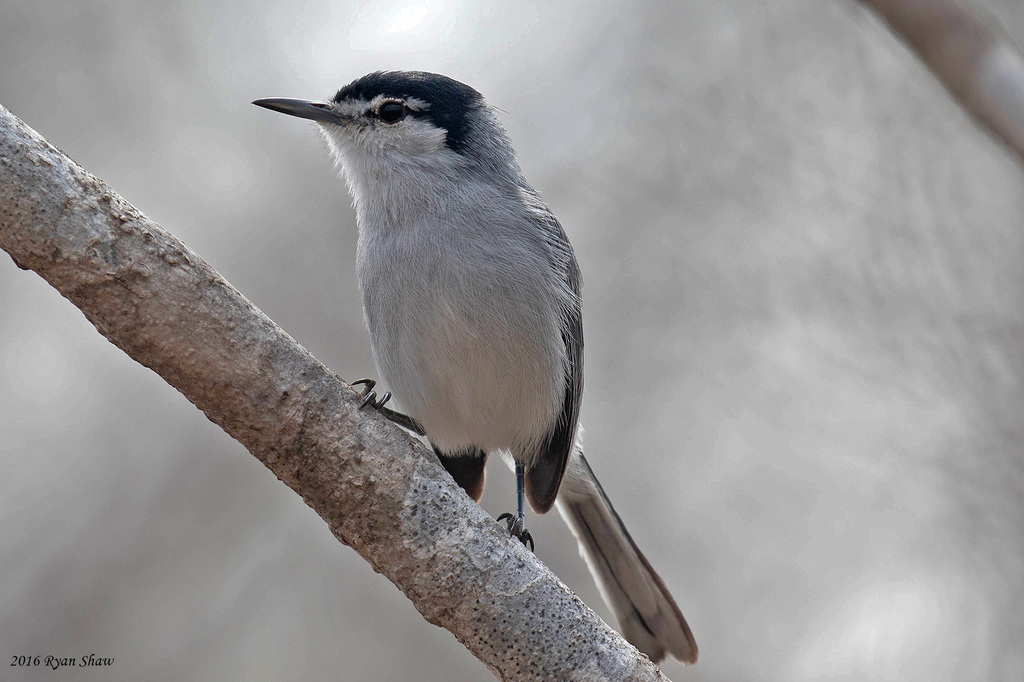
White-lored Gnatcatcher
Live sightings near you, the range map, bar charts of when it is seen, and Macaulay Library photos and recordings.
White-lored Gnatcatcher
Polioptila albiloris
The white-lored gnatcatcher (Polioptila albiloris) is a species of bird in the family Polioptilidae. It is found in Costa Rica, El Salvador, Guatemala, Honduras, Mexico, and Nicaragua. Its natural habitats are subtropical or tropical dry forests, subtropical or tropical moist lowland forests, subtropical or tropical dry shrubland, and subtropical or tropical high-altitude shrubland.
From the article White-lored gnatcatcher on Wikipedia (CC BY-SA), quoted section by section
Description
The white-lored gnatcatcher is 11 to 12 cm (4.3 to 4.7 in) long and weighs 6 to 9 g (0.21 to 0.32 oz). The nominate male in breeding plumage has a black cap down to the eyes and including the nape. The rest of the upperparts are bluish gray. The tail is black with white outermost feathers. The throat is white becoming pale bluish gray on the breast and flanks. The female has a dark gray cap and the eponymous white lores and supercilium. The juvenile is similar to the female but has browner upperparts. The male P. a. vanrossemi has a larger black cap and longer wings and tail than the nominate.
Range & habitat
The nominate white-lored gnatcatcher is found from central Guatemala south through Honduras, El Salvador, and Nicaragua into northwestern Costa Rica. P. a. vanrossemi is found in Mexico from the southern parts of the states of Michoacán, México, and Puebla south to most of Chiapas. It inhabits arid to semi-arid biomes including scrublands, thorn forest, deciduous woodland, and secondary forest. It shuns the interior of tall woodlands. It is mostly found below 1,000 m (3,300 ft) of elevation.
Wikipedia: “Distribution and habitat”
What it does
The white-lored gnatcatcher's diet is a variety of adult insects, caterpillars, and spiders. It forages mostly by gleaning but will make sallies to catch flying insects.
Wikipedia: “Feeding”
Listen
Looking for field recordings…
Where it lives
Recorded sightings
—
geo-referenced records in GBIF, from museums, herbaria and field observers.
Drag the globe to turn it. Dots are where records exist, not a range map; darker means more records.
In the stacks
Searching the stacks…
Every page naming Polioptila albiloris in the Biodiversity Heritage Library →
This page is assembled live from iNaturalist, GBIF, Wikipedia, the Source Library and the Internet Archive. It is not yet part of the hand-edited codex. iNaturalist taxon 979905.