On eBird ↗
Yellow-thighed Brushfinch
Live sightings near you, the range map, bar charts of when it is seen, and Macaulay Library photos and recordings.
Yellow-thighed Brushfinch
Atlapetes tibialis
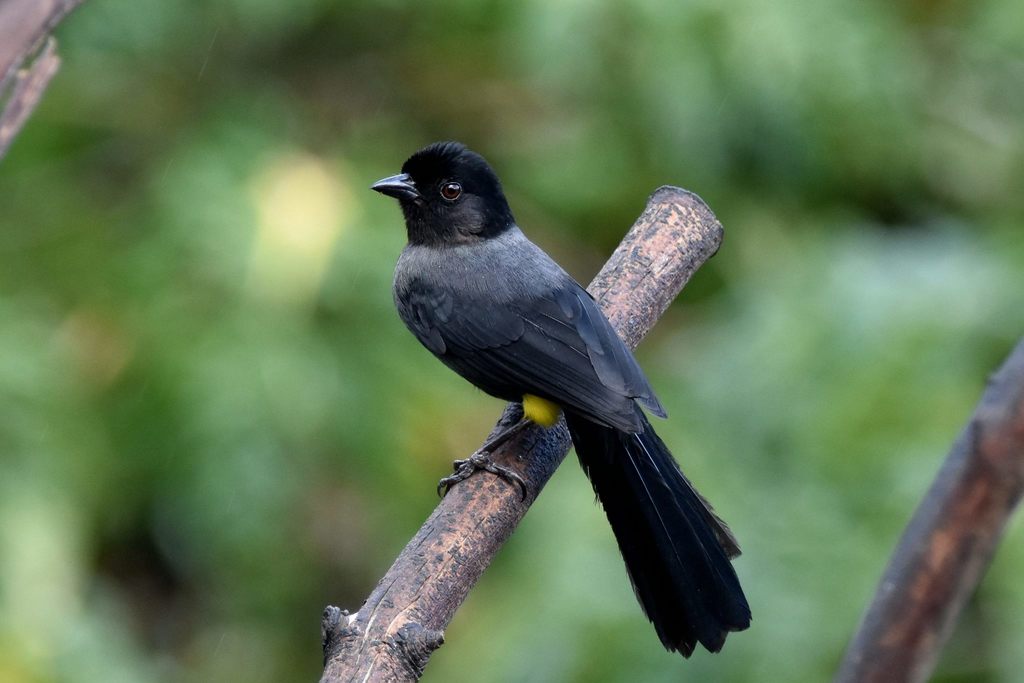
The yellow-thighed brushfinch (Atlapetes tibialis) is a passerine bird which is endemic to the highlands of Costa Rica and western Panama. Despite its name, it is not a true finch, but rather a member of the family Passerellidae, which also includes American sparrows, juncos and towhees.
From the article Yellow-thighed brushfinch on Wikipedia (CC BY-SA), quoted section by section
Description
The yellow-thighed brushfinch is about 18 cm (7.1 in) long and weighs 27 to 35 g (0.95 to 1.2 oz). The sexes have the same plumage. Adults have puffy lemon yellow feathers on their tibiae that give the species its English name. They have a black crown. The rest of their head and their upperparts are sooty slate and their wings and tail are almost black. Their chin and throat are blackish and their underparts are dull slate. They have a dark rusty brown iris, a black bill, and black to gray legs and feet. Juveniles are generally duller overall than adults and do not have the yellow tibial feathers.
Range & habitat
The yellow-thighed brushfinch is found in Costa Rica's Cordillera de Tilarán, Cordillera Central, and Cordillera de Talamanca. In the last its range continues into western Panama's Chiriquí Province. It primarily inhabits montane evergreen forest and secondary forest in the subtropical and temperate zones. It also is found in brushy pastures and clearings and in gardens. Sources differ on its elevational range. A twentieth century source places it between 1,500 and 3,400 m (4,900 and 11,200 ft). A 2007 field guide says from 1,400 m (4,600 ft) to treeline and a 2020 source says from 1,200 m (3,900 ft) to treeline.
Wikipedia: “Distribution and habitat”
What it does
The yellow-thighed brushfinch's diet has not been systematically studied, but it is known to feed on insects, spiders, seeds, fruits, and nectar. It forages in pairs and family groups, and often joins mixed-species feeding flocks. It forages mostly on the ground and in the forest understory but will feed as high as the canopy.
Wikipedia: “Feeding”
Listen
Looking for field recordings…
Where it lives
Recorded sightings
—
geo-referenced records in GBIF, from museums, herbaria and field observers.
Drag the globe to turn it. Dots are where records exist, not a range map; darker means more records.
In the stacks
Searching the stacks…
Every page naming Atlapetes tibialis in the Biodiversity Heritage Library →
This page is assembled live from iNaturalist, GBIF, Wikipedia, the Source Library and the Internet Archive. It is not yet part of the hand-edited codex. iNaturalist taxon 979617.