On eBird ↗
Yellow-shouldered Blackbird
Live sightings near you, the range map, bar charts of when it is seen, and Macaulay Library photos and recordings.
Yellow-shouldered Blackbird
Agelaius xanthomus
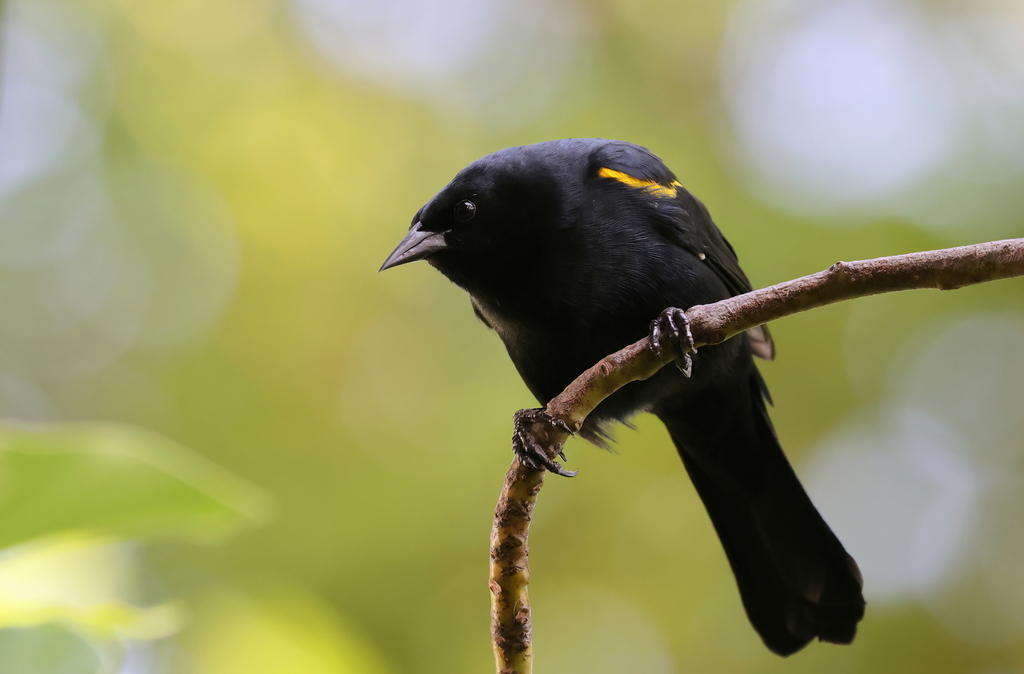
The yellow-shouldered blackbird (Agelaius xanthomus), also known as in Puerto Rican Spanish as la mariquita de Puerto Rico or capitán, is a diurnal blackbird endemic to the archipelago of Puerto Rico and belongs to the genus Agelaius of the family Icteridae. It has black plumage with a prominent yellow shoulder on its wing. Adult males and females are of similar appearance. The species is predominantly insectivorous.
From the article Yellow-shouldered blackbird on Wikipedia (CC BY-SA), quoted section by section
Description
The yellow-shouldered blackbird, as its name implies, is a glossy black bird with a small yellow humeral patch around its "shoulders" outlined by a white margin. Immature individuals possess a duller coloration and a brown abdomen. Although plumage coloration is indistinguishable between the sexes, sexual dimorphism is present in this species with males being larger than females. Plumage abnormality is rare in this species. Adult individuals measure from 20–23 cm (7.9–9.1 in); on average, males weigh 41 g (1.4 oz) and females weigh 35 g (1.2 oz). Sexual categorization may also be made by measurement of the wings, with males' being 1.1 times larger and having a mean length of 102 cm (40 in), while females' wings have an average length of 93.3 cm (36.7 in).
Range & habitat
The species was once commonly found in the coastal forests of the archipelago of Puerto Rico, but during the early 20th century, these forests were cut down to allow for the development of sugarcane plantations. After the decline of the sugar industry after the 1930s the coastal areas were developed for housing. As a result, the species is now limited to three areas: the islands of Mona and Monito, where a subspecies developed (A. g. xmonensis); the Roosevelt Roads Naval Station area in eastern Puerto Rico; and the southern Puerto Rican dry forests and mangroves. Although all three locations are considered coastal subtropical dry forests, the species has been observed as far inland as the mountain town of Lares and in subtropical wet forests during the non-breeding season. The species has also been observed at the Cabo Rojo National Wildlife Refuge. The destruction of habitat and brood parasitism by the shiny cowbird (Molothrus bonariensis) led to a drastic population decline from the mid-1970s to early 1980s. In 1976, the population of the nominate form was estimated at 2000 individuals, but in 1982, the population estimate dropped to 300 individuals. Conservation efforts have increased the population to 1250 pairs. In 1976 Post and Wiley estimated the Mona subspecies population at 200 individuals. …
Wikipedia: “Conservation and habitat”
What it does
Yellow-shouldered blackbirds are omnivorous, but are considered to be arboreal insectivores since the majority of their diet consists of insects. William Post performed studies to determine the dietary habits of the nominate form A. x. xanthomus. The studies analyzed samples of food parents brought to nestlings, and found evidence of consumption of insects belonging to the orders Lepidoptera, Orthoptera, Hemiptera, Coleoptera, Diptera, Dermaptera and Hymenoptera, arachnid material of the order Araneae, unidentified molluscs, and plant matter. Aside from natural material, the species also consumes processed food such as cattle ration, human food (cooked rice and sugar), dog food and monkey chow. Plant matter was acquired from processed foods while insects are gleaned from the canopy and sub-canopy layers of trees. During the nesting season their diet is composed of 90% arthropod material. Studies have not been performed to determine the dietary habits of the Mona subspecies, but consumption of insects, spiders, fruits from Pithecellobium species and the cacti Selenicereus species, Pilosocereus armatus (as P. royenii), Harrisia portoricensis, and Opuntia species, seeds from gumbo limbo (Bursera simaruba) and Ficus species and nectar from Aloe vera, yucca and Croton discolor have been observed.
Wikipedia: “Diet”
Listen
Looking for field recordings…
Where it lives
Recorded sightings
—
geo-referenced records in GBIF, from museums, herbaria and field observers.
Drag the globe to turn it. Dots are where records exist, not a range map; darker means more records.
In the stacks
Searching the stacks…
Every page naming Agelaius xanthomus in the Biodiversity Heritage Library →
This page is assembled live from iNaturalist, GBIF, Wikipedia, the Source Library and the Internet Archive. It is not yet part of the hand-edited codex. iNaturalist taxon 9764.