- Animals
- ›Arthropods
- ›Hexapods
- ›Insects
- ›Winged and Once-winged Insects
- ›Butterflies and Moths
- ›Owlet Moths and Allies
- ›Cutworm Moths and Allies
- ›Cutworms and Dart Moths
- ›Wainscot Moths
- ›Ichneutica
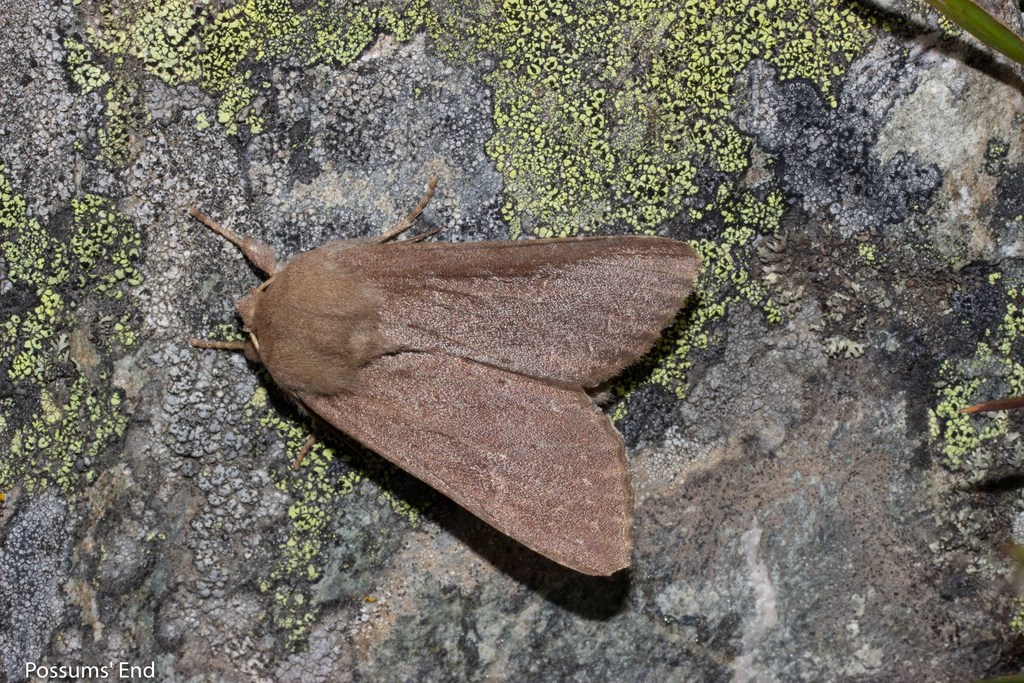
Speargrass moth
Ichneutica nullifera
Ichneutica nullifera is a moth of the family Noctuidae. This species is endemic to New Zealand and can be found in the Tongariro National Park, along the Wellington coast and throughout the South Island. The adults are large and the forewing of adults can vary in colour from pale fawn to dark grey. The larvae are coloured a bright yellow-brown with a paler underside. The larval host species are in the genus Aciphylla and as a result the adult moths are often found in habitat dominated by species in this genus. Adults are on the wing from November to early April and are sometimes attracted to light.
From the article Ichneutica nullifera on Wikipedia (CC BY-SA), quoted section by section
Description
Walker described the male adult of this species as follows:
Male. Pale fawn-colour. Abdomen very pale. Antennae serrated. Fore wings without any marks, excepting an indistinct darker dot on each of the exterior veins. Hind wings very pale fawn-colour, shining. Length of the body 10 lines; of the wings 24 lines. Hudson in his 1928 book The butterflies and moths of New Zealand described the larva of this species as follows:
The larva is very stout, bright yellowish-brown, considerably paler on the undersurface; the dorsal line is faintly indicated, the subdorsal and lateral lines are dull brown, with a chain of elongate white spots beneath each; the spiracles and dorsal surface of the posterior segments are black; there are also numerous white dots all over the larva. I. nullifera is large in size with the male of the species having a wingspan of 53 to 67 mm and the female having a wingspan of between 57 and 77 mm. The forewing colouration of specimens can vary from deep fawn to a dark grey. Of this species near relatives, I. nobilia is the most similar in appearance, but can be distinguished as a result of the deep greyish-blue sheen on that species' forewings.
Range & habitat
It is endemic to New Zealand. I. nullifera can be found in the Tongariro National Park, along the Wellington coast, and throughout the South Island.
Wikipedia: “Distribution”
What it does
The adults of this species is sometimes attracted to light and have been collected via a mercury vapour light trap. The adults are on the wing from November to early April.
Wikipedia: “Behaviour”
In human culture
The larvae of this species feeds on Aciphylla species including Aciphylla aurea, Aciphylla colensoi, Aciphylla glaucescens, Aciphylla squarrosa, Aciphylla subflabellata. The larvae prefers the softer centre of the plant and its presence can be detected by the frass it produces as well as the discolouration it causes by feeding near the base of the leaves. The larvae are often found in burrows in the stem of the host plant. The pupa, which is in a loose cocoon, can be found in the leaf litter near the roots of the host plant.
== References ==
Wikipedia: “Life history and host species”
Listen
Looking for field recordings…
Where it lives
Recorded sightings
—
geo-referenced records in GBIF, from museums, herbaria and field observers.
Drag the globe to turn it. Dots are where records exist, not a range map; darker means more records.
In the stacks
Searching the stacks…
Every page naming Ichneutica nullifera in the Biodiversity Heritage Library →
This page is assembled live from iNaturalist, GBIF, Wikipedia, the Source Library and the Internet Archive. It is not yet part of the hand-edited codex. iNaturalist taxon 974709.