- Animals
- ›Arthropods
- ›Hexapods
- ›Insects
- ›Winged and Once-winged Insects
- ›Butterflies and Moths
- ›Owlet Moths and Allies
- ›Cutworm Moths and Allies
- ›Cutworms and Dart Moths
- ›Wainscot Moths
- ›Ichneutica
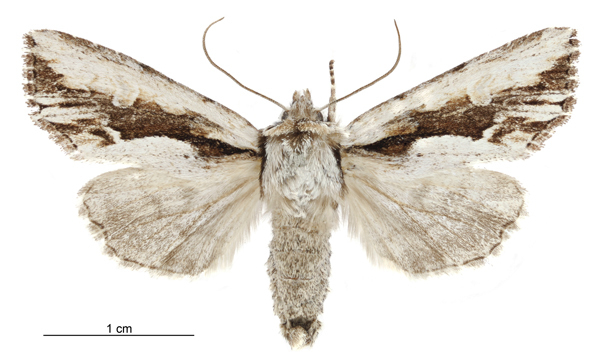
Black & White Owlet
Ichneutica paracausta
Ichneutica paracausta is a moth of the family Noctuidae. This species is endemic to New Zealand. It is found locally in the central North Island, is widespread in the South Island and can also be found in Stewart Island. I. paracausta is variable in colour, but as it has a distinctive black streak on its forewing as well as a wing pattern that is characteristic, I. paracausta is unlikely to be confused with other species. It is present on the North Island volcanic plateau as well as Little Bush Reserve in Hawkes Bay in the North Island as well as in tussock grassland, alpine and subalpine shrubland and in alpine forest. Larvae have been recorded as feeding on grasses, a pupa has been found in a cocoon under the bark of a tree and adult moths are on the wing from October to January.
From the article Ichneutica paracausta on Wikipedia (CC BY-SA), quoted section by section
Description
Alfred Philpott described the larva of this species as follows:
Length, 13 lines; dull whitish; dorsal line of indistinct darker colour; subdorsal very faint; lateral stripe more pronounced; many minute specks of colour; head pale-brownish, with darker markings; dorsal surface of first thoracic segment darker.
Meyrick described the adult of this species as follows:
Male, female. — 37 mm. Head whitish, mixed with reddish-ochreous above, with two blackish transverse lines on face. Palpi whitish, externally somewhat mixed with reddish-ochreous and black. Antennae whitish, in male moderately pectinated. Thorax and abdomen grey mixed with white and black, collar mixed with reddish-ochreous, and with a transverse blackish line, outer edge of patagia blackish. Legs ochreous-whitish, suffusedly mixed with blackish. Forewings moderately dilated, costa slightly sinuate, apex obtuse, hindmargin waved, rather oblique, rounded beneath; pale ochreous, towards costa irrorated with dark fuscous and whitish, in female more whitish; lines slender, dentate, obscure, dark fuscous; first anteriorly whitish-margined, second posteriorly white-margined on lower half; spots hardly perceptible; a slender black sinuate streak from base to middle, margined beneath rather broadly with dark ochreous-brown to first line, terminating beneath a rather broad posteriorly dilated dark ochreous-brown discal pat …
Range & habitat
This species is endemic to New Zealand. I. paracausta is found locally in the central North Island, is widespread in the South Island and can also be found in Stewart Island. I. paracausta can be found down to sea level in Southland.
Wikipedia: “Distribution”
What it does
This species is on the wing from October to January. Adults are attracted to light and have been collected via a mercury vapour light trap.
Wikipedia: “Behaviour”
In human culture
Knowledge about the life history of this species needs to be increased. Larvae have been recorded as feeding on various grasses. Pupa have been found in a slight cocoon under the bark of a tree.
== References ==
Wikipedia: “Life history and host species”
Listen
Looking for field recordings…
Where it lives
Recorded sightings
—
geo-referenced records in GBIF, from museums, herbaria and field observers.
Drag the globe to turn it. Dots are where records exist, not a range map; darker means more records.
In the stacks
Searching the stacks…
Every page naming Ichneutica paracausta in the Biodiversity Heritage Library →
This page is assembled live from iNaturalist, GBIF, Wikipedia, the Source Library and the Internet Archive. It is not yet part of the hand-edited codex. iNaturalist taxon 974690.