- Animals
- ›Arthropods
- ›Hexapods
- ›Insects
- ›Winged and Once-winged Insects
- ›Butterflies and Moths
- ›Owlet Moths and Allies
- ›Cutworm Moths and Allies
- ›Cutworms and Dart Moths
- ›Wainscot Moths
- ›Ichneutica
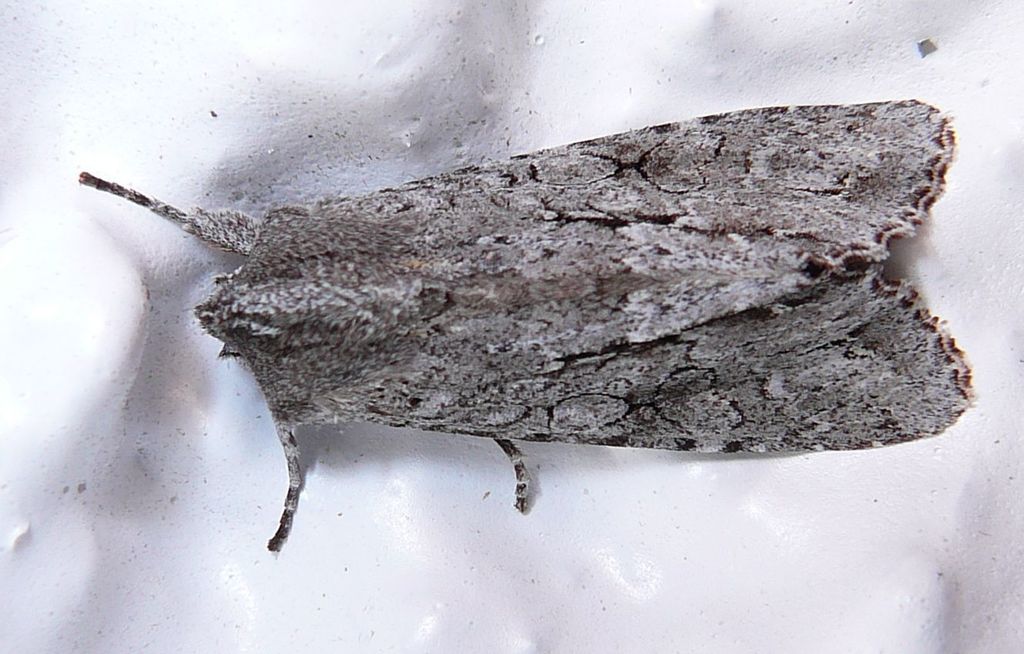
Large Grey Owlet
Ichneutica ustistriga
Ichneutica ustistriga, also known as the large grey owlet, is a moth of the family Noctuidae. It is endemic to New Zealand and can be found from the Three Kings Islands to Stewart Island. This species lives in a wide variety of habitats including domestic gardens, horticultural areas, orchards, native and exotic grasslands, as well as native forest. The larvae eat a variety of herbaceous plants. Recorded food plants include Muehlenbeckia australis, Muehlenbeckia complexa, Olearia hectorii, and Plantago lanceolata. This moth has a mauvish grey wing colour and is unlikely to be confused with other species as the patterns on its forewing are distinctive. This species is on the wing throughout the year and is attracted to both sugar and light traps. Adult moths can be found at rest on fences and tree trunks during the day.
From the article Ichneutica ustistriga on Wikipedia (CC BY-SA), quoted section by section
Description
George Hudson describes the egg of this species as follows:
The egg is semi-globose, pale green, with numerous branching ribs radiating from the micropyle and faint transverse ribs between them. Hudson described the larva of this species as follows:
The larva is dull greyish-brown with blackish subdorsal and lateral lines; there is a series of pale spots below the subdorsal line, and an obscure whitish streak below the lateral line. Walker originally described the adults of this species as follows:
Cinereous, tinged with brown. Abdomen pale cinereous, reddish ferruginous at the tip. Fore wings with three very irregular black discal ringlets, with a very incomplete ferruginous-brown band near the exterior border, with a distinct ferruginous brown streak near the interior angle, and with ferruginous marks along the costa; ciliae ferruginous. Hind wings brownish. Length of the body 7 — 8 lines; of the wings 16 — 18 lines.The adult male of this species has a wingspan of between 36 and 46 mm where as the female has a wingspan of between 38 and 53 mm. This moth has a mauvish grey wing colour and is unlikely to be confused with other species as the patterns on its forewing are distinctive.
Range & habitat
It is endemic to New Zealand and can be found from the Three Kings Islands to Stewart Island.
Wikipedia: “Distribution”
What it does
This species is on the wing throughout the year and is attracted to both sugar and light traps. Adult moths can be found at rest on fences and tree trunks during the day.
Wikipedia: “Behaviour”
In human culture
The larvae eat a variety of herbaceous plants. Recorded food plants include Muehlenbeckia australis, Muehlenbeckia complexa, Olearia hectorii, and Plantago lanceolata.
Wikipedia: “Life history and host species”
Listen
Looking for field recordings…
Where it lives
Recorded sightings
—
geo-referenced records in GBIF, from museums, herbaria and field observers.
Drag the globe to turn it. Dots are where records exist, not a range map; darker means more records.
In the stacks
Searching the stacks…
Every page naming Ichneutica ustistriga in the Biodiversity Heritage Library →
This page is assembled live from iNaturalist, GBIF, Wikipedia, the Source Library and the Internet Archive. It is not yet part of the hand-edited codex. iNaturalist taxon 974684.