- Animals
- ›Arthropods
- ›Hexapods
- ›Insects
- ›Winged and Once-winged Insects
- ›Butterflies and Moths
- ›Owlet Moths and Allies
- ›Cutworm Moths and Allies
- ›Cutworms and Dart Moths
- ›Wainscot Moths
- ›Ichneutica
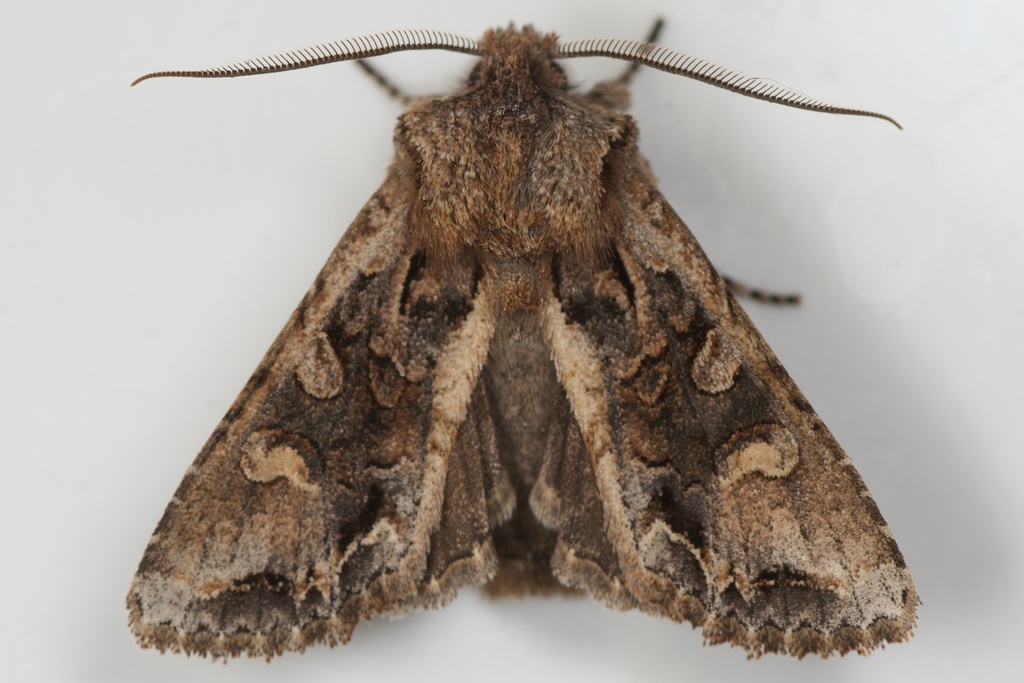
Green-Marked Owlet
Ichneutica insignis
Ichneutica insignis is a moth of the family Noctuidae. It is endemic to and found throughout New Zealand, although it appears to be scarce at inland sites of tussock grasslands. The adults are on the wing throughout the year. It is a variable species and as such can be easily confused with I. skelloni and I. plena. The larvae of this species have been recorded as feeding on Trifolium pratense.
From the article Ichneutica insignis on Wikipedia (CC BY-SA), quoted section by section
Description
George Hudson describes the eggs of this species as follows:
The egg is semi-globose, considerably flattened above and beneath. A number of branching ribs radiate from the micropyle, the spaces between them being slightly ribbed transversely. Its colour is pale green, becoming dark brown in the centre as the enclosed embryo develops. Larvae start their lives coloured pale brown with numerous black warts emitting black bristles. After about twelve days the larvae turn a pale green and after moulting, lateral and subdorsal lines begin to appear. Hudson describes the fully mature larva of this species is as follows:
A full grown larva is pale greenish-brown, inclining to yellow on the ventral surface. There lateral lines consist of a series of black markings near the posterior margin of each segment; the subdorsal lines are represented by four oblique black marks on each side of the four posterior segments of the larva. The region between these lines is much clouded with yellowish green or pink, the larva having a tendency to diverge into pink and green varieties. The anal segment is dull yellow. The head is brown, with two black stripes and several black dots.
Walker described the adults of this species as follows:
Male and female. Ferruginous-cinereous. …
Range & habitat
Although this species can be found in a variety of habitats throughout the country it is scarce or absent from inland sites of tussock grassland.
Wikipedia: “Habitat”
What it does
Adults of this species can be found on the wing throughout the year. The adults moths are attracted to light. They have been collected via a mercury vapour light trap. The sex pheromones used by I. insignis consist of combinations of tetradecenyl and dodecenyl acetates or alcohols.
Wikipedia: “Behaviour”
Listen
Looking for field recordings…
Where it lives
Recorded sightings
—
geo-referenced records in GBIF, from museums, herbaria and field observers.
Drag the globe to turn it. Dots are where records exist, not a range map; darker means more records.
In the stacks
Searching the stacks…
Every page naming Ichneutica insignis in the Biodiversity Heritage Library →
This page is assembled live from iNaturalist, GBIF, Wikipedia, the Source Library and the Internet Archive. It is not yet part of the hand-edited codex. iNaturalist taxon 974680.