- Animals
- ›Arthropods
- ›Hexapods
- ›Insects
- ›Winged and Once-winged Insects
- ›Butterflies and Moths
- ›Owlet Moths and Allies
- ›Cutworm Moths and Allies
- ›Cutworms and Dart Moths
- ›Wainscot Moths
- ›Ichneutica
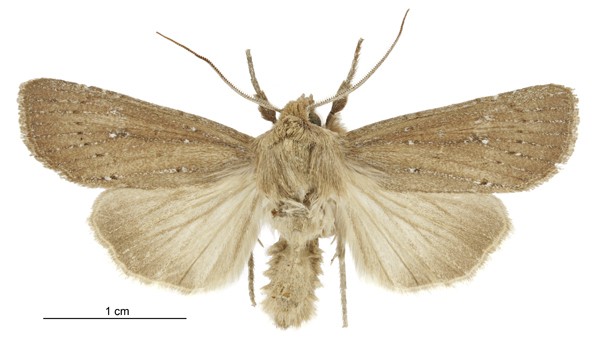
Ichneutica phaula
Ichneutica phaula is a moth of the family Noctuidae. It is endemic to New Zealand. It is found only in the South Island in the Nelson district, the eastern side of the South Island and Stewart Island. I. phaula inhabits tussock grasslands and coastal sand dunes. Host species include Ficinia spiralis, Ammophila arenaria, Poa cita and other "tussock grasses". The adults of this species are on the wing from October to December and are attracted to sugar traps. I. phaula is similar in appearance to both I. micastra, with whom it does not share a range, and I. sapiens which differs from I. phaula as I. sapiens is darker and has a more reddish tinge.
From the article Ichneutica phaula on Wikipedia (CC BY-SA), quoted section by section
Description
Meyrick described this species as follows:
Male.— 38 mm. Head, palpi, antennae, thorax, abdomen, and legs light brownish-ochreous; antennae with moderate triangular longitudinal dentations, terminating in tufts of cilia. Forewings moderately dilated, costa almost straight, apex obtuse, hindmargin somewhat oblique, rounded beneath; rather light fuscous, ochreous-tinged; veins marked with scattered white and black scales; an obscure white dot at each extremity of transverse vein; a minute black dot towards inner margin at 1⁄3; a posterior series of obscure minute black dots, bent above middle : ciha fuscous, base more ochreous, tips whitish. Hindwings fuscous-grey, base somewhat lighter; cilia whitish-ochreous, with a faint grey line, tips more whitish.The adult male has a wingspan of between 32 and 40 mm and the adult female has a wingspan of between 36 and 45 mm. This species is very similar in appearance to I. micastra, although the ranges of the two species appears not to overlap. I. phaula can be distinguished as there is a difference in pectinations on its antennae. Also both male and female I. phaula are lighter and less chunky than I. micastra. I. phaula is also similar to I. sapiens but I. phaula tends to be a paler species with I. sapiens having a more reddish tinge.
Range & habitat
I. phaula is endemic to New Zealand. This species is found only in the South Island, in the Nelson district, on the eastern side of the South Island and on Stewart Island.
Wikipedia: “Distribution”
What it does
Adults of this species are on the wing from October to December. They are attracted to light and have been collected via mercury vapour light traps and sugar traps.
Wikipedia: “Behaviour”
In human culture
Some portions of this species life history is unknown but the larval host species include Ficinia spiralis, Ammophila arenaria, Poa cita and other "tussock grasses".
== References ==
Wikipedia: “Life history and host species”
Listen
Looking for field recordings…
Where it lives
Recorded sightings
—
geo-referenced records in GBIF, from museums, herbaria and field observers.
Drag the globe to turn it. Dots are where records exist, not a range map; darker means more records.
In the stacks
Searching the stacks…
Every page naming Ichneutica phaula in the Biodiversity Heritage Library →
This page is assembled live from iNaturalist, GBIF, Wikipedia, the Source Library and the Internet Archive. It is not yet part of the hand-edited codex. iNaturalist taxon 974632.