- Animals
- ›Arthropods
- ›Hexapods
- ›Insects
- ›Winged and Once-winged Insects
- ›Butterflies and Moths
- ›Owlet Moths and Allies
- ›Cutworm Moths and Allies
- ›Cutworms and Dart Moths
- ›Wainscot Moths
- ›Ichneutica
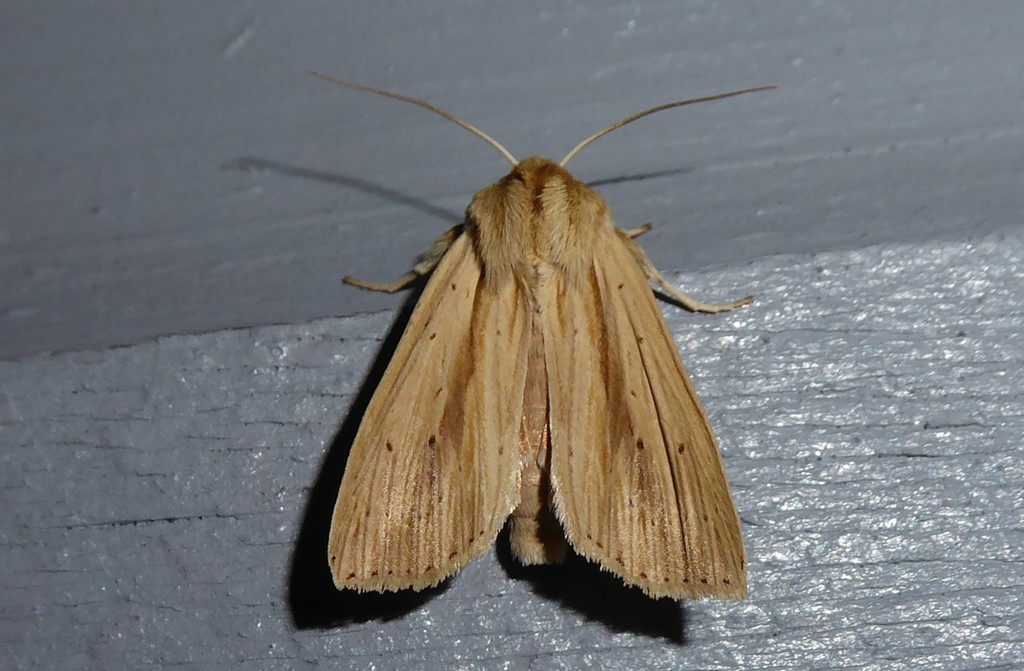
Common Dotted Wainscot
Ichneutica semivittata
Ichneutica semivittata is a moth of the family Noctuidae. It is endemic to New Zealand. It can be found from the Three King Islands down to Stewart Island. The similar species I. sulcana can be distinguished from I. semivittata as the former is much larger, has a darker hindwing and abdomen and has only one to three spots located behind the middle of the forewing in comparison to the 8 or 9 of I. semivittata. This species lives in a variety of habitats from open grasslands to clearings in forest and at a range of altitudes from the sea level to the alpine zone. Larval host species include Juncus procera, Carex secta as well as on tussock grasses such as Poa cita, P. colensoi and Festuca novae-zelandiae. Adults of this species are on the wing from August to April and are attracted to light.
From the article Ichneutica semivittata on Wikipedia (CC BY-SA), quoted section by section
Description
George Hudson described the larvae of I. semivittata as follows:
The larva, which feeds on native grasses, is about 1+1⁄4 inches in length, subcylindrical, slightly tapering at each end; dull green, very finely streaked with reddish-brown; the dorsal and subdorsal lines are indicated by fine double reddish lines; there is a series of white dots, one on each segment, except on the second and last; the lateral line is very distinct, dark reddish-brown, shaded with cream colour below; the spiracles are blackish; the underside of the larva and the whole of the second segment is a paler and clearer green than the rest of the body. Walker described the adults of this species as follows:
Male, Very pale fawn-colour. Palpi hardly ascending, as long as the breadth of the head; second joint fringed beneath; third lanceolate, less than half the length of the second. Antennae setose. Abdomen extending somewhat beyond the hind wings. Wings with black marginal points. Fore wings acute, with a short black basal line; the latter is accompanied by an ochraceous line which extends irregularly along the hind side of a brownish streak in the disk; this streak is traversed by a curved line of black points; veins towards the exterior border brownish, with brownish lines between them; under side with a brownish patch in the disk beyond the middle. …
Range & habitat
It is endemic to New Zealand. The species can be found from Three Kings Islands down to and including Stewart Island.
Wikipedia: “Distribution”
What it does
Adults of this species are on the wing from August to April. They are attracted to light and have been collected via a mercury vapour light trap.
Wikipedia: “Behaviour”
In human culture
Larval host species include Juncus procera, Carex secta as well as on tussock grasses such as Poa cita, P. colensoi and Festuca novae-zelandiae.
== References ==
Wikipedia: “Life history and host species”
Listen
Looking for field recordings…
Where it lives
Recorded sightings
—
geo-referenced records in GBIF, from museums, herbaria and field observers.
Drag the globe to turn it. Dots are where records exist, not a range map; darker means more records.
In the stacks
Searching the stacks…
Every page naming Ichneutica semivittata in the Biodiversity Heritage Library →
This page is assembled live from iNaturalist, GBIF, Wikipedia, the Source Library and the Internet Archive. It is not yet part of the hand-edited codex. iNaturalist taxon 974630.