On eBird ↗
Hooded Yellowthroat
Live sightings near you, the range map, bar charts of when it is seen, and Macaulay Library photos and recordings.
Hooded Yellowthroat
Geothlypis nelsoni
The hooded yellowthroat (Geothlypis nelsoni) is a species of bird in the Parulidae family. It is endemic to the highlands of Mexico north of the Isthmus of Tehuantepec.
From the article Hooded yellowthroat on Wikipedia (CC BY-SA), quoted section by section
Description
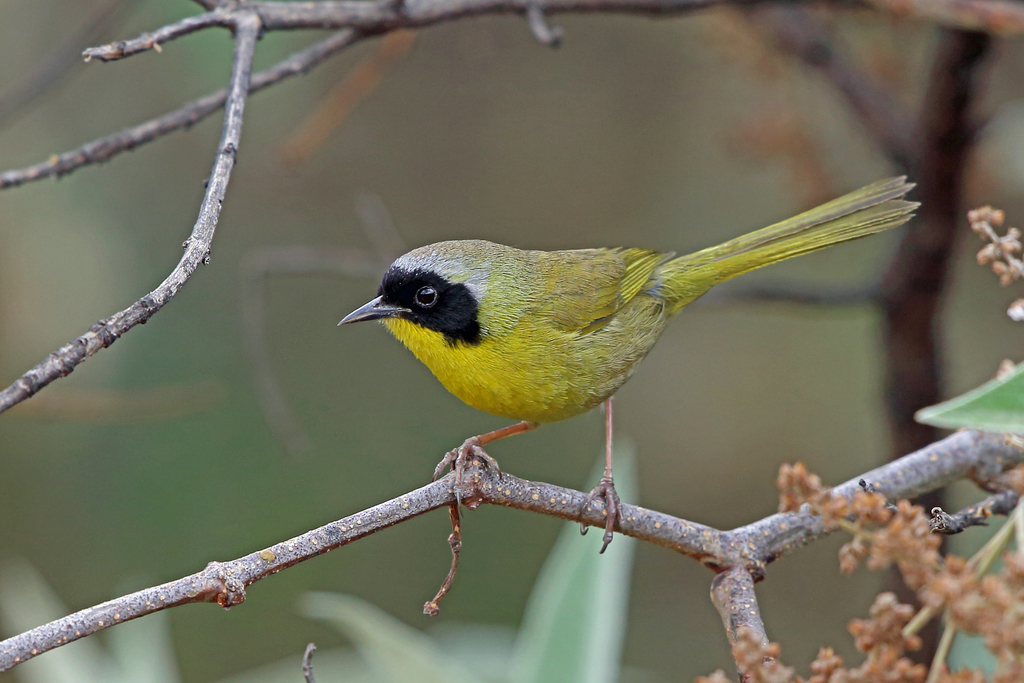
The hooded yellowthroat is about 13 cm (5.1 in) long and weighs about 10 to 12 g (0.35 to 0.42 oz). The species is sexually dimorphic. Adult males of the nominate subspecies have a wide black mask from the forehead past the eye to the side of the neck. It is bordered top and back with a medium gray band. The rest of their head and their upperparts, wings, and tail are dull olive-green. Their throat and underparts are yellow with a slightly paler belly and an olive wash on the flanks. Females have no black on their face. They have a pale grayish stripe above the lores and an olive crown and ear coverts. Their upper- and underparts are like the male's. Males of subspecies G. n. karlenae have a slightly wider mask than the nominate. Females have a more orangey breast and more bronze-yellow undertail coverts. Both sexes of both subspecies have a dark iris, a black bill that in the non-breeding season has a pale mandible, and dusky pinkish legs and feet.
Range & habitat
The nominate subspecies of the hooded yellowthroat is the more northerly of the two. It is found in the Sierra Madre Oriental from southeastern Coahuila south to west-central Veracruz and northern Puebla. Subspecies G. n. karlenae is found in the central highlands from the Distrito Federal and southern Puebla south to north-central Oaxaca. The species primarily inhabits dry scrublands, brushlands, and chaparral in the subtropical and temperate zones, though it also occurs in damper parts of them. It favors a biome called pedregal that is characterized by cactus scrub on lava beds. In winter it also inhabits the edges of pine-oak woodlands. Sources differ on the species' elevational range. One states it is 2,000 to 3,100 m (6,600 to 10,200 ft). More recent ones list it as 1,250 to 3,000 m (4,100 to 9,800 ft) and 1,400 to 3,100 m (4,600 to 10,200 ft).
Wikipedia: “Distribution and habitat”
What it does
The hooded yellowthroat feeds on insects and other invertebrates. It usually forages by gleaning in dense low vegetation.
Wikipedia: “Feeding”
Listen
Looking for field recordings…
Where it lives
Recorded sightings
—
geo-referenced records in GBIF, from museums, herbaria and field observers.
Drag the globe to turn it. Dots are where records exist, not a range map; darker means more records.
In the stacks
Searching the stacks…
Every page naming Geothlypis nelsoni in the Biodiversity Heritage Library →
This page is assembled live from iNaturalist, GBIF, Wikipedia, the Source Library and the Internet Archive. It is not yet part of the hand-edited codex. iNaturalist taxon 9734.