- Animals
- ›Arthropods
- ›Hexapods
- ›Insects
- ›Winged and Once-winged Insects
- ›Beetles
- ›Water, Rove, Scarab, Long-horned, Leaf, and Snout Beetles
- ›Cucujiform Beetles
- ›Longhorn Beetles and Allies
- ›Longhorn Beetles
- ›Round-necked Longhorn Beetles
- ›Cerambycini
- ›Cerambyx
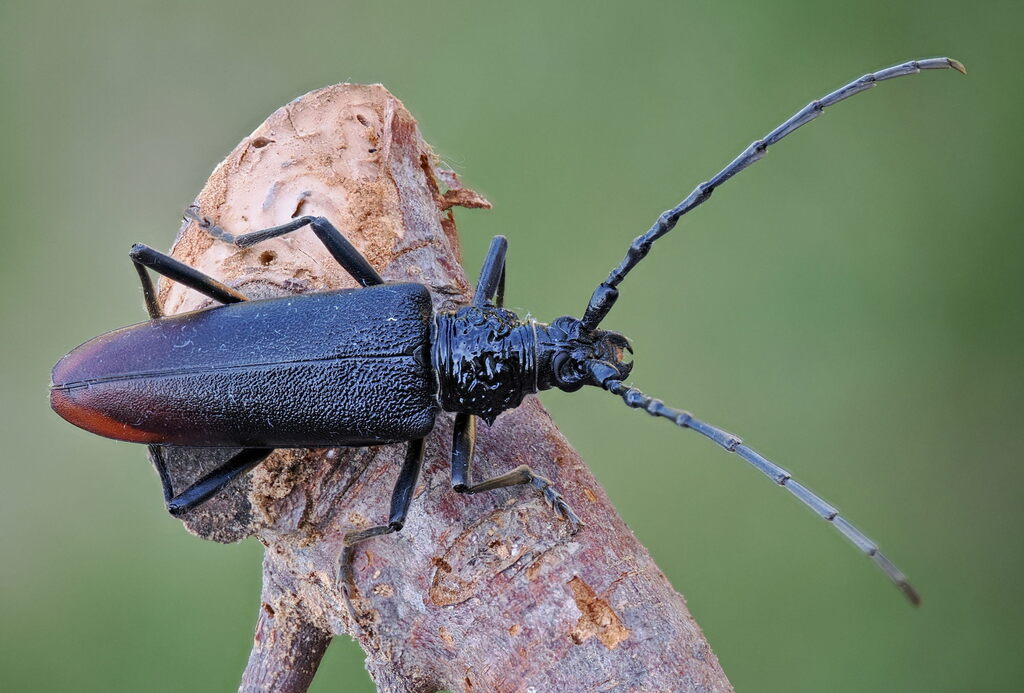
Great capricorn beetle
Cerambyx cerdo
Cerambyx cerdo, commonly known as the great capricorn beetle or cerambyx longicorn, is a species of beetle in family Cerambycidae. It occurs in North Africa (Algeria, Morocco, and Tunisia), Europe (Austria, Belarus, Bulgaria, Croatia, the Czech Republic, North Macedonia, France, Georgia, Germany, Hungary, Italy, Moldova, Poland, Portugal, Romania, Russia, Serbia, Slovakia, Spain, Sweden, Switzerland, and Ukraine), and West Asia (Armenia, Azerbaijan, Georgia, Iran, and Turkey).
The beetle was previously present in the United Kingdom but went locally extinct at least hundreds of years ago. Preserved specimens have been found in the UK, having been dated to around 4000 years old. It has been recorded in the UK since, but this is believed to be because of accidental human introduction due to wood transport.
From the article Cerambyx cerdo on Wikipedia (CC BY-SA), quoted section by section
Description
This beetle measures between 41 and 55 mm in body length and is among the largest of the European beetle species. It has an elongated, robust body and, like all members of the longhorn family, it has long antennae. In males, these thread-like antennae are longer than the body, but in females they are only as long as the hard wing cases (the elytra). The legs and body are black, except for the elytra which are reddish-brown towards the tips.
Listen
Looking for field recordings…
Where it lives
Recorded sightings
—
geo-referenced records in GBIF, from museums, herbaria and field observers.
Drag the globe to turn it. Dots are where records exist, not a range map; darker means more records.
In the stacks
Searching the stacks…
Every page naming Cerambyx cerdo in the Biodiversity Heritage Library →
This page is assembled live from iNaturalist, GBIF, Wikipedia, the Source Library and the Internet Archive. It is not yet part of the hand-edited codex. iNaturalist taxon 97022.