- Animals
- ›Chordates
- ›Vertebrates
- ›Ray-finned Fishes
- ›Spiny-rayed fishes
- ›Perches, Scorpionfishes, Sticklebacks, and Allies
- ›Perches, groupers and allies
- ›Groupers
- ›Cephalopholis
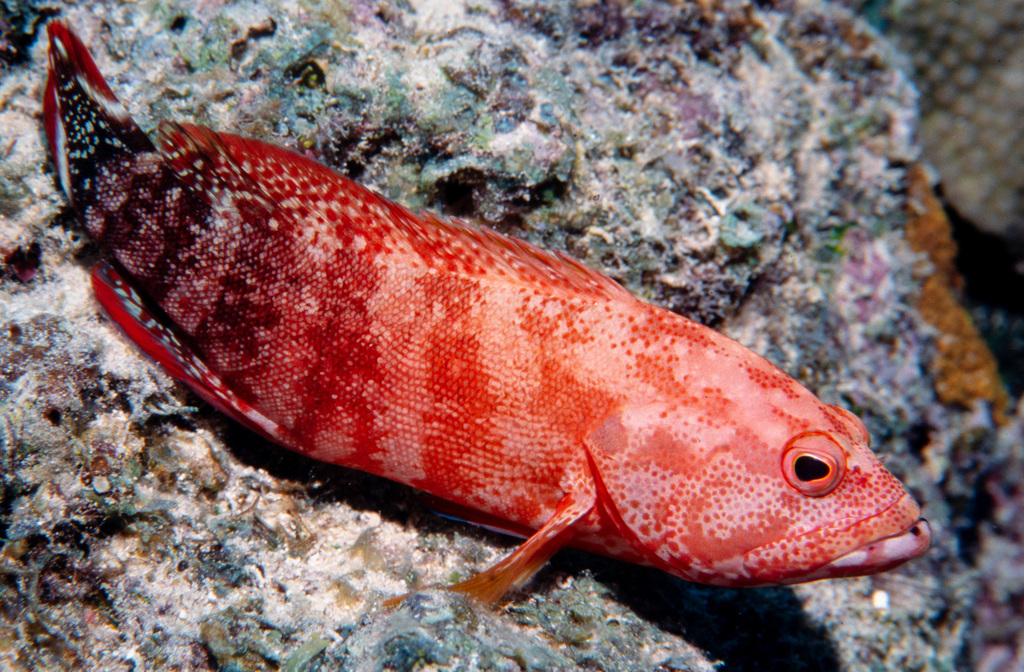
Flagtail Grouper
Cephalopholis urodeta
Cephalopholis urodeta, the darkfin hind, flagtail rockcod, chevron rockcod, duskyfin hind, duskyfin rockcod, flagtail grouper or V-tail grouper, is a species of marine ray-finned fish, a grouper of the family Epinephelidae. This fish occurs in the Western Pacific Ocean and the far eastern Indian Ocean.
From the article Cephalopholis urodeta on Wikipedia (CC BY-SA), quoted section by section
Description
Cephalopholis urodeta has been recorded growing up to a total length of 28 cm (11 in). It has a body which is less deep than the head is long with the body being around a third as deep as the standard length. The profile between the eyes is convex and the rounded preopercle has a serrated edge and a fleshy lower edge. The maxilla extends beyond the eye. The dorsal fin has 9 spines and 14–16 soft rays while the anal fin has 3 spines and 8–9 soft rays. The caudal fin is rounded and the pelvic fins do not extend to the anus. The overall colour of this fish is reddish-brown to pale greyish-brown, darkening towards the tail, with obvious whitish to pale blue diagonal lines across both lobes of the caudal fin. They frequently show six faint bars along the flanks, these fork towards the abdomen, and there are small orange-red spots on the head and nape, as well as a pair of dark spots near the tip of the lower lip. The pectoral fin are yellowish and there is normally a large reddish to brownish spot on the edge of the gill cover.
Range & habitat
Cephalopholis urodeta is found at Christmas Island in the eastern Indian Ocean but it is mainly a species of the Western Pacific Ocean. It extends as far north as Okinawa and the Ryukyu Islands of southern Japan and as far south as the southern Great Barrier Reef of Queensland in Australia. Its range extends east as far as French Polynesia and Pitcairn Island. It has also been recorded from Phoenix Islands, Jarvis Island, Palmyra Atoll, and Kingman Reef, as well as Brunei. In 1958 over 1,800 specimens of C. urodeta sourced in the South Pacific were released near Oahu in Hawaii but they failed to become established.
Wikipedia: “Distribution”
Where it lives
Recorded sightings
—
geo-referenced records in GBIF, from museums, herbaria and field observers.
Drag the globe to turn it. Dots are where records exist, not a range map; darker means more records.
In the stacks
Searching the stacks…
Every page naming Cephalopholis urodeta in the Biodiversity Heritage Library →
This page is assembled live from iNaturalist, GBIF, Wikipedia, the Source Library and the Internet Archive. It is not yet part of the hand-edited codex. iNaturalist taxon 97007.