- Animals
- ›Chordates
- ›Vertebrates
- ›Ray-finned Fishes
- ›Spiny-rayed fishes
- ›Butterflyfishes, Angelfishes, and Allies
- ›Angelfishes
- ›Centropyge
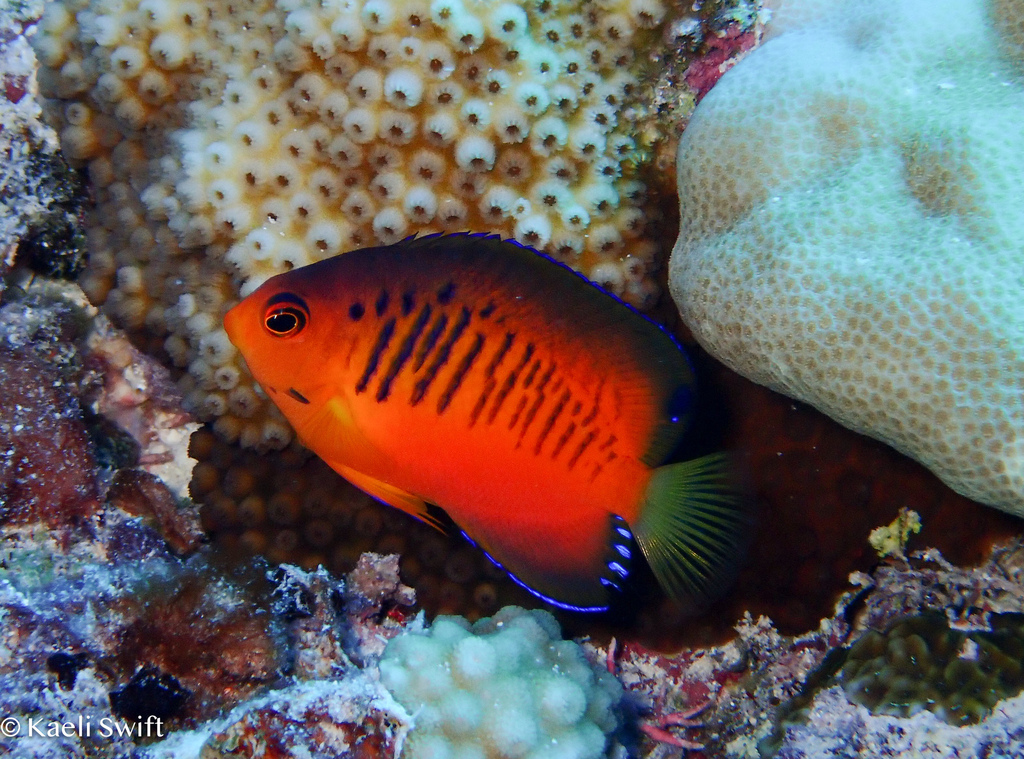
Shepard's Angelfish
Centropyge shepardi
Centropyge shepardi, the mango angelfish, Shepard's angelfish or Shepard's pygmy angelfish, is a species of marine ray-finned fish, a marine angelfish belonging to the family Pomacanthidae. It is found in the Western Pacific Ocean.
From the article Centropyge shepardi on Wikipedia (CC BY-SA), quoted section by section
Description
Centropyge shepardi has an oval-shaped. body with the dorsal and anal fins being rounded to slightly pointed at their ends. It varies in its orange background colour from nearly red to light apricot, the dorsal part being slightly darker than the ventral part. There is normally dark vertical barring on the body but this may be restricted to a small patch to the rear of the gill cover, and in rarely it may be absent. Males have a vivid blue margin to the soft rayed part of the dorsal and anal fins. The dorsal fin contains 14 spines and 16-18 soft rays while the anal fin has 3 spines and 17-18 soft rays. This species attains a maximum total length of 9 centimetres (3.5 in).
Range & habitat
Centropyge shepardi is found in the western Pacific Ocean, where its distribution is restricted to the Northern Marianas Islands, Guam, the Ogasawara Islands of southern Japan. Recently they are found at Yoron island and Okinoerabu island of southern Japan. It has been recorded from the Izu Islands of Japan, but this probably refers to vagrants. It has been reported from Palau and the Philippines but these reports need confirmation.
Wikipedia: “Distribution”
Where it lives
Recorded sightings
—
geo-referenced records in GBIF, from museums, herbaria and field observers.
Drag the globe to turn it. Dots are where records exist, not a range map; darker means more records.
In the stacks
Searching the stacks…
Every page naming Centropyge shepardi in the Biodiversity Heritage Library →
This page is assembled live from iNaturalist, GBIF, Wikipedia, the Source Library and the Internet Archive. It is not yet part of the hand-edited codex. iNaturalist taxon 96963.