- Animals
- ›Chordates
- ›Vertebrates
- ›Ray-finned Fishes
- ›Spiny-rayed fishes
- ›Butterflyfishes, Angelfishes, and Allies
- ›Angelfishes
- ›Centropyge
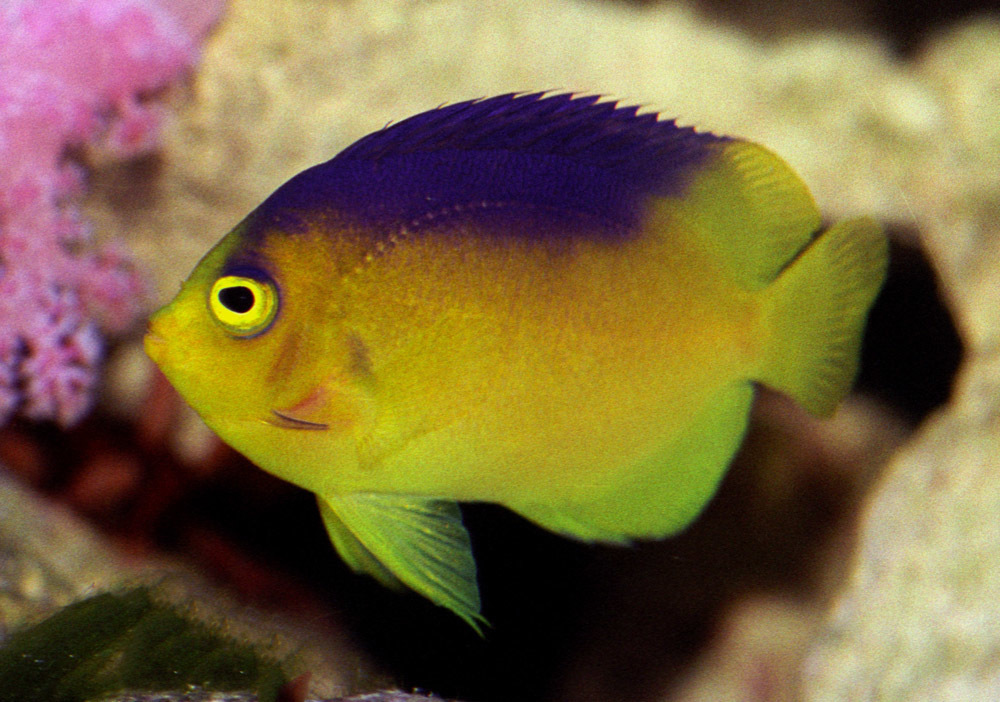
Cocos-Keeling Angelfish
Centropyge colini
Centropyge colini, the Cocos-Keeling angelfish, or Colin's angelfish is a small marine angelfish measuring up to 9 cm, it is predominantly yellow with the upper quarter of its body being bright blue in colour. It inhabits reefs up to a depth of 100m in the Indo-west Pacific Ocean, including around the Cocos (Keeling) Islands for which it is named. It is a rare and elusive species which spends much of its time hiding amongst rocks and rubble...
From the article Cocos-Keeling angelfish on Wikipedia (CC BY-SA), quoted section by section
Description
The Cocos-Keeling angelfish is mainly lemon-yellow in colour with a wide blue stripe from the nape along the back to the middle of the dorsal fin. There is a thin purplish ring around the eye. The dorsal fin contains 14 spines and 16-17 soft rays while the anal fin has 3 spines and 17 soft rays. This species attains a maximum total length of 9 centimetres (3.5 in).
Range & habitat
The Cocos-Keeling angelfish has been recorded from a scattering of sites in the Indo-West Pacific. These include the Spratly Islands, Palau, Papua New Guinea, Indonesia, Marshall Islands, Cocos Keeling Islands, Fiji and Guam, with an unconfirmed report from the Ogasawara Islands off Japan.
Wikipedia: “Distribution”
In human culture
The specific name honours the biologist Patrick L. Colin who helped collect the type.
Wikipedia: “Etymology”
Where it lives
Recorded sightings
—
geo-referenced records in GBIF, from museums, herbaria and field observers.
Drag the globe to turn it. Dots are where records exist, not a range map; darker means more records.
In the stacks
Searching the stacks…
Every page naming Centropyge colini in the Biodiversity Heritage Library →
This page is assembled live from iNaturalist, GBIF, Wikipedia, the Source Library and the Internet Archive. It is not yet part of the hand-edited codex. iNaturalist taxon 96942.