- Animals
- ›Chordates
- ›Vertebrates
- ›Ray-finned Fishes
- ›Carps, Characins, Catfishes and Allies
- ›Minnows, Suckers, Carps, and Loaches
- ›Carps and Minnows
- ›True Minnows
- ›North American Minnows
- ›Campostoma
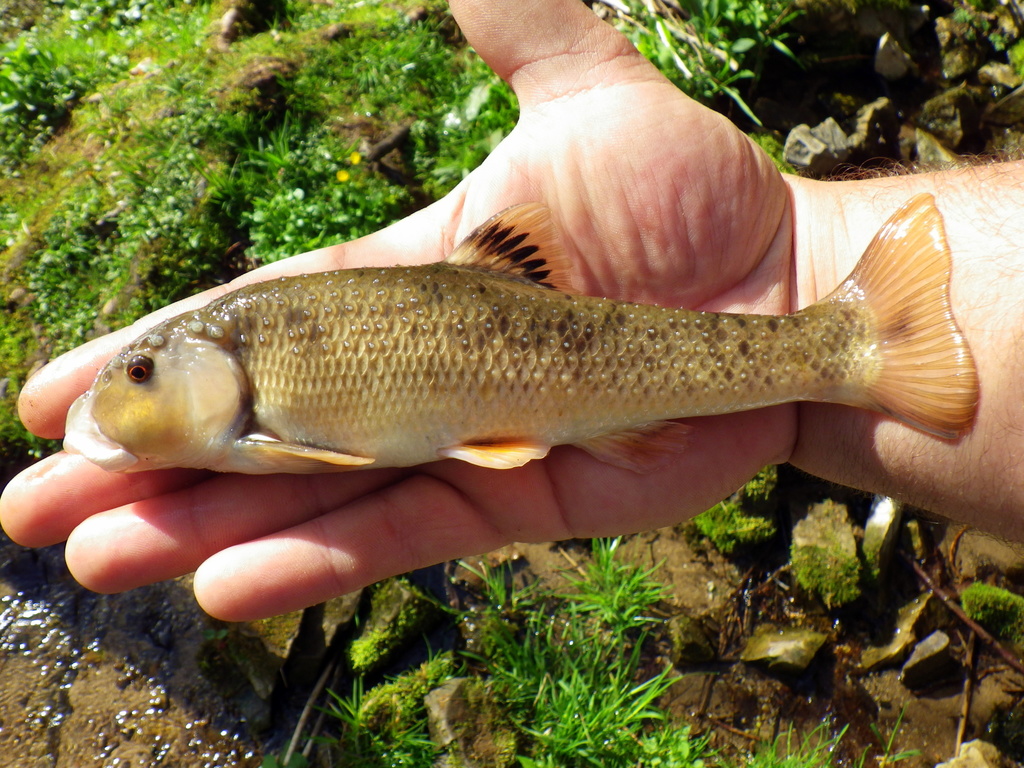
Largescale Stoneroller
Campostoma oligolepis
The largescale stoneroller (Campostoma oligolepis) is a species of freshwater ray-finned fish in the family Leuciscidae, the shiners, daces and minnows. This fish is found in the eastern United States.
From the article Largescale stoneroller on Wikipedia (CC BY-SA), quoted section by section
Range & habitat
The largescale stoneroller is found natively in many of North American streams, rivers, lakes, and creeks. It is native to the Upper Mississippi River and Lake Michigan drainages of Wisconsin, eastern Minnesota, eastern Iowa, and northern Illinois; Ozarkian streams of central and southern Missouri, and northern Arkansas; Mobile Bay drainage, Georgia, Alabama, and eastern Mississippi; parts of Green, Cumberland, and Tennessee River drainages of Kentucky, Tennessee, Georgia, and Alabama It has also been introduced into other areas in North America like the Illinois River in Oklahoma. It is thought that the reason for their introduction into the Oklahoma is due to the fact that it is a popular baitfish, and has effects on this area in ways that have not been noticed by scientist and researchers. The largescale stoneroller ranges from Alabama to Oklahoma.
Wikipedia: “Geographic distribution”
What it does
The largescale stoneroller inhabits well-oxygenated waters with temperatures around 46–32 °F (8–0 °C), with low turbulence and a reduced flow of water. It prefers upland habitats above the Fall Line. It is a herbivorous fish which eats diatoms, green algae, and blue-green bacteria, with a tendency to ingest less sand and silt than the central stoneroller. The largescale stoneroller's predators include large and smallmouth bass, the spotted bass, sauger, and the walleye. It is a popular baitfish so anglers also catch them for fishing. The largescale stoneroller can tolerate waters that are polluted and therefore it does not have many competing species.
Wikipedia: “Ecology”
Where it lives
Recorded sightings
—
geo-referenced records in GBIF, from museums, herbaria and field observers.
Drag the globe to turn it. Dots are where records exist, not a range map; darker means more records.
In the stacks
Searching the stacks…
Every page naming Campostoma oligolepis in the Biodiversity Heritage Library →
This page is assembled live from iNaturalist, GBIF, Wikipedia, the Source Library and the Internet Archive. It is not yet part of the hand-edited codex. iNaturalist taxon 96632.