- Animals
- ›Chordates
- ›Vertebrates
- ›Ray-finned Fishes
- ›Carps, Characins, Catfishes and Allies
- ›Minnows, Suckers, Carps, and Loaches
- ›Carps and Minnows
- ›True Minnows
- ›North American Minnows
- ›Campostoma
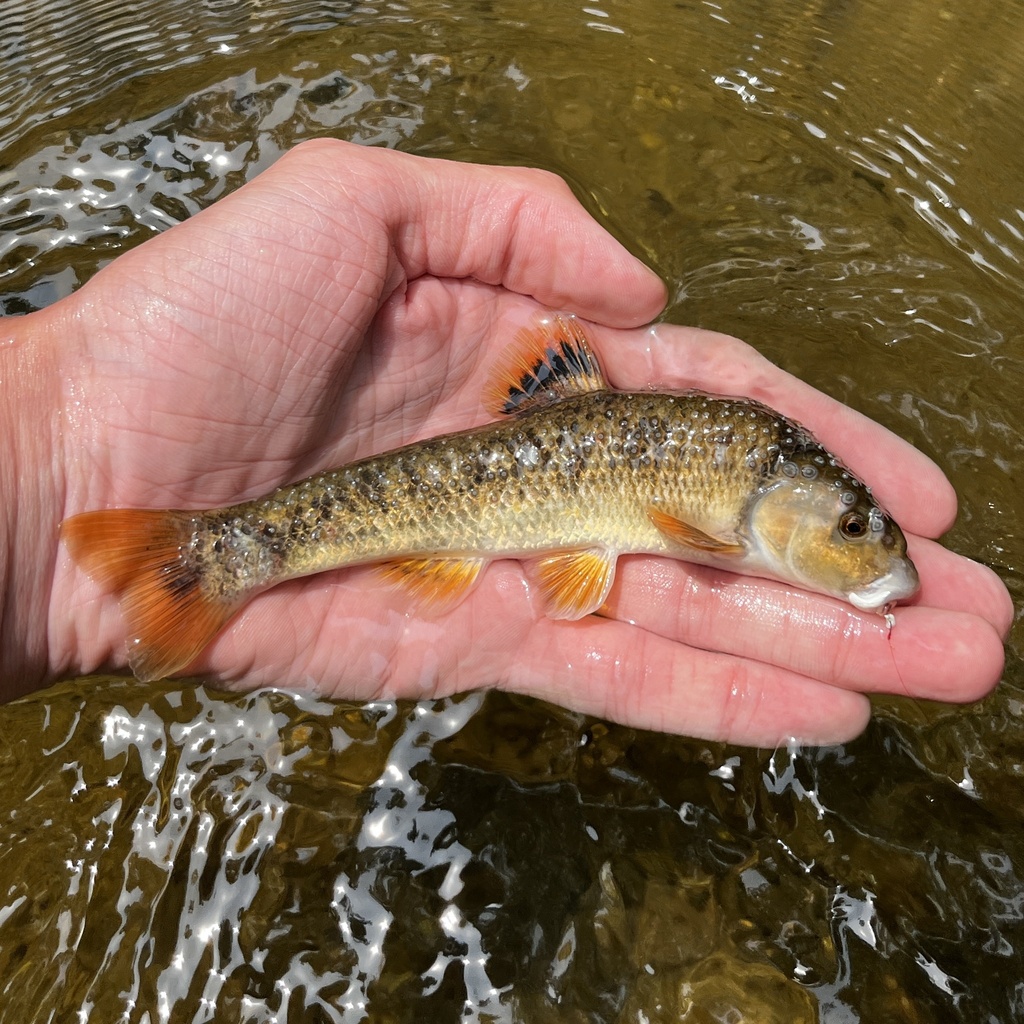
Central Stoneroller
Campostoma anomalum
The central stoneroller, or Ohio stoneroller (Campostoma anomalum), is a species of freshwater ray-finned fish in the family Leuciscidae, the shiners, daces and minnows. This fish is found in North America.
From the article Central stoneroller on Wikipedia (CC BY-SA), quoted section by section
Range & habitat
The central stoneroller is widespread in freshwater streams throughout a large portion of the eastern, central, and midwestern United States. It is present in the Atlantic Ocean, Great Lakes, Mississippi River, and Hudson Bay basins in the US, from New York west to North Dakota and Wyoming and south to South Carolina and Texas. Isolated populations are also found in Canada and Mexico. The central stoneroller is benthopelagic, inhabiting either the midwaters or bottom of freshwater streams and rivers. It requires some current and is most commonly found in riffles and pools of moderate to high gradient streams with a gravel substrate bottom. However, it is a very tolerant species and can be found in almost any stream system with adequate food, leading to its widespread distribution.
Wikipedia: “Distribution”
What it does
The central stoneroller is generally herbivorous, feeding primarily on algae scraped from rocks and logs with the cartilaginous ridge on its lower jaw. Young fish feed on rotifers, filamentous algae, and microcrustaceans. It also feeds on detritus, diatoms, and occasionally aquatic insects. It is classified as a grazing minnow in its feeding behavior, and large schools of these fish often feed together. Central stonerollers may consume up to 27 percent of their body weight in benthic algae per day. One Kansas study found that algae contributed most (47 percent) to the diet of central stonerollers, followed by detritus (30 percent), animal matter (21 percent), and terrestrial vegetation (2 percent). Some human-induced factors that reduce the abundance of the central stoneroller are altered flow regimens, habitat fragmentation, impacts to aquatic and riparian habitat associated with agricultural practices, and increased siltation and aquatic vegetation.
Wikipedia: “Ecology”
In human culture
Central stonerollers reach maturity in one to four years. Breeding males begin building nests in late winter and continue throughout midsummer, creating large, bowl-shaped depressions in calmer waters by rolling stones along the bottom with their noses, giving them their common name. The males aggressively defend their nests against rival males. Spawning occurs in early spring and summer, varying by region, with those fish in warmer climates generally spawning earlier than those in colder climates. Females remain in deeper water outside the nesting site, entering only briefly to produce anywhere between 200 and 4800 eggs in a nest. The male fertilizes the eggs, causing them to become adhesive and lodge in the gravel of the nest, preventing them from being carried away by the currents. The eggs are then abandoned by both parents and hatch within a few days. The newly hatched fish school together to feed in the warmer and more protected backwaters and vegetated stream margins. This species is generally found in small, clear streams with gravel, rubble, or exposed bedrock. Often the most abundant species in small streams, schools may contain several hundred individuals. Central stonerollers also display some intolerance to heavy siltation or pollutants, which affect the quantity of available algae in pool and riffle habitats.
Wikipedia: “Life history”
Where it lives
Recorded sightings
—
geo-referenced records in GBIF, from museums, herbaria and field observers.
Drag the globe to turn it. Dots are where records exist, not a range map; darker means more records.
In the stacks
Searching the stacks…
Every page naming Campostoma anomalum in the Biodiversity Heritage Library →
This page is assembled live from iNaturalist, GBIF, Wikipedia, the Source Library and the Internet Archive. It is not yet part of the hand-edited codex. iNaturalist taxon 96631.