On eBird ↗
Spotted Green Pigeon
Live sightings near you, the range map, bar charts of when it is seen, and Macaulay Library photos and recordings.
Spotted Green Pigeon
Caloenas maculata
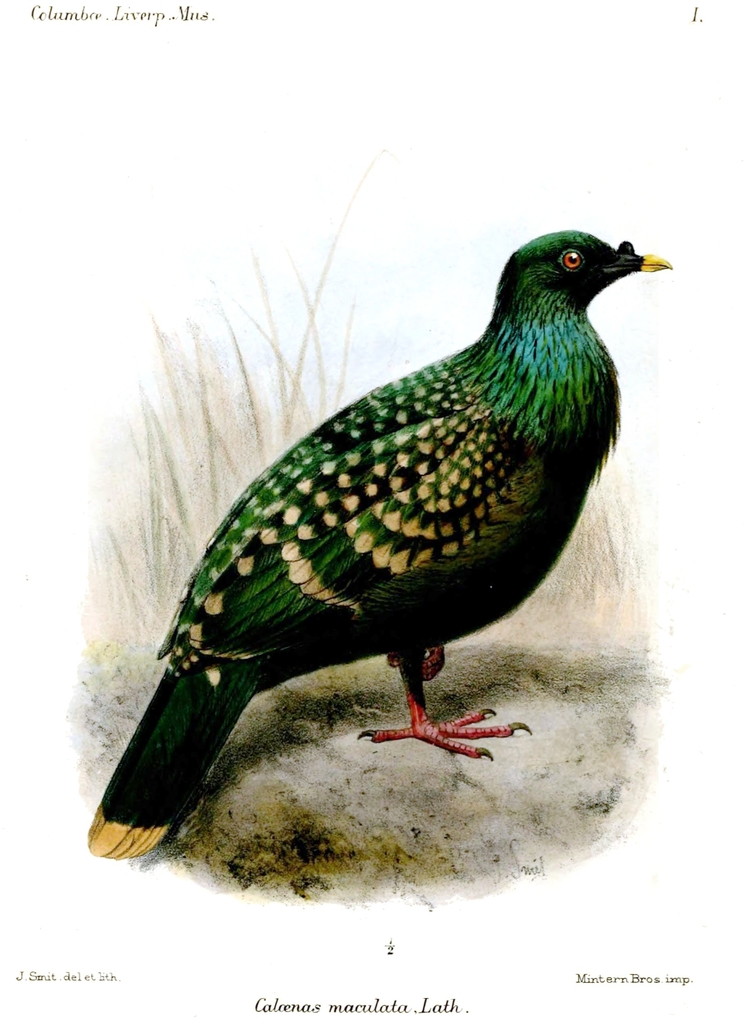
The spotted green pigeon or Liverpool pigeon (Caloenas maculata) is a species of pigeon which is most likely extinct. It was first mentioned and described in 1783 by John Latham, who had seen two specimens of unknown provenance and a drawing depicting the bird. The taxonomic relationships of the bird were long obscure, and early writers suggested many different possibilities, though the idea that it was related to the Nicobar pigeon (C. nicobarica) prevailed, and it was therefore placed in the same genus, Caloenas. Today, the species is only known from a specimen kept in World Museum, Liverpool. Overlooked for much of the 20th century, it was recognised as a valid extinct species by the IUCN Red List only in 2008. It may have been native to an island somewhere in the South Pacific Ocean or the Indian Ocean, and it has been suggested that a bird referred to as titi by Tahitian islanders was this bird. In 2014, a genetic study confirmed it as a distinct species related to the Nicobar pigeon, and showed that the two were the closest relatives of the extinct dodo and Rodrigues solitaire.
The surviving specimen is 32 cm (13 in) long, and has very dark, brownish plumage with a green gloss. The neck feathers are elongated, and most of the feathers on the upperparts and wings have a yellowish spot on their tips. It has a black bill with a yellow tip, and the end of the tail has a pale band. It has relatively short legs and long wings. It has been suggested it had a knob on its bill, but there is no evidence for this.
From the article Spotted green pigeon on Wikipedia (CC BY-SA), quoted section by section
Description
Latham's 1823 description of the spotted green pigeon from A General History of Birds (expanded from the one in A General Synopsis of Birds) reads as follows:
Length twelve inches. Bill black, tipped with pale yellow; round the eye somewhat naked; general colour of the plumage dark green, and glossy; the head and neck are darker than the rest, and of one plain colour; the feathers of the neck long and narrow, like the hackles of a Cock; every feather of the wings and scapulars tipped with a spot of very pale cinereous white, with a point running upwards, somewhat triangular: quills and tail black; the feathers of the first tipped with cinereous white, those of the last with ferruginous white, and even at the end: belly, thighs, and vent, dusky black: the legs are brown, and the shins covered half way with downy feathers; claws black. We have only seen two specimens; one in the collection of Gen. Davies, the other in possession of Sir Joseph Banks. In a drawing of one at Sir Ashton Lever's, the end of the tail is deep ferruginous. Most literature addressing the spotted green pigeon simply repeated Latham's descriptions, adding little new information, until Gibbs published a more detailed description in 2001, followed by the museum curator Hein van Grouw in 2014. …
What it does
The behaviour of the spotted green pigeon was not recorded, but theories have been proposed based on its physical features. Gibbs found the delicate, part-feathered legs and long tail indicative of at least partially arboreal habits. After noting that the wings were not short after all, van Grouw stated that the bird would not have been terrestrial, unlike the related Nicobar pigeon. He pointed out that the overall proportions and shape of the bird (longer tail, shorter legs, primary feathers probably reaching the middle of the tail) was more similar to the pigeons of the genus Ducula. It may therefore have been ecologically similar to those birds, have likewise been strongly arboreal, and kept to the dense canopy of forests. By contrast, the mainly terrestrial Nicobar pigeon forages on the forest floor. The dark eyes of the Nicobar pigeon are typical of species that forage on forest floors, whereas the coloured bill and presumably coloured eyes of the spotted green pigeon are similar to those of frugivorous (fruit-eating) pigeons. The feet of the spotted green pigeon are also similar to those of pigeons that forage in trees. The slender bill indicates that it fed on soft fruits. Believing that the wings were short and round, Gibbs thought the bird was not a strong flyer, and therefore not nomadic (periodically moving from place to place). …
Wikipedia: “Behaviour and ecology”
Listen
Looking for field recordings…
Where it lives
Recorded sightings
—
geo-referenced records in GBIF, from museums, herbaria and field observers.
Drag the globe to turn it. Dots are where records exist, not a range map; darker means more records.
In the stacks
Searching the stacks…
Every page naming Caloenas maculata in the Biodiversity Heritage Library →
This page is assembled live from iNaturalist, GBIF, Wikipedia, the Source Library and the Internet Archive. It is not yet part of the hand-edited codex. iNaturalist taxon 96477.