- Animals
- ›Chordates
- ›Vertebrates
- ›Birds
- ›Cuckoos
- ›Cuckoos
- ›Typical Cuckoos, Malkohas, and allies
- ›Cacomantis
On eBird ↗
Gray-bellied Cuckoo
Live sightings near you, the range map, bar charts of when it is seen, and Macaulay Library photos and recordings.
Grey-bellied Cuckoo
Cacomantis passerinus
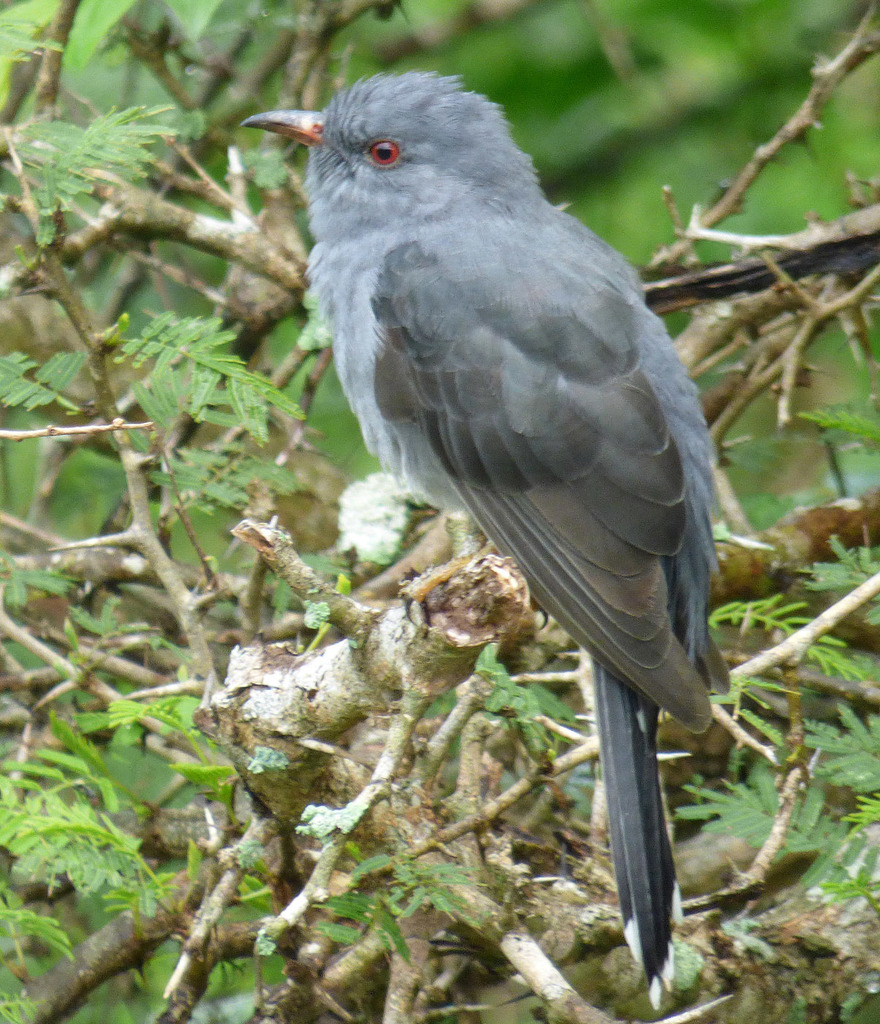
The grey-bellied cuckoo or the Indian plaintive cuckoo (Cacomantis passerinus) is a cuckoo with widespread occurrence throughout Asia.
From the article Grey-bellied cuckoo on Wikipedia (CC BY-SA), quoted section by section
Description
The grey-bellied cuckoo is one of the smaller cuckoos, at a total length of about 23 cm. Adults are mainly grey with a white lower belly and undertail. There is a white patch on the wings. Some females are dark-barred reddish brown above with an unbarred tail and have strongly dark-barred whitish underparts. The juvenile resembles the female but is of a duller grey.
Range & habitat
The grey-bellied cuckoo breeds in tropical southern Asia from India and Sri Lanka to south China and Indonesia. It has been reported from Bangladesh, Bhutan, India, the Maldives, Myanmar, Nepal, Pakistan, and Sri Lanka. It is a short-distance migrant, since birds at more northerly latitudes and on higher ground are summer visitors, leaving for warmer areas in winter. The species prefers light woodland and cultivated areas.
Wikipedia: “Distribution and habitat”
What it does
The grey-bellied cuckoo is a brood parasite and uses warblers as hosts. It lays a single egg. Its diet consists of a variety of insects and caterpillars. This is a noisy species, with a persistent and loud pee-pip-pee-pee call, with its tail depressed.
Wikipedia: “Ecology”
Listen
Looking for field recordings…
Where it lives
Recorded sightings
—
geo-referenced records in GBIF, from museums, herbaria and field observers.
Drag the globe to turn it. Dots are where records exist, not a range map; darker means more records.
In the stacks
Searching the stacks…
Every page naming Cacomantis passerinus in the Biodiversity Heritage Library →
This page is assembled live from iNaturalist, GBIF, Wikipedia, the Source Library and the Internet Archive. It is not yet part of the hand-edited codex. iNaturalist taxon 96386.