- Animals
- ›Chordates
- ›Vertebrates
- ›Birds
- ›Hawks, Eagles, Kites, and Allies
- ›Hawks, Eagles, and Kites
- ›Buteonine Hawks, Kites, and allies
- ›Buteo
On eBird ↗
Socotra Buzzard
Live sightings near you, the range map, bar charts of when it is seen, and Macaulay Library photos and recordings.
Socotra Buzzard
Buteo socotraensis
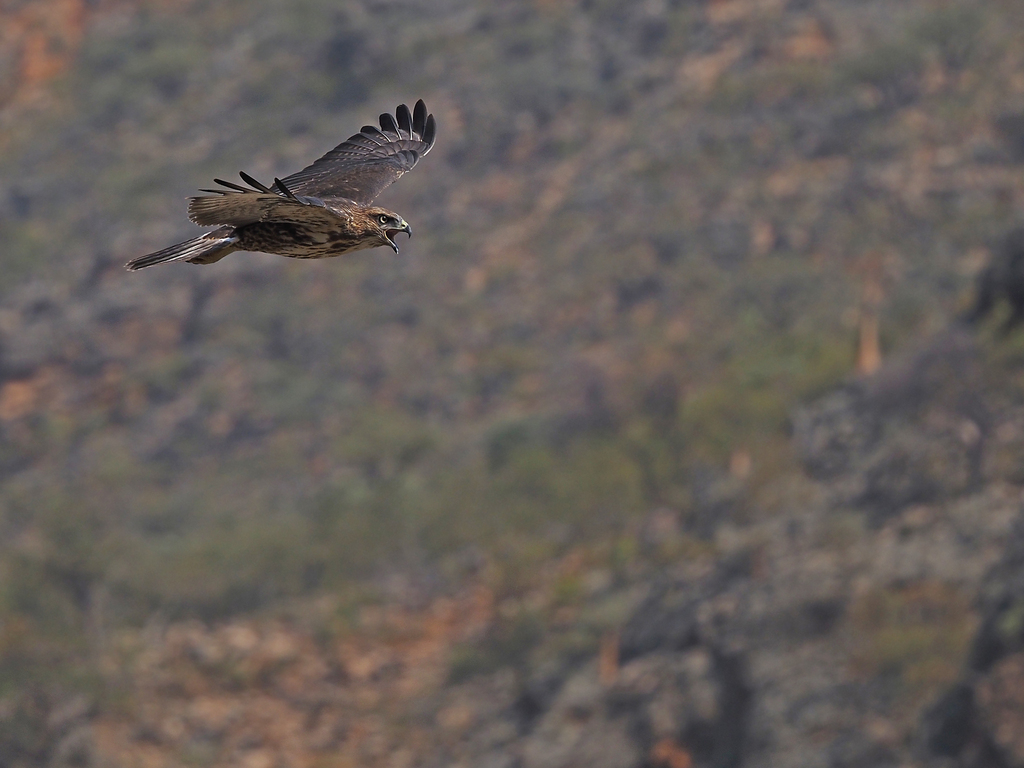
The Socotra buzzard (Buteo socotraensis) is a medium to large bird of prey that is sometimes considered a subspecies of the widespread common buzzard (Buteo buteo). As its name implies, it is native to the island of Socotra, Yemen. It is listed as Vulnerable on the IUCN Red List, as its small population (250 – 500 mature individuals as of 2022) is believed to be decreasing.
From the article Socotra buzzard on Wikipedia (CC BY-SA), quoted section by section
Description
The Socotra buzzard measures 45 cm in length. Adults typically have yellow-white abdomen and breast. They display fine brown streaking on their throat and breast, with the streaking being heavier on breast, abdomen, flanks, and thighs. Certain individuals display a white throat and upper breast. The species exhibits short, compact wings with a length of approximately 358 mm, a tail length of 188.5 mm, and a tarsus length of 65.19 mm. There is little difference in plumage between adults and juveniles, the main difference being in the intensity of the streaking on the underparts
Range & habitat
Buteo socotraensis is found only on the island of Socotra, Yemen. It inhabits the foothills and plateaus of the island, as well as terrain with deep ravines. It is usually found at altitudes between 150–800 m. It requires cliffs to nest, and is not dependent on trees. It has been suggested that it may compete for nesting habitat with vultures, ravens, and falcons. Population surveys indicate that there are fewer than 500 individuals on the island.
Wikipedia: “Habitat and Distribution”
What it does
The island of Socotra has few mammals, making the buzzard's diet consist mainly of reptiles and invertebrates. Its opportunistic hunting style makes it unlikely that it hunts other bird species.
Wikipedia: “Diet”
Listen
Looking for field recordings…
Where it lives
Recorded sightings
—
geo-referenced records in GBIF, from museums, herbaria and field observers.
Drag the globe to turn it. Dots are where records exist, not a range map; darker means more records.
In the stacks
Searching the stacks…
Every page naming Buteo socotraensis in the Biodiversity Heritage Library →
This page is assembled live from iNaturalist, GBIF, Wikipedia, the Source Library and the Internet Archive. It is not yet part of the hand-edited codex. iNaturalist taxon 96262.