On eBird ↗
Gray-crowned Rosy-Finch
Live sightings near you, the range map, bar charts of when it is seen, and Macaulay Library photos and recordings.
Gray-crowned Rosy-Finch
Leucosticte tephrocotis
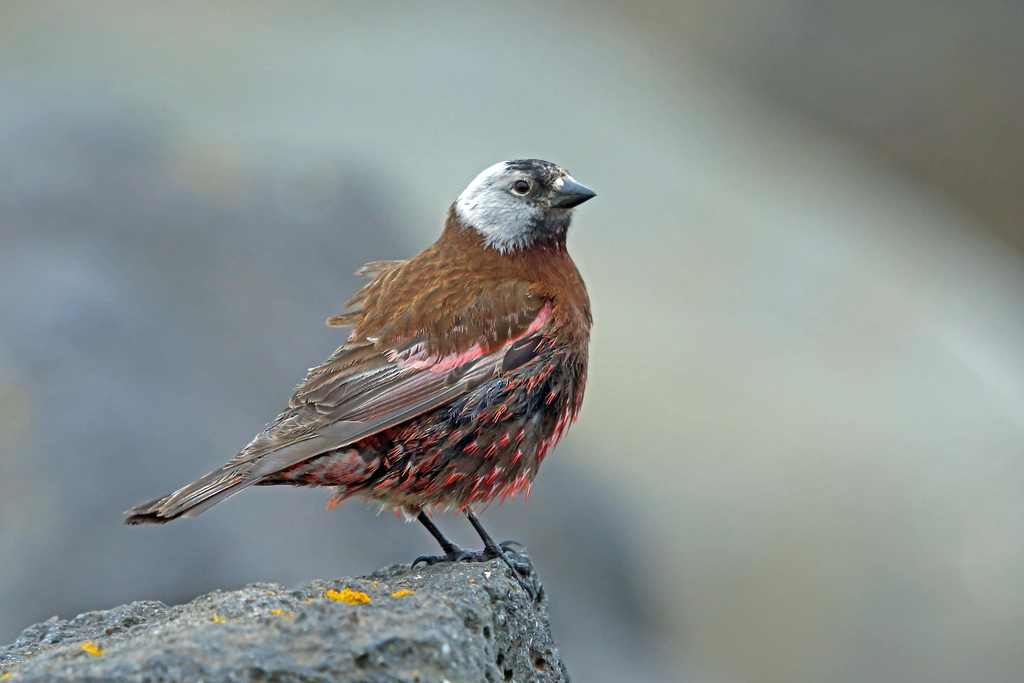
The gray-crowned rosy finch, or gray-crowned rosy-finch, (Leucosticte tephrocotis) is a species of passerine bird in the family Fringillidae native to Alaska, western Canada, and the north-western United States. Due to its remote and rocky alpine habitat it is rarely seen. There are currently six recognized subspecies. It is one of four species of rosy finches.
From the article Gray-crowned rosy finch on Wikipedia (CC BY-SA), quoted section by section
Description
Within the finch family, the gray-crowned rosy finch is medium-large with a comparatively long notched tail and wing. Adults are brown on the back and breast and mainly pink on the rest of the underparts and the wings. The forehead and throat are black; the back of the head is grey. They have short black legs and a long forked tail. There is some variability in the amount of grey on the head. Adult females and juveniles are similar. Overall length is 140 to 160 mm (5.5–6.3 in), wingspan 33 cm (13 in), and weight 22 to 60 g (0.78–2.12 oz). L. t. wallowa has an almost entirely gray head. The Pribilof and Aleutian subspecies have a length of 170 to 210 mm (6.7–8.3 in) and weight of 42 to 60 g (1.5–2.1 oz), about twice the size of the other subspecies. The black rosy finch has a black instead of brown body and the brown-capped rosy finch is a lighter brown and lacks the gray face patch.
Range & habitat
The ancestor of the three species of North American rosy finches migrated from Asia. All rosy finches live in an alpine or tundra environment. The gray-crowned rosy finch has a wide range and large numbers throughout Alaska, and western Canada and the United States. L. t. griseonucha permanently resides in the Aleutian Islands and umbrina on the Pribilof Islands. A small number of gray-crowned rosy finches winters on the mainland in South-Central Alaska and visits feeders there. The other taxa: littoralis, tephrocotis, wallowa, and dawsoni are found from the Canadian and American Rockies and migrate south to the western United States. L. t. tephrocotis summers from Montana to the Yukon, while littoralis breeds closer to the coast, from northern California to west-central Alaska. Due to its remote habitat, few of its nests have been found, it is rarely spotted, and the population is stable. They are invariably found amongst rocks. The areas the subspecies breed in rarely overlap during breeding season. Males typically outnumber females throughout the year. An individual was seen north of Boonville, in Lewis County, NY beginning on Sunday, March 4 through at least Thursday, March 8. This is only the second confirmed report for New York State.
Wikipedia: “Distribution and habitat”
What it does
Rosy finches are very environment-specific. In the summer their breeding habitat is rocky islands and barren areas on mountains from Alaska to the northwestern United States. These mountain breeding areas tend to be snowfields and rocky scree. When not breeding they form large flocks of over 1000 individuals which are sometimes known to include snow buntings (P. nivalis), Lapland longspurs (C. lapponicus), and horned larks (E. alpestris), as well as other rosy-finch species. They descend in flocks as far as the fringes of the western plains beginning in autumn when the snows get deep. They return to alpine regions when snow is still deep in early spring. They may breed at a higher altitude than any other breeding bird in North America. Due to these extreme breeding altitudes, they are very difficult to observe during breeding times. They build a cup nest in mid-June at a sheltered, hidden location on the ground or on a cliff and are monogamous. They are known to use protected areas such as mine shafts and abandoned buildings for nesting. Both sexes collect the nesting material of grass, roots, lichen, moss, and sedge, but only the female builds the nest. Lining material consists of fine grass, hair, and feathers. The female lays 3–5 eggs which she incubates for approximately two weeks. Both sexes feed the chicks, which leave the nest after 2–3 weeks. …
Wikipedia: “Behavior”
Listen
Looking for field recordings…
Where it lives
Recorded sightings
—
geo-referenced records in GBIF, from museums, herbaria and field observers.
Drag the globe to turn it. Dots are where records exist, not a range map; darker means more records.
In the stacks
Searching the stacks…
Every page naming Leucosticte tephrocotis in the Biodiversity Heritage Library →
This page is assembled live from iNaturalist, GBIF, Wikipedia, the Source Library and the Internet Archive. It is not yet part of the hand-edited codex. iNaturalist taxon 9617.