On eBird ↗
Black Rosy-Finch
Live sightings near you, the range map, bar charts of when it is seen, and Macaulay Library photos and recordings.
Black Rosy-Finch
Leucosticte atrata
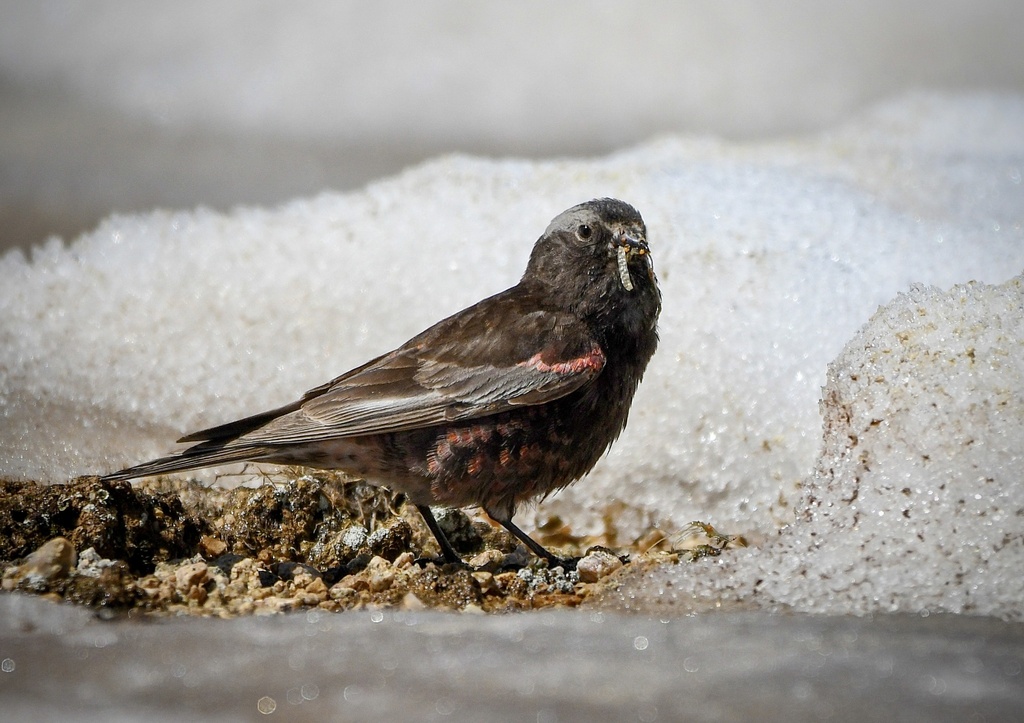
The black rosy finch or black rosy-finch (Leucosticte atrata) is a species of passerine bird in the family Fringillidae native to alpine areas above treeline, of the western United States. It is the most range-restricted member of its genus, and a popular photography subject for birdwatchers.
From the article Black rosy finch on Wikipedia (CC BY-SA), quoted section by section
Description
Adults are black on the head, back and breast with pink on the belly, rump and wings. There is a patch of grey at the back of the head. They have short black legs and a long forked tail. The grey-crowned rosy finch has a brown body instead of black and the brown-capped rosy finch and lacks the grey patch on the back of the head.
Range & habitat
The black rosy finch's breeding habitat is mountain areas above the tree-line, amongst alpine rocks and cliffs. Because of this it is one of the least studied birds in North America. Its distribution range is between that of the grey-crowned rosy finch (L. tephrocotis), which is located to north and west, and the brown-capped rosy finch (L. australis), which is located to the south and east. The paucity of definitive information about its breeding distribution lead the Wildlife Action Plan Joint Team of the Utah Division of Wildlife Resources to designate the finch a "species of greatest conservation need" in Utah.
Wikipedia: “Distribution and habitat”
What it does
The black rosy finch builds a cup nest in a cavity on a cliff. Most birds migrate short distances to lower elevations and further south and return to the alpine areas in April. These birds forage on the ground, may fly to catch insects in flight. They mainly eat seeds from weeds and grasses and insects, often in areas where snow is melting, uncovering food items and new plant shoots are growing. They often feed in small flocks, sometimes mixing with grey-crowned rosy finches. A male will defend its female's territory during breeding season, not just the nest but wherever she goes. This behavior is common with the rosy finches. When breeding both males and females develop throat pouches, known as gular pouches or gular skin, to carry food to their chicks, a trait seen in only one other North American genus, Pinicola. Due to their inaccessibility, actual black rosy finch nests had been reached by only three researchers as of 2002. The nests are made of grass and stems and lined with fine grass, hair, and feathers. They are known to use protected areas such as openings in cliffs, mine shafts, caves, and rafters. They eat seeds and insects, usually foraged from the ground, including snowfields. Their call is a buzz-sounding "chew".
Wikipedia: “Behavior”
Listen
Looking for field recordings…
Where it lives
Recorded sightings
—
geo-referenced records in GBIF, from museums, herbaria and field observers.
Drag the globe to turn it. Dots are where records exist, not a range map; darker means more records.
In the stacks
Searching the stacks…
Every page naming Leucosticte atrata in the Biodiversity Heritage Library →
This page is assembled live from iNaturalist, GBIF, Wikipedia, the Source Library and the Internet Archive. It is not yet part of the hand-edited codex. iNaturalist taxon 9611.