On eBird ↗
Slender-billed Grackle
Live sightings near you, the range map, bar charts of when it is seen, and Macaulay Library photos and recordings.
Slender-billed Grackle
Quiscalus palustris
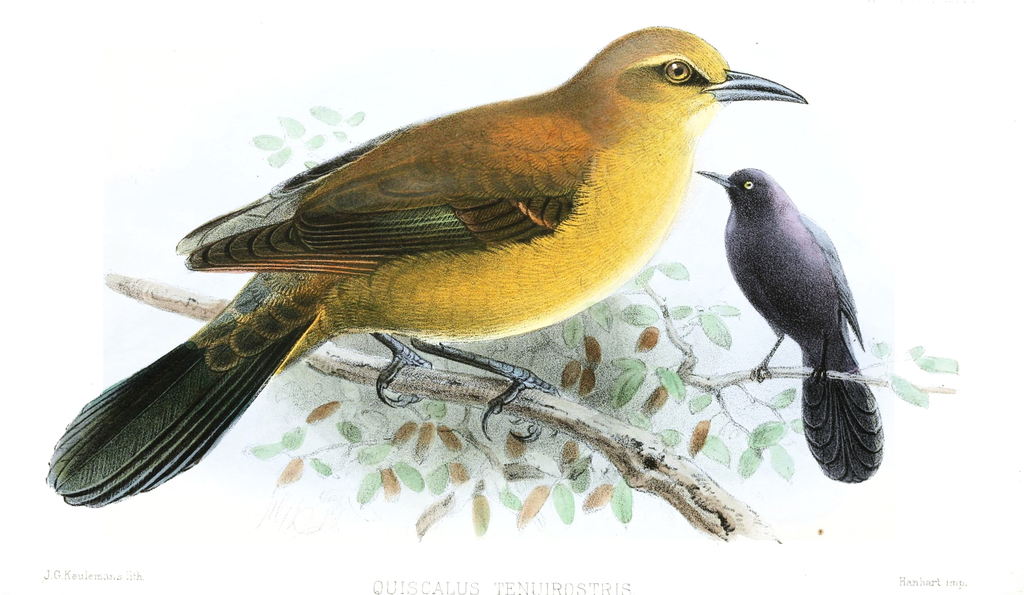
The slender-billed grackle (Quiscalus palustris) is an extinct species of grackle in the Icteridae (New World blackbirds) family of birds. The species was closely related to the western clade of the great-tailed grackle, from which it diverged quite recently, around 1.2 million years ago. It weighed 2.5 oz to 5 oz.
The slender-billed grackle was endemic to central Mexico, especially in the Valley of Mexico and the Toluca Valley. Early observations recorded by Franciscan friar Bernardino de Sahagún in the 16th-century manuscript General History of the Things of New Spain indicate that the species was found in cultivated areas and towns. Later records indicated that it might be a marsh specialist. The species became extinct around the turn of the 20th century.
From the article Slender-billed grackle on Wikipedia (CC BY-SA), quoted section by section
Range & habitat
Marsh from both The Valley of Mexico and The Valley of Toluca. The slender-billed grackle was originally known from the Rio Lerma area in Mexico. It has not been recorded since 1910. Several records of the slender-billed grackle are known from three different habitats, such as wetlands, cultivated plots, and human settlements. Slender-billed grackles inhabited marshes and borders of the lakes. Emergent aquatic vegetation was commonly used for nesting material by the slender-billed grackles.
Nesting. The slender-billed grackle usually nested in marshes and aquatic vegetation; however, as the population in Mexico increased, the species was able to adapt to the changes in the environment and learned to nest in towns and cultivated plots. The slender-billed grackle hatched its eggs in reeds.
Diet and Behavior. The diet of the slender-billed grackle consisted of animals, plants, and fruits. It mainly ate worms, flies, and maize. The slender-billed grackle also tended to group and form flocks. The males would proclaim their breeding territory by noisy displays.
Human interaction. When the initial European settlers came to central Mexico, they observed that the Aztecs targeted the slender-billed grackle; the reason for this is partially unclear. …
Wikipedia: “Habitat”
Listen
Looking for field recordings…
Where it lives
Recorded sightings
—
geo-referenced records in GBIF, from museums, herbaria and field observers.
Drag the globe to turn it. Dots are where records exist, not a range map; darker means more records.
In the stacks
Searching the stacks…
Every page naming Quiscalus palustris in the Biodiversity Heritage Library →
This page is assembled live from iNaturalist, GBIF, Wikipedia, the Source Library and the Internet Archive. It is not yet part of the hand-edited codex. iNaturalist taxon 9608.