 NL·0746
Herbarium of the Nature Library
- Name
- Tangara chilensis
- Family
- Thraupidae
- Native to
- Amazon Basin and eastern Andean foothills, from Colombia and Venezuela through Ecuador, Peru, Bolivia, the Guianas and Amazonian Brazil
- Habitat
- Tropical lowland rainforest, Foothill forest, Forest edge
On eBird ↗
Paradise Tanager
Live sightings near you, the range map, bar charts of when it is seen, and Macaulay Library photos and recordings.
Paradise tanager
Tangara chilensis
Also calledSete-cores-da-amazônia (Portuguese) · Tangara paraíso (Spanish) · Calliste septicolore (French)
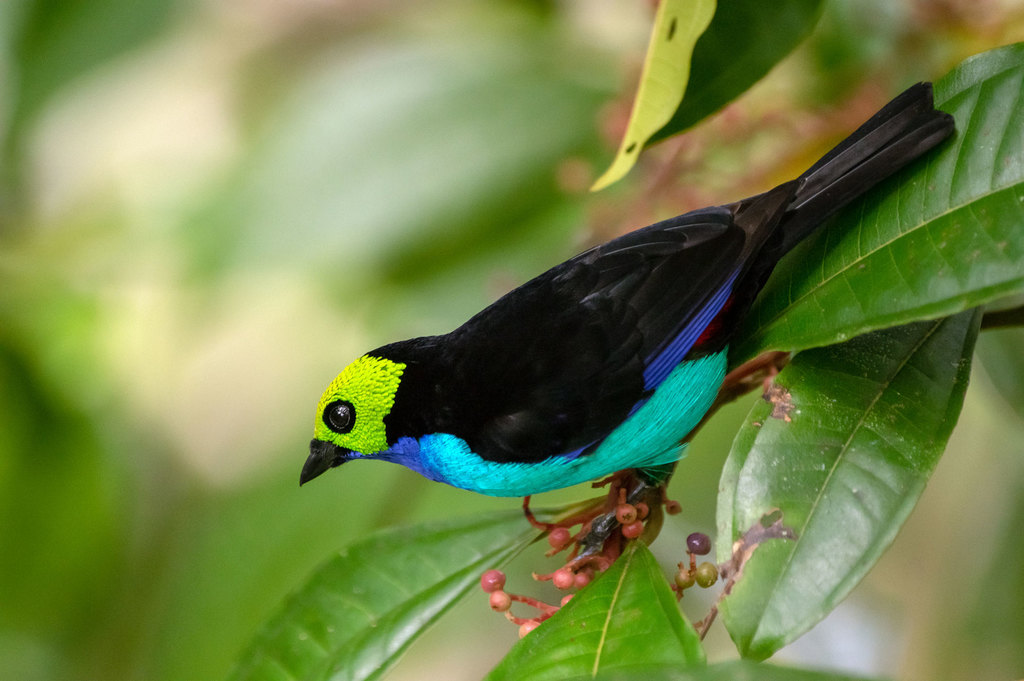
A small Amazonian canopy tanager painted in lime-green, black, scarlet, turquoise and violet. Despite its scientific name, it has never lived in Chile.
The paradise tanager is a brilliantly multicolored, medium-sized songbird whose length varies between 13.5 and 15 cm. It has a light green head, sky blue underparts and black upper body plumage.The vivid colours of the paradise tanager have been linked to underlying achromatic feather layers that enhance the brilliance of structural colours. Depending on subspecies, the behind is yellow and red or all red. The beak is black and the legs are grey. It is native to the Amazon rainforest. Wikipedia
What it can do
- iTravels in noisy groups at the core of mixed-species canopy flocks
- iiSearches undersides of leaves and twigs for insects while hanging acrobatically
- iiiDisperses small seeds of fruiting trees and epiphytes
In the field
Field marks
- aShining apple-green head contrasting with velvety black back
- bScarlet (or, in some populations, red-and-yellow) rump
- cTurquoise-blue underparts and violet-blue throat
- dBlack wings and tail
- Voice
- High, thin 'tsit' and 'zeet' notes given constantly by flocks; no well-developed song.
- Not to be confused with
- Seven-colored Tanager (Atlantic Forest of Brazil) has a turquoise-green head, black throat and orange rump; ranges do not overlap. Green-and-gold Tanager is largely green-gold without the black back.
- Where to see it
- Canopy towers and forest edges in Amazonian Ecuador (Sacha, Yasuní), Peru (Tambopata, Manu) and Brazil (Cristalino).
- When
- Resident year-round
Listen
Looking for field recordings…
Life & habits
- Diet
- Small fruits and berries; insects and spiders
- Habitat
- Canopy and edges of humid lowland and foothill forest, up to about 1,600 m
- Size
- 13.5–15 cm; about 18–20 g
Groups of 5–10 often lead the mixed flocks that sweep through the Amazon canopy each morning.
Where it lives
Recorded sightings
—
geo-referenced records in GBIF, from museums, herbaria and field observers.
Native range
Amazon Basin and eastern Andean foothills, from Colombia and Venezuela through Ecuador, Peru, Bolivia, the Guianas and Amazonian Brazil
Drag the globe to turn it. Dots are where records exist, not a range map; darker means more records.
In the stacks
Searching the stacks…
Every page naming Tangara chilensis in the Biodiversity Heritage Library →
Marginalia
Nicholas Vigors named it chilensis in 1832, apparently because the specimens reached Europe from a dealer who mislabelled them as Chilean.
Curiosity
Its Brazilian name sete-cores means 'seven colours'.
Kinship
Fact-checked: 1 correction made to this sheet. Photographs: iNaturalist contributors under the licences shown. Records: GBIF.org. Historical plates: Source Library (CC BY-SA 4.0; originals public domain). Summary text: Nature Library editors and Wikipedia (CC BY-SA). Medicinal and edibility notes are historical and educational, not advice. iNaturalist taxon 9593.