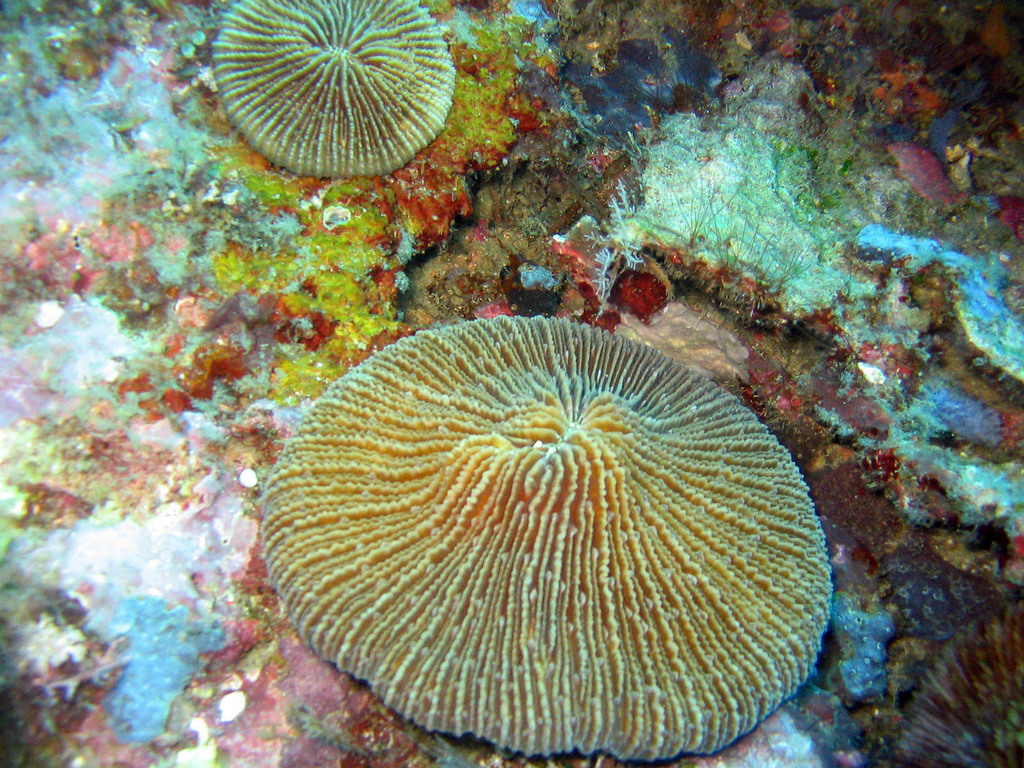
Danafungia scruposa
Danafungia scruposa is a species of coral that is the first to have been observed to eat jellyfish. It was described by Klunzinger in 1879 and has a diameter of around 25 centimetres (10 in). It is rated as a least-concern species.
From the article Danafungia scruposa on Wikipedia (CC BY-SA), quoted section by section
Description
They are about 25 centimetres (10 in) in diameter and normally eat a variety of food from bacteria to mesozooplankton measuring 1 mm in diameter. During an algal bloom in 2009 researchers observed the coral consuming the jellyfish Aurelia aurita. This was the first time such behaviour has been seen in the wild. It is not known how the coral captures jellyfish. It may have caught the jellyfish with its tentacles in the same way as some sea anemones feed on other jellyfish species. This coral is unusual in that it consists of a single oval or circular polyp up to 38 centimetres (15 in) across. The species may contain tentacular lobes and it has dense septa. It is blue or brown in colour.
Range & habitat
D. scruposa is found in the eastern and western Indian Ocean, the eastern central, northwestern and western central Pacific Ocean, Japan, the East China Sea, the Red Sea, and eastern Australia. No population figures are available for the species but it is believed to be common and is found at depths between 1 and 27 metres (3 and 89 ft) on the slopes of reefs. A 1991 study of specimens found that 51% were bleached. It is threatened by bleaching, disease, climate change, fishing, preadators, and human activities. F. scruposa is classified as a least concern species by the IUCN.
Wikipedia: “Distribution”
Where it lives
Recorded sightings
—
geo-referenced records in GBIF, from museums, herbaria and field observers.
Drag the globe to turn it. Dots are where records exist, not a range map; darker means more records.
In the stacks
Searching the stacks…
Every page naming Danafungia scruposa in the Biodiversity Heritage Library →
This page is assembled live from iNaturalist, GBIF, Wikipedia, the Source Library and the Internet Archive. It is not yet part of the hand-edited codex. iNaturalist taxon 957010.