
Cnidarians
Cnidaria
Cnidaria ( nih-DAIR-ee-ə, ny-) is a phylum of animals containing over 11,000 species of aquatic invertebrates found both in freshwater and marine environments (predominantly the latter), including jellyfish, hydroids, sea anemones, corals and some of the smallest marine parasites. Their distinguishing features are a simple nerve net distributed throughout a gelatinous body, and the presence of cnidocytes or cnidoblasts, specialized cells with ejectable organelles used mainly for envenomation and capturing prey. Their bodies consist of mesoglea, a non-living, jelly-like substance, sandwiched between two layers of epithelium that are mostly one cell thick. Many cnidarian species can reproduce both sexually and asexually.
Cnidarians mostly have two basic body forms: swimming medusae and sessile polyps, both of which are radially symmetrical with mouths surrounded by tentacles that bear cnidocytes, which are specialized stinging cells used to capture prey. Both forms are monostomatic, meaning they have a single orifice and body cavity that are used for digestion and respiration. Many cnidarian species produce colonies that are single organisms composed of medusa-like or polyp-like zooids, or both (hence they are trimorphic). Cnidarians' activities are coordinated by a decentralized nerve net and simple receptors. Cnidarians also have rhopalia, which are involved in gravity sensing and sometimes chemoreception. Several free-swimming species of Cubozoa and Scyphozoa possess balance-sensing statocysts, and some have simple eyes.
8 branches of this phylum, most-observed first

Sea Anemones and Corals
classAnthozoa

True Jellies
classScyphozoa

Hydrozoans
classHydrozoa

Stalked Jellies
classStaurozoa

Box Jellies
classCubozoa

Myxozoans
classMyxozoa
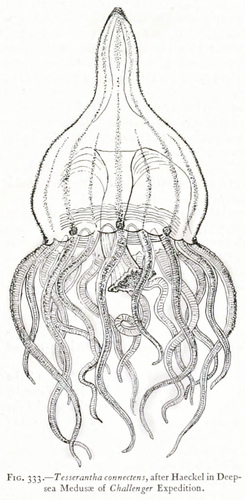
Tesseranthidae
familyTesseranthidae

Polypodiozoans
classPolypodiozoa
Where it lives
Recorded sightings
—
geo-referenced records in GBIF, from museums, herbaria and field observers.
Drag the globe to turn it. Dots are where records exist, not a range map; darker means more records.
In the old herbals & bestiaries

In the stacks
Searching the stacks…
Every page naming Cnidaria in the Biodiversity Heritage Library →
This page is assembled live from iNaturalist, GBIF, Wikipedia, the Source Library and the Internet Archive. It is not yet part of the hand-edited codex. iNaturalist taxon 47534.