On eBird ↗
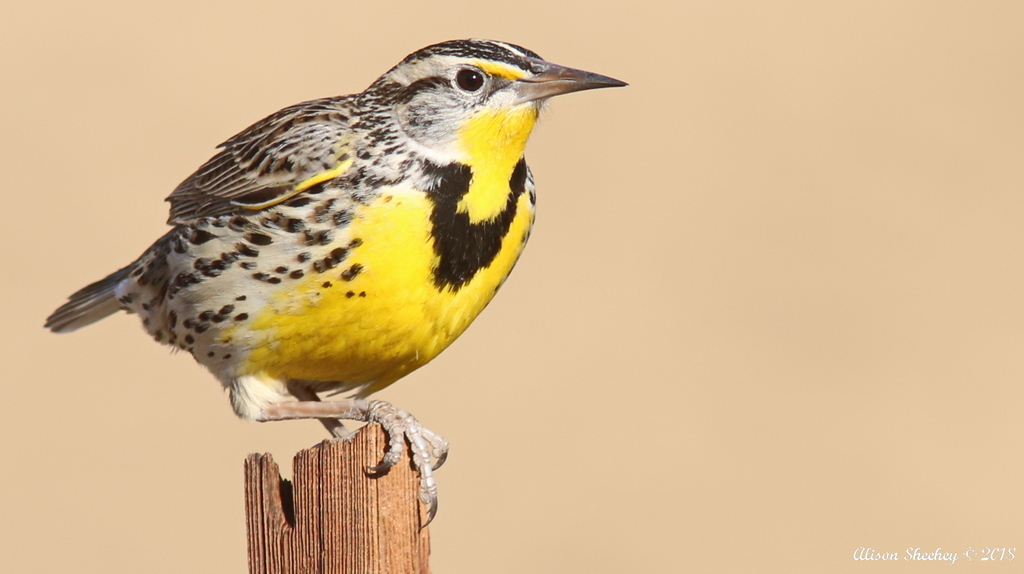
Western Meadowlark
Live sightings near you, the range map, bar charts of when it is seen, and Macaulay Library photos and recordings.
Western Meadowlark
Sturnella neglecta
The western meadowlark (Sturnella neglecta) is a medium-sized icterid bird, about 20 cm (7.9 in) in length. It is found across western and central North America and is a partial migrant, breeding in western Canada and western United States west of the Great Lakes, and in northern Mexico. In the northern half of the breeding range, the birds migrate south for the winter, while further south they are resident all year. The winter range also extends south and southeast of the breeding range, as far as central Mexico, and east to western Florida. The western meadowlark nests on the ground in open grasslands and shrublands. It feeds on bugs and seeds. The western meadowlark has distinctive calls described as watery or flute-like, which distinguish it from the closely related eastern meadowlark. The western meadowlark is the state bird of six states; in Kansas, Montana, Nebraska, North Dakota, Oregon, and Wyoming.
From the article Western meadowlark on Wikipedia (CC BY-SA), quoted section by section
Description
Western meadowlark adults have yellow underparts with a black "V" on the breast and white flanks streaked with black. Their upper parts are mostly brown, but also have black streaks. These birds have long, pointed bills and their heads are striped with light brown and black bands. Measurements:
Length: 16–26 cm (6.3–10.2 in) Wingspan: 41 cm (16 in) Weight: 89–115 g (3.1–4.1 oz) These birds have a flute-like warbled song. These calls contrast with the simple, whistled call of the eastern meadowlark.
Range & habitat
The breeding habitat includes grasslands, prairies, pastures, and abandoned fields, all of which may be found across western and central North America, as far south as northern Mexico. In regions where their range overlaps with the eastern species, this species prefers thinner, drier vegetation; the two species generally do not interbreed but do defend territory against one another. Their nests are situated on the ground and are covered with a roof woven from grass. There may be more than one nesting female in a male's territory. Nests are sometimes destroyed by mowing operations with eggs and young in them. Western meadowlarks are permanent residents throughout much of their range. Northern birds may migrate to the southern parts of their range; some birds also move east in the southern United States. It has also been introduced to Hawaii to control insects, and is now found on the island of Kauai. Attempted introductions to other islands failed, likely due to the presence of the small Indian mongoose, which is absent from Kauai.
Wikipedia: “Distribution and habitat”
What it does
Western meadowlarks forage on the ground or in low to semi-low vegetation. They sometimes search for food by probing with their bills. They mainly eat insects, although they will consume seeds and berries. In winter, these birds often feed in flocks.
Wikipedia: “Food and feeding”
Listen
Looking for field recordings…
Where it lives
Recorded sightings
—
geo-referenced records in GBIF, from museums, herbaria and field observers.
Drag the globe to turn it. Dots are where records exist, not a range map; darker means more records.
In the stacks
Searching the stacks…
Every page naming Sturnella neglecta in the Biodiversity Heritage Library →
This page is assembled live from iNaturalist, GBIF, Wikipedia, the Source Library and the Internet Archive. It is not yet part of the hand-edited codex. iNaturalist taxon 9535.