On eBird ↗
Eastern Meadowlark
Live sightings near you, the range map, bar charts of when it is seen, and Macaulay Library photos and recordings.
Eastern Meadowlark
Sturnella magna
The eastern meadowlark (Sturnella magna) is a medium-sized icterid bird, very similar in appearance to its sister species, the western meadowlark. It occurs from eastern North America to northern South America, where it is also most widespread in the east. The Chihuahuan meadowlark was formerly considered to be conspecific with the eastern meadowlark.
From the article Eastern meadowlark on Wikipedia (CC BY-SA), quoted section by section
Description
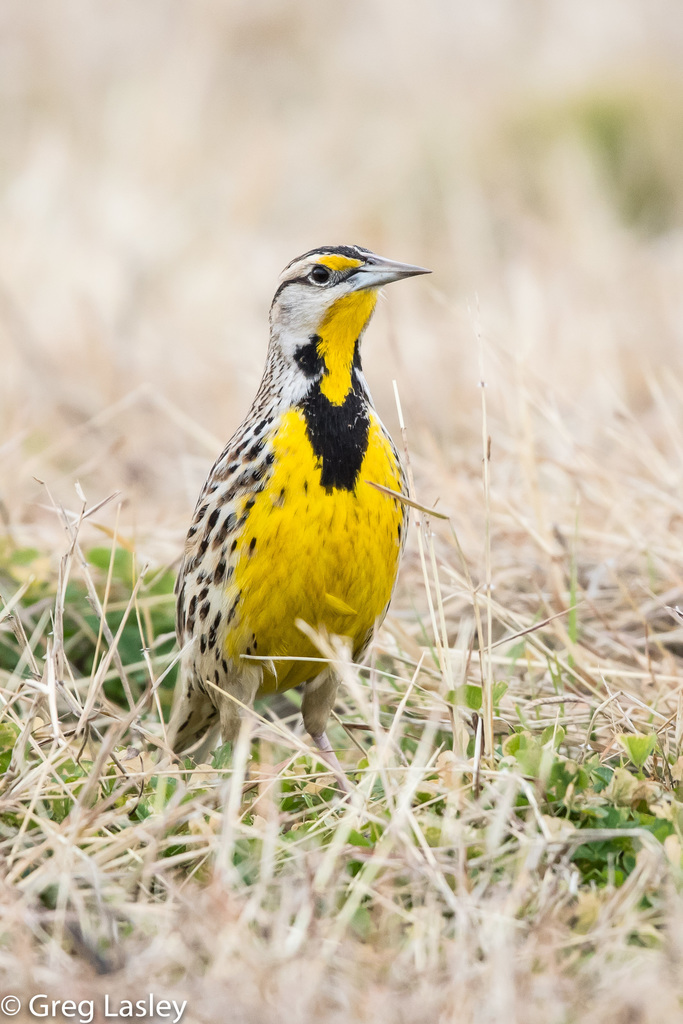
The adult eastern meadowlark measures from 19 to 28 cm (7.5 to 11.0 in) in length and spans 35–40 cm (14–16 in) across the wings. Body mass ranges from 76 to 150 g (2.7 to 5.3 oz). The extended wing bone measures 8.9–12.9 cm (3.5–5.1 in), the tail measures 5.3–8.6 cm (2.1–3.4 in), the culmen measures 2.8–3.7 cm (1.1–1.5 in) and the tarsus measures 3.6–4.7 cm (1.4–1.9 in). Females are smaller in all physical dimensions. Adults have yellow underparts with a black "V" on the breast and white flanks with black streaks. The upperparts are mainly brown with black streaks. They have a long pointed bill; the head is striped with light brown and black. The song of this bird is of pure, melancholy whistles, and thus simpler than the jumbled and flutey song of the western meadowlark; their ranges overlap across central North America. In the field, the song is often the easiest way to tell the two species apart, though plumage differences do exist, like tail pattern and malar coloration. In nonbreeding plumage, eastern meadowlarks tend to have more yellow-brown coloration in their flanks and more distinct striping on their heads. The pale Chihuahuan meadowlark of northern Mexico and the southwestern US was recognized as a separate species by the American Ornithological Society in 2022.
Range & habitat
Their breeding habitat is grasslands and prairie, also pastures and hay fields. This species is a permanent resident throughout much of its range, though most northern birds migrate southwards in winter. In 1993 this species was first recorded in El Salvador, and the discovery of a breeding pair in 2004 confirmed that the species is a resident there.
Wikipedia: “Distribution and habitat”
What it does
These birds forage on the ground or in low vegetation, sometimes probing with the bill. They mainly eat arthropods, but also seeds and berries. In winter, they often feed in flocks. About three-quarters of the eastern meadowlark's diet is from animal sources like beetles, grasshoppers, and crickets. They also eat grain and seeds.
Wikipedia: “Food and feeding”
Listen
Looking for field recordings…
Where it lives
Recorded sightings
—
geo-referenced records in GBIF, from museums, herbaria and field observers.
Drag the globe to turn it. Dots are where records exist, not a range map; darker means more records.
In the stacks
Searching the stacks…
Every page naming Sturnella magna in the Biodiversity Heritage Library →
This page is assembled live from iNaturalist, GBIF, Wikipedia, the Source Library and the Internet Archive. It is not yet part of the hand-edited codex. iNaturalist taxon 9528.