On eBird ↗
Black-bellied Seedeater
Live sightings near you, the range map, bar charts of when it is seen, and Macaulay Library photos and recordings.
Black-bellied Seedeater
Sporophila melanogaster
The black-bellied seedeater (Sporophila melanogaster) is a Near Threatened species of bird in the family Thraupidae, the tanagers and allies.. It is endemic to Brazil but has been recorded as a vagrant to Argentina.
From the article Black-bellied seedeater on Wikipedia (CC BY-SA), quoted section by section
Description
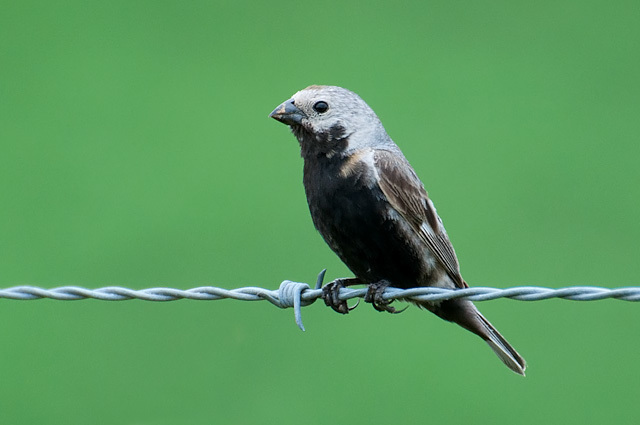
The black-bellied seedeater is 10 to 10.6 cm (3.9 to 4.2 in) long and weighs 8 to 10.5 g (0.28 to 0.37 oz). It is one of the smallest of its genus. It has a smallish bill with a rounded culmen. The species is sexually dimorphic. Adult males have a mostly bluish gray head and neck with a black throat. Their upperparts are bluish gray and their tail blackish gray. Their wings are blackish gray with white bases on the primaries that show as a patch on the folded wing. Their sides are bluish gray and the rest of their underparts black. Females have an olive-brown head and back. Their tail and wings are a darker olive-brown with the same white primary patch as males. Their underparts are a buffier brown. Both sexes have a brown iris and dark legs. Males have a black or dark gray bill; females have a brownish gray bill with a pale yellowish mandible. Juveniles resemble adult females.
Range & habitat
The black-bellied seedeater is found in southeastern Brazil. It ranges from northeastern Rio Grande do Sul north to eastern Mato Grosso do Sul, the southern half of Goías, and the western half of Minas Gerais. It inhabits tall moist grasslands, including marshes, and scrubby areas. In elevation it ranges from near sea level to 1,100 m (3,600 ft). The South American Classification Committee has records of the species as a vagrant in Argentina.
Wikipedia: “Distribution and habitat”
What it does
The black-bellied seedeater feeds on grass seeds, especially those of native grasses but also those of exotics, and also includes some small arthropods in its diet. It typically feeds while clinging to stems, sometimes upside down as the stem bends. In the breeding season it forages in pairs or family groups and outside it in larger groups that include other seed-eating species.
Wikipedia: “Feeding”
Listen
Looking for field recordings…
Where it lives
Recorded sightings
—
geo-referenced records in GBIF, from museums, herbaria and field observers.
Drag the globe to turn it. Dots are where records exist, not a range map; darker means more records.
In the stacks
Searching the stacks…
Every page naming Sporophila melanogaster in the Biodiversity Heritage Library →
This page is assembled live from iNaturalist, GBIF, Wikipedia, the Source Library and the Internet Archive. It is not yet part of the hand-edited codex. iNaturalist taxon 9507.