On eBird ↗
Chestnut-bellied Seedeater
Live sightings near you, the range map, bar charts of when it is seen, and Macaulay Library photos and recordings.
Chestnut-bellied Seedeater
Sporophila castaneiventris
The chestnut-bellied seedeater (Sporophila castaneiventris) is a species of bird in the family Thraupidae. It is found in Bolivia, Brazil, Colombia, Ecuador, French Guiana, Guyana, Peru, Suriname, and Venezuela. Its natural habitats are subtropical or tropical moist shrubland and heavily degraded former forest.
From the article Chestnut-bellied seedeater on Wikipedia (CC BY-SA), quoted section by section
Description
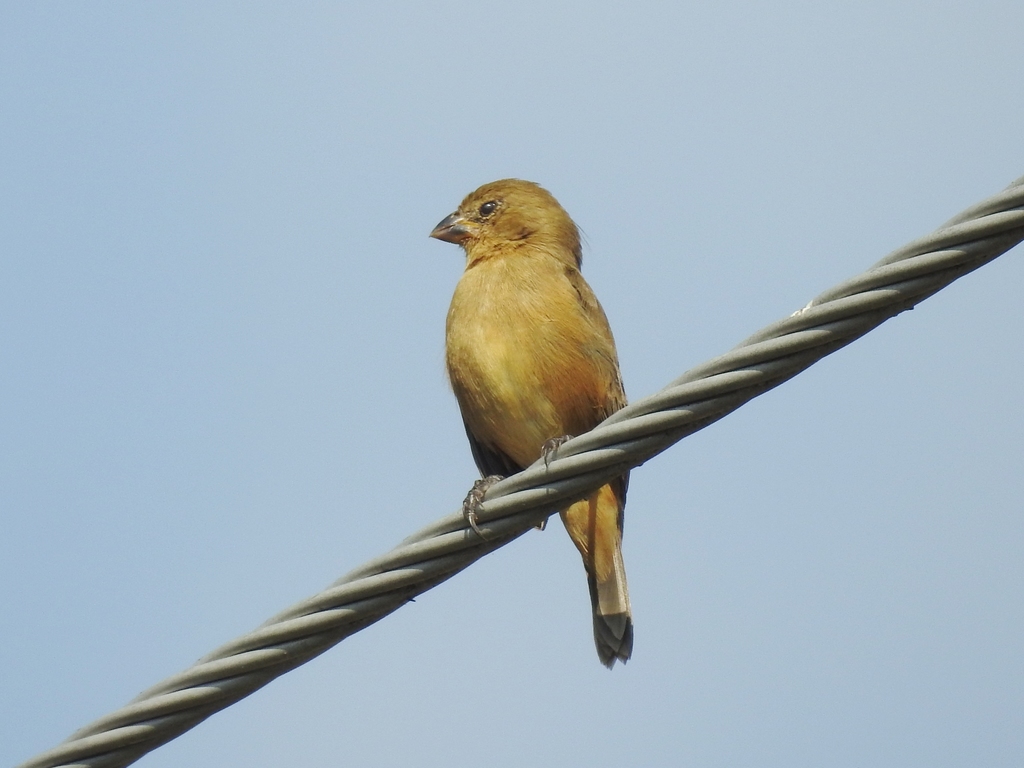
The chestnut-bellied seedeater is about 10 cm (3.9 in) long and weighs an average of 7.8 g (0.28 oz). It has a short, thick bill with a rounded culmen. The species is sexually dimorphic. Adult males have a blue-gray head and upperparts with sometimes a tiny white spot behind the bill. Their tail is mostly blackish with gray edges at the base of the outer feathers. Their wings are blackish with grayish edges on most feathers. Their throat and breast are widely chestnut that narrows through the belly between blue-gray flanks and again widens on the vent and undertail coverts. Females have a buff face on an otherwise warm sandy brown head. Their upperparts are also warm sandy brown. Their wings are a darker brown with sandy brown edges on the coverts. Their tail is also a darker brown. Their throat and underparts are warm buff that is palest on the belly. Both sexes have a dark brown iris. Males have a black bill and black legs; females have dark horn to blackish bill and blackish legs.
Range & habitat
The chestnut-bellied seedeater is found from extreme southwestern Amazonas state in southern Venezuela south and west through the southeastern third of Colombia and eastern Ecuador and Peru into northern Bolivia. From Colombia, Peru, and Bolivia its range continues through Brazil to the Atlantic in Amapá. Its northern limit in Brazil roughly follows a line from where northern Amazonas meets Venezuela south to the Amazon River in central Amazonas and then northeast to Amapá. Its southern boundary is from western Rondônia at northeastern Bolivia northeast to the Atlantic. From Amapá its range continues west across northern French Guiana, Suriname, and Guyana almost to Venezuela. The chestnut-bellied seedeater inhabits grassy and shrubby landscapes including clearings in forest, agricultural areas, lawns and parks in settled areas, and even floating vegetation in lakes and marshes. In elevation it reaches about 200 m (700 ft) in Venezuela, 500 m (1,600 ft) in Colombia, 1,300 m (4,300 ft) in Ecuador, 1,400 m (4,600 ft) in Peru, and 500 m (1,600 ft) in Brazil.
Wikipedia: “Distribution and habitat”
What it does
The chestnut-bellied seedeater feeds primarily on grass seeds but also includes fruits and Müllerian bodies of Cecropia trees in its diet. It feeds mostly while clinging to grass stems but will feed on the ground when stems are lying down. It often forages in small flocks.
Wikipedia: “Feeding”
Listen
Looking for field recordings…
Where it lives
Recorded sightings
—
geo-referenced records in GBIF, from museums, herbaria and field observers.
Drag the globe to turn it. Dots are where records exist, not a range map; darker means more records.
In the stacks
Searching the stacks…
Every page naming Sporophila castaneiventris in the Biodiversity Heritage Library →
This page is assembled live from iNaturalist, GBIF, Wikipedia, the Source Library and the Internet Archive. It is not yet part of the hand-edited codex. iNaturalist taxon 9498.