On eBird ↗
Chestnut Seedeater
Live sightings near you, the range map, bar charts of when it is seen, and Macaulay Library photos and recordings.
Chestnut Seedeater
Sporophila cinnamomea
The chestnut seedeater (Sporophila cinnamomea) is a species of bird in the family Thraupidae. It is found in Argentina, Brazil, Paraguay, and Uruguay (where it can still be seen at the Quebrada de los Cuervos).
From the article Chestnut seedeater on Wikipedia (CC BY-SA), quoted section by section
Description
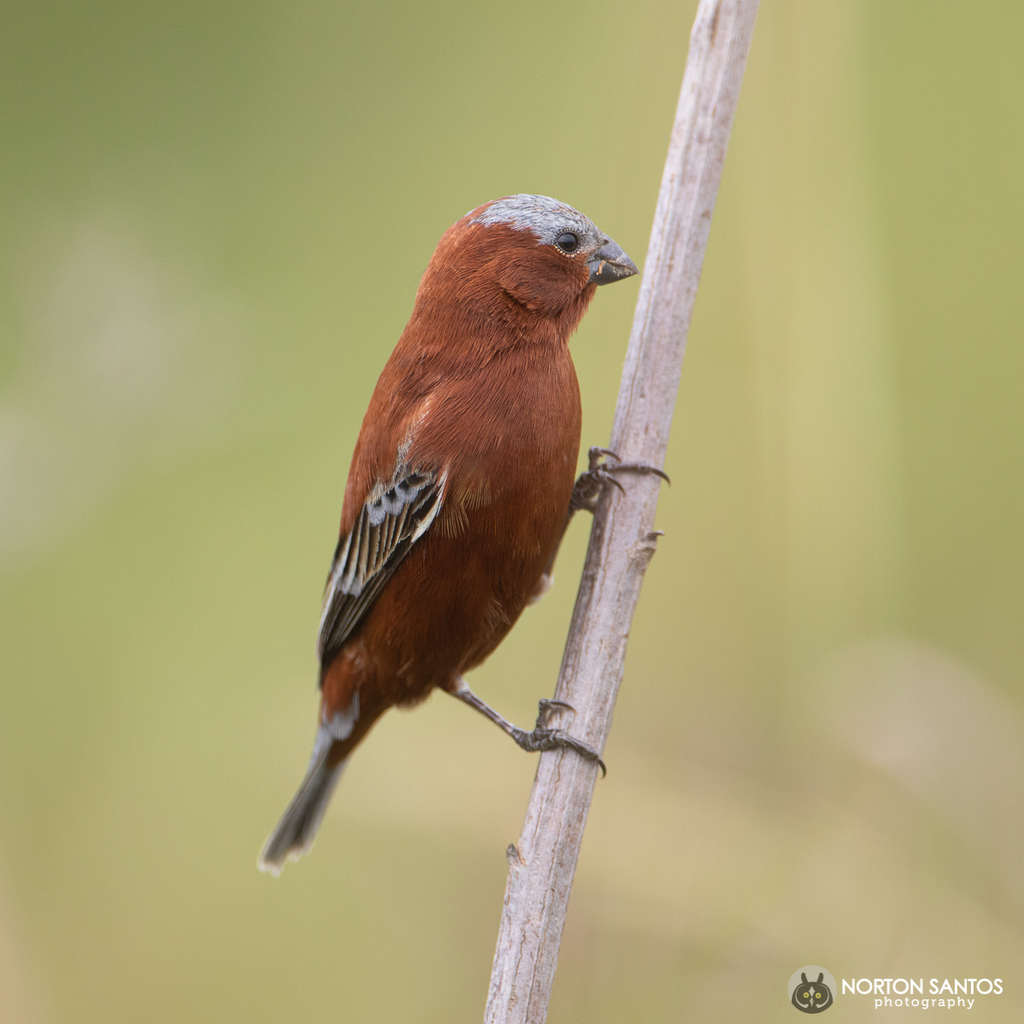
The chestnut seedeater is about 10 cm (3.9 in) long and weighs an average of about 8.6 g (0.30 oz). It is one of the smallest of its genus. It has a smallish bill with a rounded culmen. The species is sexually dimorphic. Adult males have a medium gray crown to just below the eye; the rest of their head is chestnut. Their body is almost entirely chestnut with medium gray uppertail coverts. Their tail is mostly dark brown with cinnamon-brown feather edges. Their wings' greater and median coverts are dark grayish brown with light gray edges. Their flight feathers are dark grayish brown with cinnamon-brown edges and the primaries have white bases that show as a patch on the folded wing. Females have a mostly warm sandy brown head with a buff face. Their upperparts are also warm sandy brown and their tail is darker brown. Their wings are darker brown with sandy edges on the coverts. Their underparts are mostly warm buff with a whitish belly. Both sexes have a dark brown iris and black legs. Males have a black bill; females have a dark horn-colored one. Juveniles resemble adult females.
Range & habitat
The chestnut seedeater is found from most of Uruguay and northeastern Argentina's Entre Rios Province north through eastern Paraguay and Brazil to Tocantins. At its widest its range spans from northeastern Paraguay across Brazil from western Mato Grosso do Sul to Rio de Janeiro state. It inhabits grasslands with some shrubs, especially but not exclusively seasonally flooded lowlands and marshes.
Wikipedia: “Distribution and habitat”
What it does
The chestnut seedeater feeds on grass seeds, especially those of native grasses, and also includes some small arthropods in its diet. It typically feeds while clinging to stems, sometimes upside down as the stem bends. In the breeding season it forages in pairs or family groups and outside it in larger groups that include other seed-eating species.
Wikipedia: “Feeding”
Listen
Looking for field recordings…
Where it lives
Recorded sightings
—
geo-referenced records in GBIF, from museums, herbaria and field observers.
Drag the globe to turn it. Dots are where records exist, not a range map; darker means more records.
In the stacks
Searching the stacks…
Every page naming Sporophila cinnamomea in the Biodiversity Heritage Library →
This page is assembled live from iNaturalist, GBIF, Wikipedia, the Source Library and the Internet Archive. It is not yet part of the hand-edited codex. iNaturalist taxon 9495.