On eBird ↗
Lined Seedeater
Live sightings near you, the range map, bar charts of when it is seen, and Macaulay Library photos and recordings.
Lined Seedeater
Sporophila lineola
The lined seedeater (Sporophila lineola) is a species of bird in the family Thraupidae, the tanagers and allies. It is found in every mainland South American country except Uruguay, though it has occurred in Chile and on Trinidad as a vagrant.
From the article Lined seedeater on Wikipedia (CC BY-SA), quoted section by section
Description
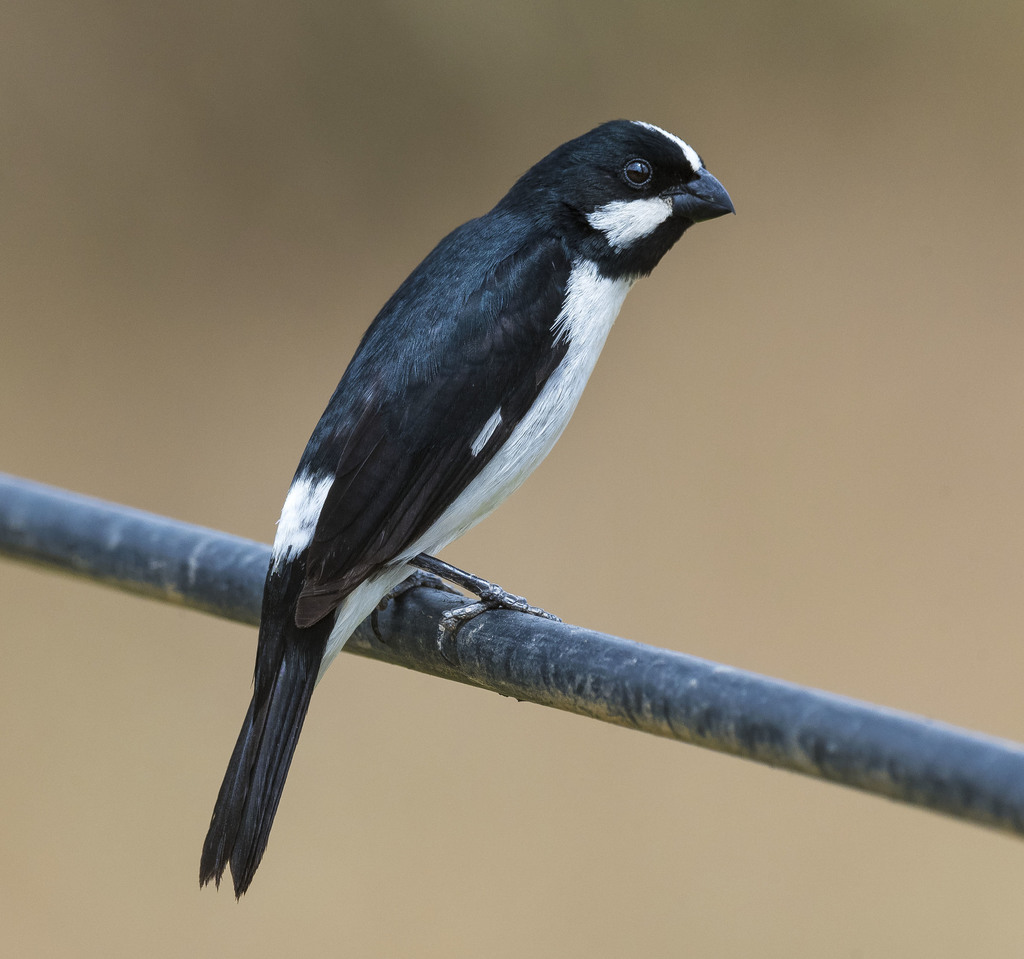
The lined seedeater is 10 to 11 cm (3.9 to 4.3 in) long and weighs 7.5 to 12 g (0.26 to 0.42 oz). It has a short thick bill with a rounded culmen. The species is sexually dimorphic. Adult males have a mostly black head with a wide white stripe on the forehead and crown and a large triangular white patch on the lower ear coverts and cheek. Their upperparts are black except for a thin white band on the rump. Their wings are mostly black with white bases on the primaries that show as a patch on the closed wing. Their tail is also black. Their throat is black that extends rearward under the white cheek. Their underparts are whitish with black thighs. Adult females have a brownish olive head, upperparts, wings, and tail. Their throat is creamy buff, their breast buffy, and their belly and undertail coverts a paler buff. Both sexes have a dark brown iris. Males have a black bill and legs. Females have a dark maxilla, a horn-colored mandible, and blackish legs.
Range & habitat
Over the course of the year the lined seedeater is found from the southeastern half of Colombia south through eastern Ecuador, eastern Peru, and eastern Bolivia into northern Argentina. From those countries its range extends east across most of Venezuela, the Guianas, Paraguay, and most of Brazil. It has occurred as a vagrant in Chile, on Trinidad, and in Panama and Costa Rica. Its seasonal distribution is described in the Movement section. The lined seedeater is primarily a species of open to semi-open landscapes. These include savanna, caatinga, woodlands in the Gran Chaco, dry forest, and shrubby edges and clearings of denser forest. It is often found near water. In elevation it ranges from sea level to 1,200 m (3,900 ft) in Brazil and to 500 m (1,600 ft) in Venezuela, though there are sight records as high as 1,450 m (4,800 ft) in the latter. It is found below 500 m (1,600 ft) in Colombia, below 400 m (1,300 ft) in Ecuador, and below 1,300 m (4,300 ft) in Peru. Remarkably, the vagrant in Chile was photographed at 4,250 m (13,900 ft).
Wikipedia: “Distribution and habitat”
What it does
The lined seedeater feeds mostly on seeds, especially those of grasses. It forages on the ground and while clinging to grass stalks. In the breeding season it usually is in pairs but forms small flocks outside that time.
Wikipedia: “Feeding”
Listen
Looking for field recordings…
Where it lives
Recorded sightings
—
geo-referenced records in GBIF, from museums, herbaria and field observers.
Drag the globe to turn it. Dots are where records exist, not a range map; darker means more records.
In the stacks
Searching the stacks…
Every page naming Sporophila lineola in the Biodiversity Heritage Library →
This page is assembled live from iNaturalist, GBIF, Wikipedia, the Source Library and the Internet Archive. It is not yet part of the hand-edited codex. iNaturalist taxon 9491.