On eBird ↗
Rock Ptarmigan
Live sightings near you, the range map, bar charts of when it is seen, and Macaulay Library photos and recordings.
Rock Ptarmigan
Lagopus muta
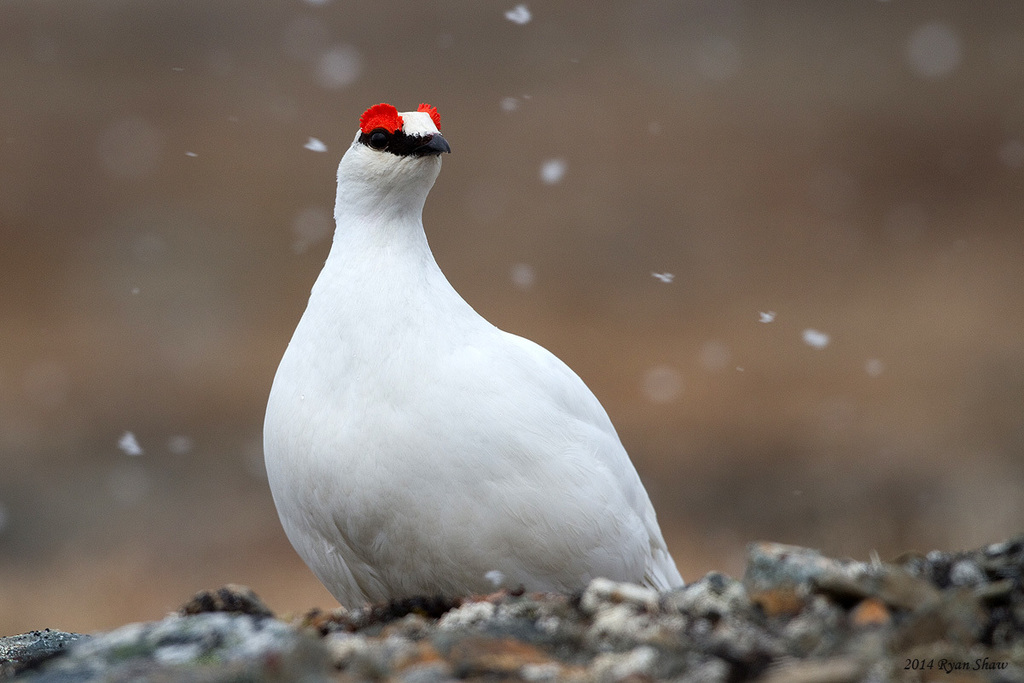
The rock ptarmigan (Lagopus muta) is a medium-sized game bird in the grouse tribe. It is known simply as the ptarmigan in Europe. It is the official bird for the Canadian territory of Nunavut, where it is known as the aqiggiq (ᐊᕿᒡᒋᖅ), and the official game bird for the province of Newfoundland and Labrador. In Japan, it is known as the raichō (雷鳥), which means "thunder bird"; it is the official bird of Gifu, Nagano, and Toyama Prefectures and is a protected species nationwide.
From the article Rock ptarmigan on Wikipedia (CC BY-SA), quoted section by section
Description
The rock ptarmigan is 34–36 cm (13–14 in) long with an 8 cm (3.1 in) tail and with a wingspan of 54–60 cm (21–24 in) and a weight of 440–640 g (15.5–22.6 oz). It is about ten percent smaller than the willow ptarmigan. The rock ptarmigan is camouflaged to match the seasons; its feathers moult from white in winter to grey and brown in spring or summer. The breeding male has greyish upper parts with white wings and underparts. In winter, its plumage becomes completely white except for the black outer tail feathers and eye line. It can be distinguished from the winter willow ptarmigan by habitat; the rock ptarmigan prefers higher elevations and more barren habitats. It also differs in its slender bill; males additionally have black lores, absent in the willow ptarmigan, though they are also absent in female rock ptarmigan.
Range & habitat
The rock ptarmigan is a sedentary species which breeds across Arctic and Subarctic Eurasia and North America (including Greenland) on rocky mountainsides and tundra. It is widespread in the Arctic Cordillera and across the Eurasian Arctic from Norway, Sweden east to the Siberian Far East. It is also found in isolated populations in the mountains of Scotland, the Pyrenees, the Alps, Bulgaria, the Urals, the Pamir Mountains, the Altay Mountains, and Japan, where it occurs only in the Japanese Alps and on Mount Haku. Because of the remote habitat in which it lives, it has only a few predators, notably gyrfalcon, golden eagle, and arctic fox, and it can be surprisingly approachable. The small population living on Franz Josef Land in the Russian High Arctic overwinters during the polar night and survives by feeding on rich vegetation on and underneath high cliffs where seabird colonies are located in summer. In Great Britain, it occurred in England in the Lake District fells until the early 1800s, and slightly later in the Southern Uplands of Scotland, but is now absent from these regions, occurring now only in the Scottish Highlands. During the last ice age, the species was far more widespread in continental Europe.
Migration. …
Wikipedia: “Distribution and habitat”
What it does
Food sources can vary tremendously depending on the region of their distribution. In Alaska, rock ptarmigans consume aspen buds, dwarf birch and willow buds and catkins as a staple winter diet. They transition their diets over to Empetrum nigrum (crowberries) and Vaccinium vitis-idaea (cowberry or lingonberry) shrubs during the spring. The greatest variety in its diet occurs during early summer, when it feeds on willow leaves, as well as the leaves and flowers of Dryas and locoweed. It also feeds on berries, bistort seeds, and birch buds from late summer to autumn. Insects, larvae and snails are eaten by chicks.
Wikipedia: “Feeding”
In human culture
The ptarmigan's genus name, Lagopus, is derived from Ancient Greek lagos (λαγώς lagṓs), meaning "hare", + pous (πούς poús), "foot", in reference to the bird's feathered legs. The species name, muta, comes from Neo-Latin and means "mute", referring to the simple croaking song of the male. It was for a long time misspelt mutus, in the erroneous belief that the ending of Lagopus denotes masculine gender. However, as the Ancient Greek term λαγώπους lagṓpous is of feminine gender, and the species name has to agree with that, the feminine muta is correct. The word ptarmigan comes from the Gaelic tarmachan, meaning croaker. The p- was added due to a mistaken belief in a Greek origin, as if the word were related to Greek words like πτερόν (pterón), 'wing'.
Wikipedia: “Etymology”
Listen
Looking for field recordings…
Where it lives
Recorded sightings
—
geo-referenced records in GBIF, from museums, herbaria and field observers.
Drag the globe to turn it. Dots are where records exist, not a range map; darker means more records.
In the stacks
Searching the stacks…
Every page naming Lagopus muta in the Biodiversity Heritage Library →
This page is assembled live from iNaturalist, GBIF, Wikipedia, the Source Library and the Internet Archive. It is not yet part of the hand-edited codex. iNaturalist taxon 949.