- Animals
- ›Arthropods
- ›Hexapods
- ›Insects
- ›Winged and Once-winged Insects
- ›Dragonflies and Damselflies
- ›Damselflies
- ›Coenagrionoid Damselflies
- ›Narrow-winged Damselflies
- ›Argia
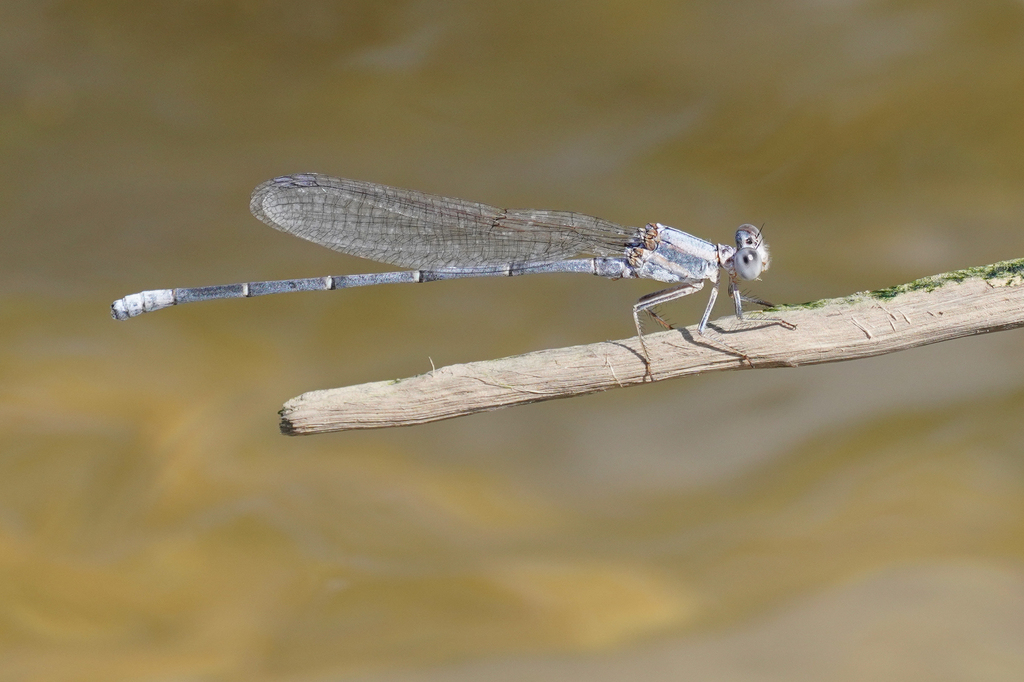
Powdered Dancer
Argia moesta
The powdered dancer (Argia moesta) is a damselfly of the family Coenagrionidae. It is native to North America. It may be seen year-round in at least some of its range.
From the article Powdered dancer on Wikipedia (CC BY-SA), quoted section by section
Description
Males have a blue tip at the end of the abdomen. Immature (freshly moulted, or teneral) males are tan to dark brown, turning darker with age and becoming almost completely whitish (pruinose) at maturity.
Females come in blue and brown forms based on the color of the thorax, which has hair thin dark shoulder stripes.
The blue form female is very similar to the female blue-fronted dancer; a key to separating these two is the number of cells below the stigma: our species has two cells below the stigma where a blue-fronted dancer has one.
In human culture
The common name refers directly to the male's pruinosity, appearing to be covered with a powdery blue or grayish substance. Older males are more pruinose, and may even be more ash white than blue. The specific epithet moesta, means sorrowful, and may refer to customs (such as those on Ash Wednesday) of dusting oneself with ashes to express sorrow or mourning.
Wikipedia: “Etymology”
Listen
Looking for field recordings…
Where it lives
Recorded sightings
—
geo-referenced records in GBIF, from museums, herbaria and field observers.
Drag the globe to turn it. Dots are where records exist, not a range map; darker means more records.
In the stacks
Searching the stacks…
Every page naming Argia moesta in the Biodiversity Heritage Library →
This page is assembled live from iNaturalist, GBIF, Wikipedia, the Source Library and the Internet Archive. It is not yet part of the hand-edited codex. iNaturalist taxon 94557.