On eBird ↗
Spotted Towhee
Live sightings near you, the range map, bar charts of when it is seen, and Macaulay Library photos and recordings.
Spotted Towhee
Pipilo maculatus
The spotted towhee (Pipilo maculatus) is a large New World sparrow. The taxonomy of the towhees has been debated in recent decades, and until 1995 this bird and the eastern towhee were considered a single species, then named rufous-sided towhee. Another outdated name for the spotted towhee is the Oregon towhee (particularly for the subspecies Pipilo maculatus oregonus). The call may be harsher and more varied than for the eastern towhee.
From the article Spotted towhee on Wikipedia (CC BY-SA), quoted section by section
Description
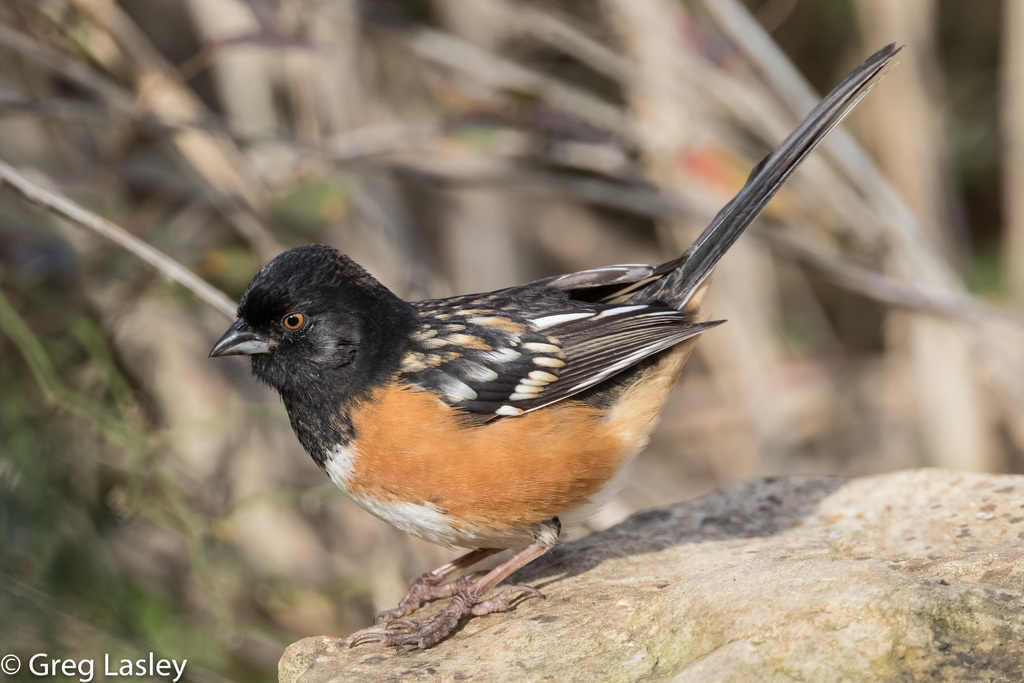
The spotted towhee is a large New World sparrow, roughly the same size as a gray catbird. It has a long, dark, fan-shaped tail with white corners on the end. It has a round body (similar to New World sparrows) with bright red eyes and dull pink legs. The spotted towhee is between 17 cm (6.7 in) and 21 cm (8.3 in) long, and weighs in at between 33 g (1.2 oz) and 49 g (1.7 oz). It has a wingspan of 28 cm (11 in). Adult males have a generally darker head, upper body and tail with a white belly, rufous sides, white spots on their back and white wing bars. Females look similar but are dark brown and grey instead of black. The spotted towhee has white spots on its primary and secondary feathers; the eastern towhee is the same in terms of its size and structure but does not have white spots, though does have a white base on the primary feathers, absent in spotted towhee.
Range & habitat
The spotted towhee lives in dry upland forests, open forests, brushy fields, and chaparrals. It breeds across north-western North America and is present year-round in California, Nevada, Arizona, Utah, Oregon, Washington, Idaho and southern British Columbia. It is not found in arid climates and as a result does not reside in the Sonoran Desert, but resides in northern Arizona and the entirety of California except the southeast corner that borders Arizona. It has also been known to expand as far eastward as western Iowa and southwestern Minnesota. It also occurs in fringe wetland forests and riparian forests near the border of upland forests. Because the spotted towhee's habitat overlaps with areas of the United States that experience regular forest fires (Arizona, New Mexico, California), it tends to be found in unburned chaparral and avoids chaparral and forests which have been burned due to lack of ground cover and minimal foraging ability. Spotted towhees will be present in an area that is recovering after a burn (less than 15 years old), due to excellent ground cover and ease of ground foraging from the recovering understory vegetation, although populations will decrease after a forest fire until the vegetation has grown back.
Its breeding habitat in the southwest is largely dependent on coastal sage scrub, as it provides cover from predators. …
Wikipedia: “Distribution and habitat”
What it does
These birds forage on the ground or in low vegetation, with a habit of noisily rummaging through dry leaves searching for food. During the breeding season (spring and summer) they mainly eat insects, ground dwelling beetles, spiders and other arthropods that reside in the leaf litter that is foraged by the spotted towhee. They only eat protein rich food in the breeding season, and in the fall and winter they focus on foraging for acorns, seeds, oats, and berries. They will frequent bird feeders if present in their woodland habitat.
Wikipedia: “Diet”
Listen
Looking for field recordings…
Where it lives
Recorded sightings
—
geo-referenced records in GBIF, from museums, herbaria and field observers.
Drag the globe to turn it. Dots are where records exist, not a range map; darker means more records.
In the stacks
Searching the stacks…
Every page naming Pipilo maculatus in the Biodiversity Heritage Library →
This page is assembled live from iNaturalist, GBIF, Wikipedia, the Source Library and the Internet Archive. It is not yet part of the hand-edited codex. iNaturalist taxon 9420.