On eBird ↗
Mauritius Duck
Live sightings near you, the range map, bar charts of when it is seen, and Macaulay Library photos and recordings.
Mascarene Teal
Anas theodori
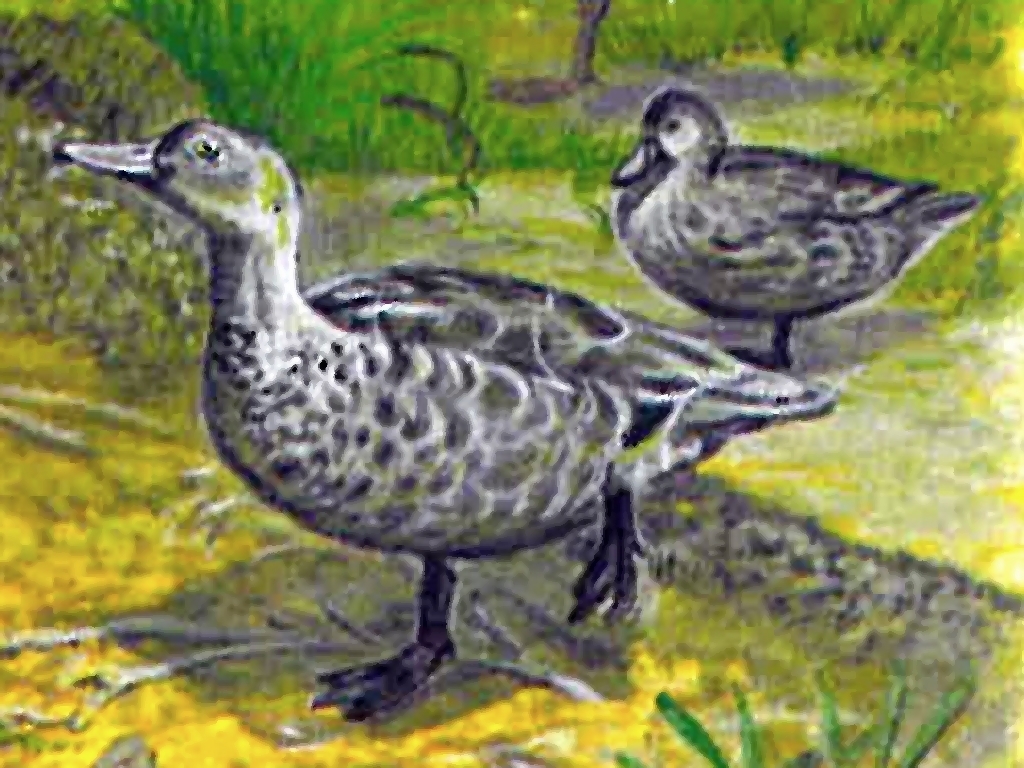
The Mascarene teal (Anas theodori), also known as the Mauritius duck and Sauzier's teal, is an extinct species of duck that lived on the Mascarene Islands of Mauritius and Réunion. A small duck was mentioned in 17th century accounts from these islands which is thought to be this species, and it may also be depicted in one illustration. In 1893, various bones from the Mare aux Songes swamp of Mauritius were used to name a new species in the duck genus Anas, A. theodori, after Théodore Sauzier who directed the excavations. Additional remains from Réunion were considered to belong to the same species in 1999, and it was determined to be related to the Sunda teal of the Indian Ocean.
The Mascarene teal was a small duck; in comparison with the extant ducks of Madagascar, it was larger than Bernier's teal, but smaller than Meller's duck. While overall most similar to the Sunda teal, the two differ in details of the sternum and lower leg bones. One contemporary account described the bird as "grey". Based on the proportions of its limb-bones, it had normal flight capabilities and was able to fly between Mauritius and Réunion, explaining how it occurred on both islands. It possibly nested in tree holes similar to related teals. The species was listed among the favourite prey of hunters; while abundant in 1681, it declined quickly thereafter, becoming extinct on Mauritius around 1700 and on Réunion a decade later. It was probably driven to extinction due to overhunting and predation by introduced animals, particularly cats.
From the article Mascarene teal on Wikipedia (CC BY-SA), quoted section by section
Description
The Mascarene teal was a small duck, and in comparison with the extant ducks of Madagascar, it was larger than Bernier's teal but smaller than Meller's duck. Based on the known bones, the sternum was 27.7 mm (1 in) wide and 21.7 mm (1 in) deep, the coracoid 41.1–42.5 mm (2–2 in) long, the humerus 69.6–73.1 mm (3–3 in) long, the ulna 63 mm (2 in) long, the tibiotarsus 71 mm (3 in) long, and the tarsometatarsus 42 mm (2 in) long. While overall most similar to the Sunda teal, the Mascarene teal differs in that the carina of the sternum (a keel-like ridge) projects further forwards, and the lower manubrial spine (a projection from the sternum) is narrow and elongated in the Sunda teal, and more elongated than in the Mascarene teal. The coracoid of the Mascarene teal is very similar to that of the Sunda teal. They both share a small, upwards directed spike on the internal side of the coracoid's hind surface, followed by a small depression. On the coracoid's front surface, near the acrocoracoid's (an upwards expansion of the coracoid) internal side, there is an almost circular muscle scar (for the attachment of muscles) in both species. The humeri of the Mascarene and Sunda teal look very similar, with the humeral head (the upper, expanded part of the bone) forming a well-developed rim over the tricipital fossa (a depression), with a well-developed and elongated pectoral attachment. …
What it does
Mourer-Chauviré and colleagues stated in 1999 that the proportions of the Mascarene teal's limb-bones are very similar to those of the Sunda teal, indicating no reduction in flight capability, and are very different from those of flightless species like the Auckland teal (Anas aucklandica) and the Amsterdam wigeon (Anas marecula). It is possible that the Mascarene teal had normal flight capabilities and was able to fly between Mauritius and Réunion, explaining how it occurred on both islands. Hume and the British ornithologist Michael Walters added in 2012 that it may also have moved seasonally. Cheke and Hume suggested in 2008 that, like the related Bernier's and Indo-Australasian teals, the Mascarene teal possibly nested in tree holes, as did the local starlings and parrots. Many other endemic species of Mauritius and Réunion were lost after the arrival of humans, so that the ecosystems of these islands are severely damaged and hard to conserve. Before humans arrived, the islands were entirely covered in forests, very little of which remains today because of deforestation. The surviving endemic fauna is still seriously threatened. On Mauritius, the Mascarene teal lived alongside other recently extinct birds such as the dodo, the Mauritian sheldgoose, the red rail, the broad-billed parrot, the Mauritius blue pigeon, the Mauritius scops owl, and the Mauritius night heron. …
Wikipedia: “Behaviour and ecology”
Listen
Looking for field recordings…
Where it lives
Recorded sightings
—
geo-referenced records in GBIF, from museums, herbaria and field observers.
Drag the globe to turn it. Dots are where records exist, not a range map; darker means more records.
In the stacks
Searching the stacks…
Every page naming Anas theodori in the Biodiversity Heritage Library →
This page is assembled live from iNaturalist, GBIF, Wikipedia, the Source Library and the Internet Archive. It is not yet part of the hand-edited codex. iNaturalist taxon 94032.