- Animals
- ›Chordates
- ›Vertebrates
- ›Ray-finned Fishes
- ›Carps, Characins, Catfishes and Allies
- ›Minnows, Suckers, Carps, and Loaches
- ›Carps and Minnows
- ›True Minnows
- ›Old World Minnows
- ›Anaecypris
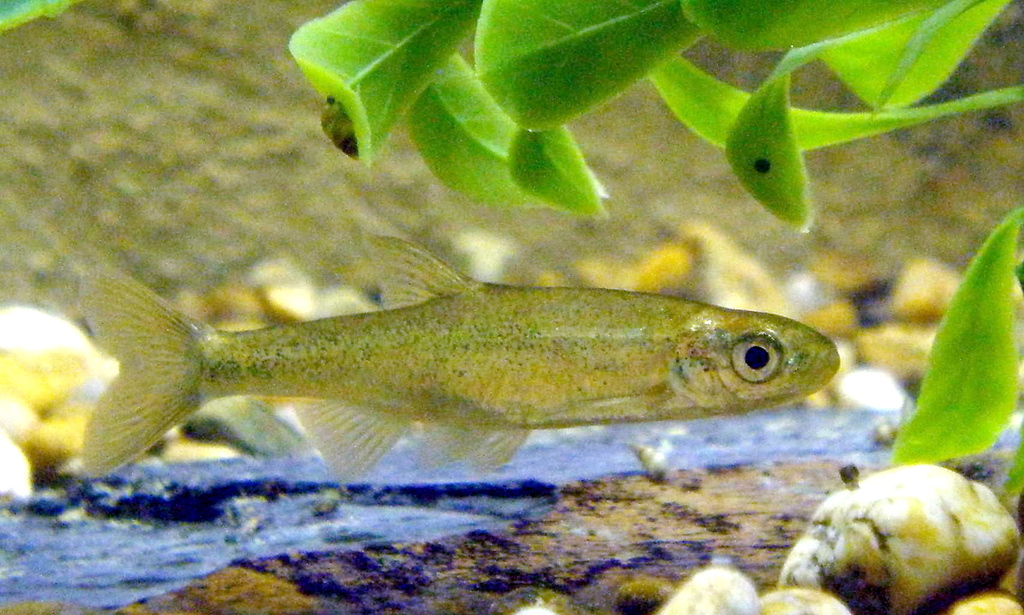
Jarabugo
Anaecypris hispanica
Anaecypris hispanica, the Spanish minnowcarp, is a small species of ray-finned fish species in the family Cyprinidae. It is the only living member of the genus Anaecypris. It is endemic to the Iberian Peninsula and is found in the basin of the Guadiana River in southern Spain and Portugal. Its natural habitats are rivers and intermittent rivers which are shallow,highly oxygentated, have a water temperature of no more than 25°C and have a coarse stream bed....
From the article Anaecypris hispanica on Wikipedia (CC BY-SA), quoted section by section
Description
Anaecypris hispanica differs from related fishes present on the Iberian peninsula by possessing an upturned mouth, the origin of the dorsal fin is behind the base of the pelvic fin base, there is a scaleless keel between the pelvic fin and the anus and there is an incomplete lateral line has between 2 and 23 pored scales. This species has a maximum fork length of 7.5 cm (3.0 in)>
Range & habitat
Anaecypris hispanica is endemic to the Iberian Peninsula where it is found in the drainage system of the Guadiana with an isolated population in the Rio Bembézar in the Guadalquivir drainage. The Spanish minnowcarp is found in shallow stretches of minor streams and rivers, these streams are subject to wide variations of flow. Many of them can almost completelydry out during summer and autumn, when the fish survive in the disconnected pools remaining until the flow resumes. When the flow is high these fishes are found in both riffles and deeper poolswhere the streambed is made up of exposed bedrocks, cobbles and gravel.
Wikipedia: “Distribution and habitat”
In human culture
Anaecypris hispanica is the type species of the genus Anaecypris, this name combines Anas, the Latin name for the Guadiana, with cypris, meaning a small carp, a common suffix used in the names of cyprinoid genera. The specific name hispanica, the Roman name for the Iberian peninsula, where this species is endemic.
Wikipedia: “Etymology”
Where it lives
Recorded sightings
—
geo-referenced records in GBIF, from museums, herbaria and field observers.
Drag the globe to turn it. Dots are where records exist, not a range map; darker means more records.
In the stacks
Searching the stacks…
Every page naming Anaecypris hispanica in the Biodiversity Heritage Library →
This page is assembled live from iNaturalist, GBIF, Wikipedia, the Source Library and the Internet Archive. It is not yet part of the hand-edited codex. iNaturalist taxon 94013.