On eBird ↗
Guadeloupe Amazon
Live sightings near you, the range map, bar charts of when it is seen, and Macaulay Library photos and recordings.
Guadeloupe Parrot
Amazona violacea
The Guadeloupe amazon or Guadeloupe parrot (Amazona violacea) is a hypothetical extinct species of parrot that is thought to have been endemic to the Lesser Antillean island region of Guadeloupe. Mentioned and described by 17th- and 18th-century writers, it received a scientific name in 1789. It was moved to the genus Amazona in 1905, and is thought to have been related to, or possibly the same as, the extant imperial amazon. A tibiotarsus (a lower leg bone) and an ulna (a lower arm bone) from the island of Marie-Galante may belong to the Guadeloupe amazon. In 1905, a species of extinct violet macaw was also claimed to have lived on Guadeloupe, but in 2015, it was suggested to have been based on a description of the Guadeloupe amazon.
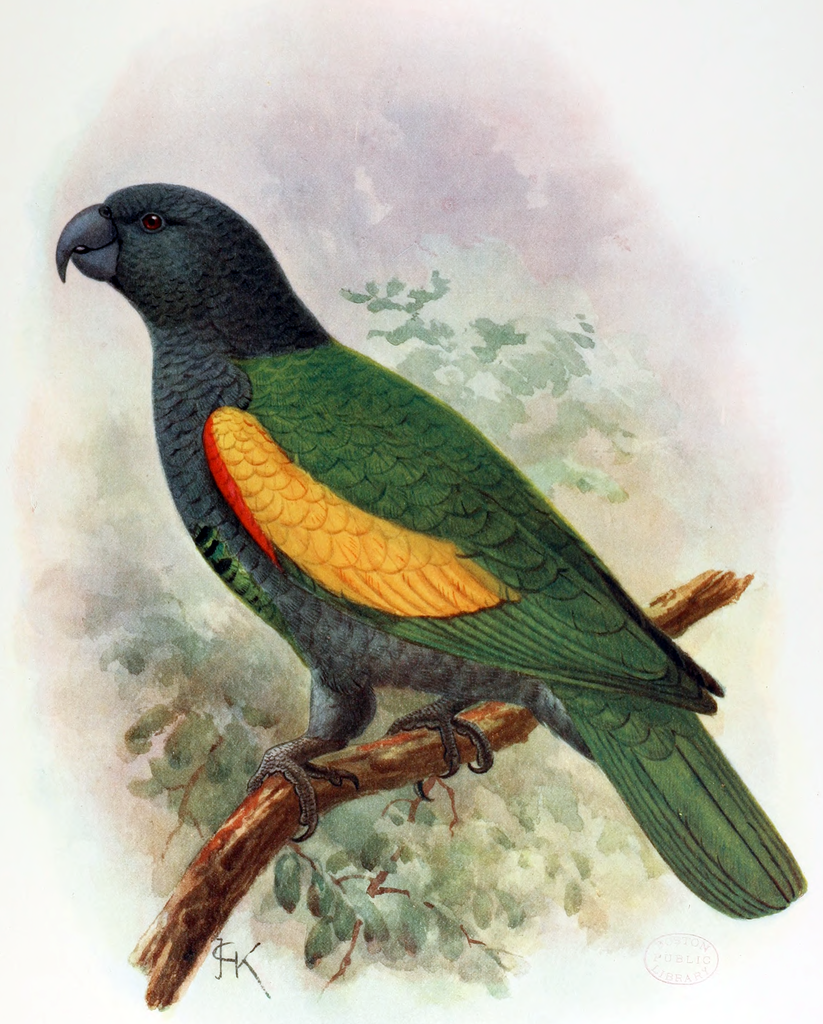
According to contemporary descriptions, the head, neck and underparts of the Guadeloupe amazon were mainly violet or slate, mixed with green and black; the back was brownish green; and the wings were green, yellow and red. It had iridescent feathers, and was able to raise a "ruff" of feathers around its neck. The bird fed on fruits and nuts, and the male and female took turns sitting on the nest. It was eaten by French settlers, who also destroyed its habitat. Rare by 1779, it appears to have become extinct by the end of the 18th century.
From the article Guadeloupe amazon on Wikipedia (CC BY-SA), quoted section by section
Description
Du Tertre described the Guadeloupe amazon as follows in 1654:
The Parrot of Guadeloupe is almost as large as a fowl. The beak and the eye are bordered with carnation. All the feathers of the head, neck, and underparts are of a violet color, mixed with a little green and black, and changeable like the throat of a pigeon. All the upper part of the back is brownish green. The long quills are black, the others yellow, green, and red, and it has on the wing-coverts two rosettes of rose color. Labat described the bird as follows in 1742:
The Parrots of these islands are distinguishable from those of the mainland of Guinea (? Guiana) by their different plumage; those of Guadeloupe are a little smaller than the Macaws. The head, neck, and underparts are slaty, with a few green and black feathers; the back is wholly green, the wings green, yellow, and red. Clark noted that the iridescent feathers described are not unique to the Guadeloupe amazon, as other freshly killed amazons also show this to a greater or lesser degree, especially the Saint Vincent amazon (Amazona guildingii). He suggested that the black of the head and underparts of the Guadeloupe bird could have been the borders of the feathers, as seen in the imperial amazon, whereas the green may have been a sign of immaturity, like in the Saint Vincent amazon. …
What it does
In 1664 Du Tertre described some behavioural traits of the Guadeloupe amazon, and listed items among its diet:
When it erects the feathers of its neck, it makes a beautiful ruff about its head, which it seems to admire, as a peacock its tail. It has a strong voice, talks very distinctly, and learns quickly if taken young. It lives on the wild fruits which grow in the forests, except that it does not eat the manchioneel. Cotton seed intoxicates it, and affects it as wine does a man; and for that reason they eat it with great eagerness ... The flavor of its flesh is excellent, but changeable, according to the kind of food. If it eats cashew nuts, the flesh has an agreeable flavor of garlic; if 'bois des inde' it has a flavor of cloves and cinnamon; if on bitter fruits, it becomes bitter like gall. If it feeds on genips, the flesh becomes wholly black, but that does not prevent its having a very fine flavor. When it feeds on guavas it is at its best, and then the French commit great havoc among them. Clark noted that the Saint Vincent amazon and other amazon species can also raise a "ruff" of feathers around their neck when excited. In 1667, Du Tertre repeated his description of the Guadeloupe amazon, and added some details about its breeding behaviour:
We had two which built their nest a hundred paces from our house in a large tree. …
Wikipedia: “Behaviour and ecology”
Listen
Looking for field recordings…
Where it lives
Recorded sightings
—
geo-referenced records in GBIF, from museums, herbaria and field observers.
Drag the globe to turn it. Dots are where records exist, not a range map; darker means more records.
In the stacks
Searching the stacks…
Every page naming Amazona violacea in the Biodiversity Heritage Library →
This page is assembled live from iNaturalist, GBIF, Wikipedia, the Source Library and the Internet Archive. It is not yet part of the hand-edited codex. iNaturalist taxon 93796.