On eBird ↗
Montserrat Oriole
Live sightings near you, the range map, bar charts of when it is seen, and Macaulay Library photos and recordings.
Montserrat Oriole
Icterus oberi
The Montserrat oriole (Icterus oberi) is a Vulnerable species of bird in the family Icteridae, the oropendolas, New World orioles, and New World blackbirds. It is endemic to the island of Montserrat, a British Overseas Territory in the Lesser Antilles of the Caribbean. It is the national bird of the island.
From the article Montserrat oriole on Wikipedia (CC BY-SA), quoted section by section
Description
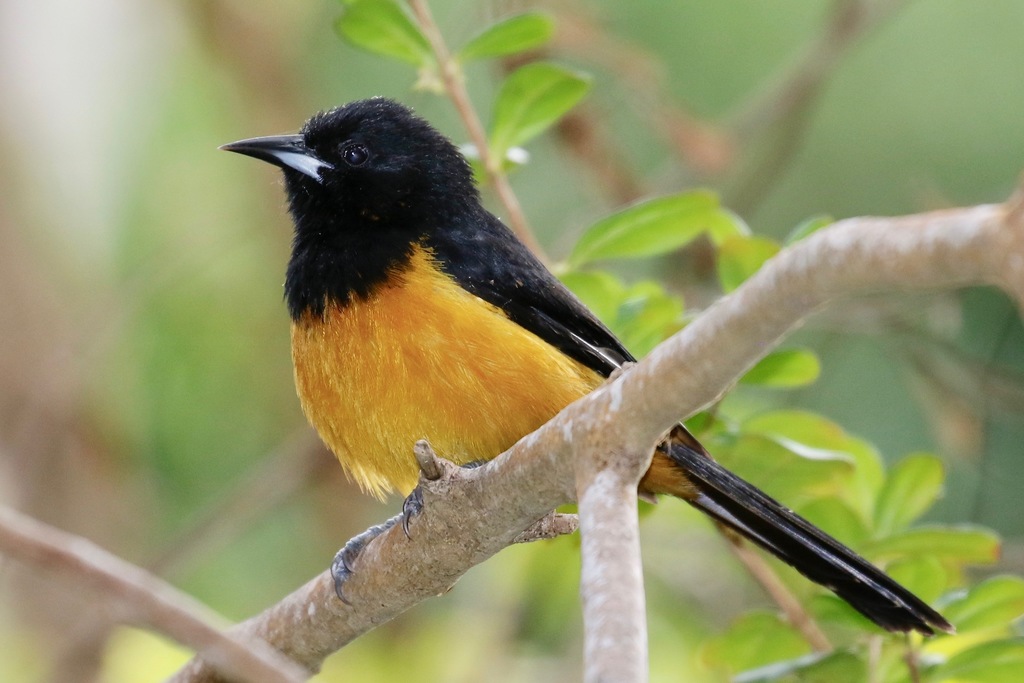
The Montserrat oriole is 20 to 22 cm (7.9 to 8.7 in) long. Males weigh 36 to 39 g (1.3 to 1.4 oz) and females 31.5 to 35.4 g (1.1 to 1.2 oz). Adult males have a black head, throat, upper breast, mantle, back, wings, and tail. Their belly, flanks, and rump are rich yellowish orange. Adult females have a greenish yellow head and greenish olive upperparts and tail. Their wings are greenish brown with yellow leading edges on the flight feathers. Their throat, breast, flanks, and belly are greenish yellow. Both sexes have a black iris, a silvery black bill, and blackish gray legs and feet. Juveniles resemble adult females but are overall duller.
Range & habitat
The Montserrat oriole is found only in the Centre Hills and South Soufriere Hills on Montserrat. It apparently previously inhabited a wider range but forest clearance for agriculture in the nineteenth and early twentieth centuries reduced its available habitat. Hurricane Hugo in 1989 felled many trees across the island. The eruptions of the Soufrière Hills volcano beginning in 1995 destroyed half or more of its habitat in those hills. Volcanic ash further damaged forest outside the lava flows. The species inhabits mesic to wet montane evergreen forest. Most of the island's forest is secondary; while the Montserrat oriole is found in both mature and early successional forest it seems to prefer the latter. Most of the species' remaining habitat is at elevations between about 250 and 900 m (800 and 3,000 ft). However, it is found as low as 100 m (300 ft).
Wikipedia: “Distribution and habitat”
What it does
The Montserrat oriole's diet has not been studied in detail. It is known to include insects, spiders, and snails, some fruit, and possibly flowers and nectar. It forages mostly in pairs, from the forest's understory to its subcanopy. It gleans prey from foliage and from within flowers, and also pries off bark to find it.
Wikipedia: “Feeding”
Listen
Looking for field recordings…
Where it lives
Recorded sightings
—
geo-referenced records in GBIF, from museums, herbaria and field observers.
Drag the globe to turn it. Dots are where records exist, not a range map; darker means more records.
In the stacks
Searching the stacks…
Every page naming Icterus oberi in the Biodiversity Heritage Library →
This page is assembled live from iNaturalist, GBIF, Wikipedia, the Source Library and the Internet Archive. It is not yet part of the hand-edited codex. iNaturalist taxon 9355.