On eBird ↗
Epaulet Oriole
Live sightings near you, the range map, bar charts of when it is seen, and Macaulay Library photos and recordings.
Epaulet Oriole
Icterus cayanensis
The epaulet oriole (Icterus cayanensis) is a species of bird in the family Icteridae. The moriche oriole, formerly considered a distinct species (I. chrysocephalus) is now placed herein as a subspecies. The variable oriole, (I. pyrrhopterus), was formerly considered conspecific, but has recently been split by the SACC.
From the article Epaulet oriole on Wikipedia (CC BY-SA), quoted section by section
Description
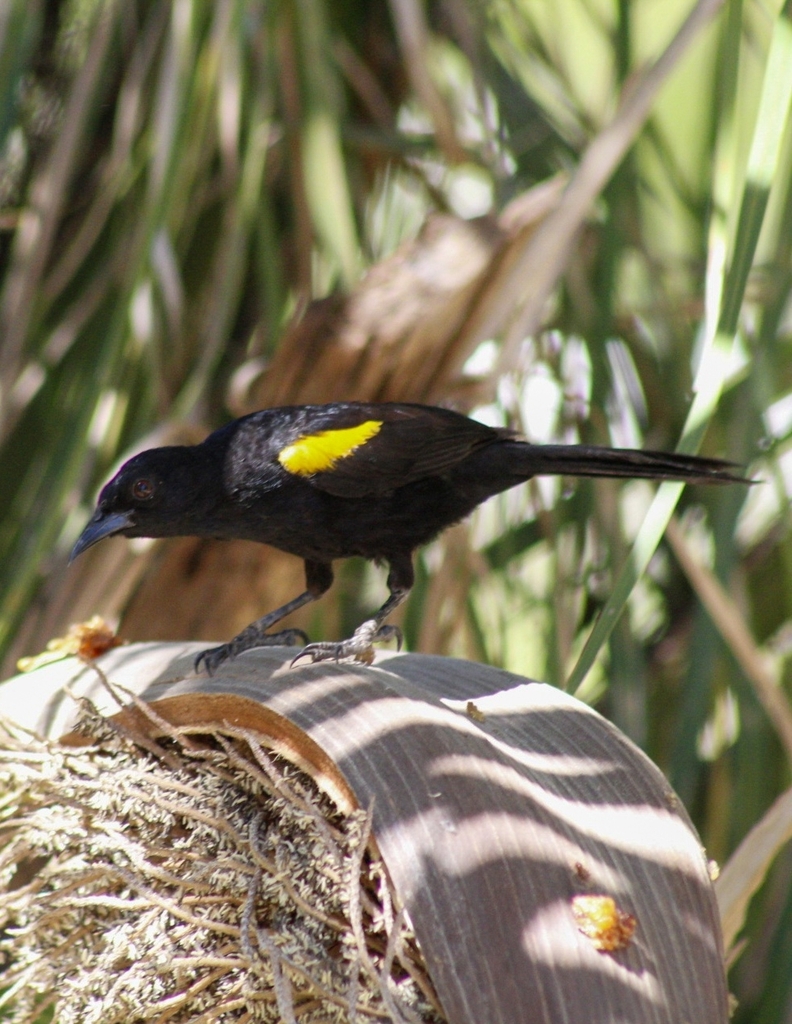
The epaulet oriole is about 22 cm (8.7 in) long. Males weigh an average of about 45 g (1.6 oz) and females an average of about 42 g (1.5 oz). The sexes have the same plumage. Adults of the nominate subspecies are almost entirely black. They have yellow lesser and median wing coverts that show as the eponymous epaulet on the closed wing. Subspecies I. c. chrysocephalus is also mostly black but has a golden-yellow crown, nape, rump, epaulets, and thighs. Juveniles of both subspecies are blackish brown rather than pure black and their yellow parts are duller than adults'. Both subspecies have a brown to deep red-brown iris, a blackish bill, and leaden gray to blackish legs and feet.
Range & habitat
The epaulet oriole is a bird of the Amazon Basin. Subspecies I. c. chrysocephalus is the more northwesterly of the two. It is found from the southeastern half of Colombia south through eastern Ecuador into northern Peru as far as Huánuco Department. Its range extends east through southern and far eastern Venezuela and the Guianas and northern Brazil's Roraima and Amazonas states. It also occurs on Trinidad, though that population may be descended from escaped cage birds. The nominate subspecies' range slightly overlaps that of I. c. chrysocephalus in the Guianas. Its range otherwise extends south and east from that of chrysocephalus to encompass Amazonian Brazil, eastern Peru, and northern Bolivia. The epaulet oriole inhabits a variety of landscapes including the edges, clearings, and canopy of mature forest, swamp forest, gallery forest, and sometimes parks and gardens. In much of its range it favors moriche palm (Mauritia flexuosa) groves in marshes and along waterways. In elevation in Brazil it ranges from sea level to 900 m (3,000 ft). It reaches 1,050 m (3,400 ft) in Colombia, 500 m (1,600 ft) in Ecuador, and 1,500 m (4,900 ft) in Peru. In Venezuela it reaches only 200 m (700 ft) north of the Orinoco River but 1,200 m (3,900 ft) south of it.
Wikipedia: “Distribution and habitat”
What it does
The epaulet oriole's diet has not been studied but is believed to be mostly insects and other arthropods. It is known to feed on fruits, nectar, and sap. It usually forages singly or in pairs but does join mixed-species feeding flocks. It forages mostly in the forest canopy but in more open areas will seek food even down to the ground.
Wikipedia: “Feeding”
Listen
Looking for field recordings…
Where it lives
Recorded sightings
—
geo-referenced records in GBIF, from museums, herbaria and field observers.
Drag the globe to turn it. Dots are where records exist, not a range map; darker means more records.
In the stacks
Searching the stacks…
Every page naming Icterus cayanensis in the Biodiversity Heritage Library →
This page is assembled live from iNaturalist, GBIF, Wikipedia, the Source Library and the Internet Archive. It is not yet part of the hand-edited codex. iNaturalist taxon 9343.