- Plants
- ›Vascular Plants
- ›flowering plants
- ›Dicots
- ›Sunflowers, Bellflowers, Fanflowers, and Allies
- ›Sunflowers, Daisies, Asters, and Allies
- ›Asteroideae
- ›asters and allies
- ›Asterinae
- ›Aster
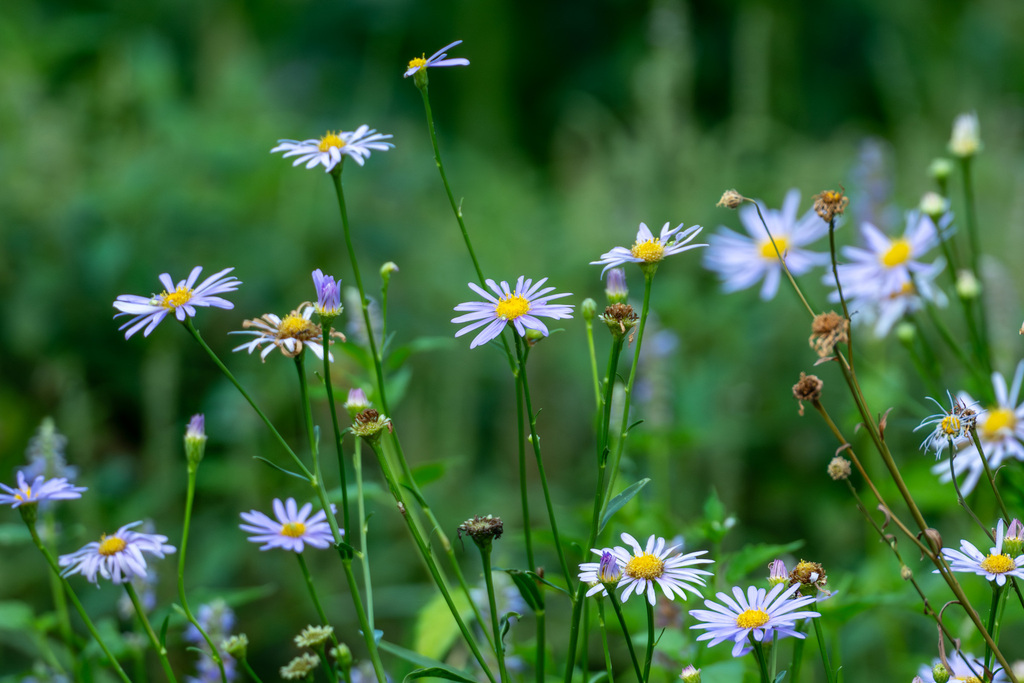
Korean aster
Aster koraiensis
Miyamayomena koraiensis (Korean:벌개미취), commonly called Korean starwort, is a herbaceous perennial plant of the family Asteraceae (Compositae). It can be found in temperate regions, mostly in Korea, in lawns, on roadsides, and other areas with moist soils. Korean starwort is a Korean endemic plant and was first named in the genus Aster in 1909. In Korea, its young leaves are used in food preparation.
From the article Miyamayomena koraiensis on Wikipedia (CC BY-SA), quoted section by section
Description
Aster koraiensis is a perennial herb. The height is about 50~60 cm. The leaves are green color, alternate, lanceolate and pinnately lobed. They are 12~19 cm length and 1.5~3 cm width of leaves. The main stem grows from rhizome, a horizontal stem of plant that is found underground. The leaves on the roots, radical leaves, fall when flowers begin to open. Leaflike bracts can be found. The flower is bisexual and pale violet color and has an inflorescence head which diameter is about 4~5 cm (Only one flower per stem). The involucre is 13 mm length, and 8 mm diameter and has four lines of involucral scale. The achene has about 4 mm length and 1.3 mm diameter and lanceolate shape. There is no pappus. It blooms from June to September; the fruits (achenes) mature in November.
Range & habitat
Miyamayomena koraiensis originated in Korea and also is naturalized throughout Korea peninsula (South Korea and North Korea). It can be easily found anywhere in Korea (around flower gardens, roadsides, mountains, valley, etc.).
Wikipedia: “Distribution”
Where it lives
Recorded sightings
—
geo-referenced records in GBIF, from museums, herbaria and field observers.
Drag the globe to turn it. Dots are where records exist, not a range map; darker means more records.
In the stacks
Searching the stacks…
Every page naming Aster koraiensis in the Biodiversity Heritage Library →
This page is assembled live from iNaturalist, GBIF, Wikipedia, the Source Library and the Internet Archive. It is not yet part of the hand-edited codex. iNaturalist taxon 933829.