- Animals
- ›Cnidarians
- ›Sea Anemones and Corals
- ›Hexacorallians
- ›Stony Corals
- ›Table and Staghorn Corals
- ›Acropora
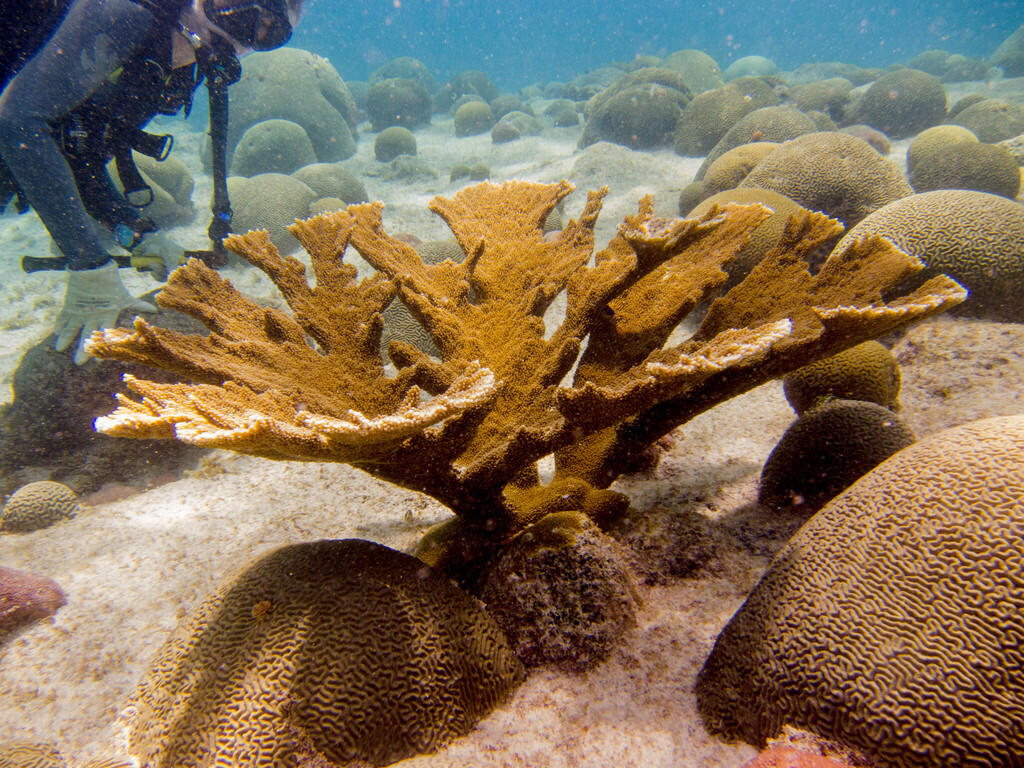
Elkhorn Coral
Acropora palmata
Elkhorn coral (Acropora palmata) is an important reef-building coral in the Caribbean. The species has a complex structure with many branches which resemble that of elk antlers; hence, the common name. The branching structure creates habitat and shelter for many other reef species. Elkhorn coral is known to grow quickly with an average growth rate of 5 to 10 cm (2.0 to 3.9 in) per year. They can reproduce both sexually and asexually, though asexual reproduction is much more common and occurs through a process called fragmentation.
Although Elkhorn coral dominated the Caribbean in the early 1980s, the species has since dramatically declined in numbers. Scientists have estimated that between 1980 and 2006, when it was listed in the Endangered Species Act (ESA), the population declined by around 97%. This decline was due to a variety of factors, including disease, algae growth, climate change, ocean acidification, and human activity. In May 2006, Elkhorn coral was officially listed as threatened in the ESA along with another species in the Acropora genus, staghorn coral. Some conservation efforts are now in place to protect the species and promote increased genetic variability among the species. Following the 2023 marine heatwave, Elkhorn corals are now considered functionally extinct within Florida’s Coral Reef.
From the article Elkhorn coral on Wikipedia (CC BY-SA), quoted section by section
Description
Elkhorn coral produce hard antler-like structures composed of calcium carbonate. These structures can be over 2 (> 6 ft.) meters high and 13 meters (43 ft) wide and are a dull, brownish-yellow.
Wikipedia: “Appearance”
Range & habitat
Elkhorn coral live in shallow habitats, which give them abundant access to light. Like all animals, Elkhorn coral requires oxygen to survive, most of which they obtain through special, photosynthetic algae living in their tissues called zooxanthellae. Therefore, in order to help zooxanthellae produce as much oxygen as possible, Elkhorn coral live in shallow regions between 1 and 5 meters deep to ensure that abundant light reaches the zooxanthellae, maximizing photosynthesis.
Wikipedia: “Habitat”
What it does
Elkhorn coral's primary source of nutrients comes from photosynthetic algae, zooxanthellae, that live inside the coral's cells. Therefore, Elkhorn coral are highly dependent on the sunlight for sustenance, leaving Elkhorn coral vulnerable to increased turbidity or water clarity. During bleaching events, or long-term periods of increased turbidity, Elkhorn coral can obtain nourishment from alternative food sources through filter feeding.
Zooxanthellae. As mentioned, Elkhorn coral have special algae living in their tissues known as zooxanthellae. Zooxanthellae meet their nutritional requirements using photosynthesis, a process that converts carbon dioxide and water into sugars and oxygen. Elkhorn coral provide habitat for these algae and, in turn, receive an abundant source of oxygen, enabling them to grow quickly.
Filter feeding. Elkhorn coral can also use filter feeding techniques to obtain food. At night, Elkhorn coral use their tentacles to snatch free-swimming zooplankton from the water. Zooplankton complete daily diel migrations. In the morning, zooplankton sink to the depths of the ocean where predators are scarce, and then come nightfall, they rise back towards the surface. By concentrating their predation activities at night, Elkhorn coral expend less energy catching large amounts of prey. …
Wikipedia: “Diet”
In human culture
Several factors limit the amount of information regarding the life history of Elkhorn coral. These factors include the necessity for additional tools to assess future population changes, sexual reproduction, and environmental disturbances.
Wikipedia: “Life history limitations”
Where it lives
Recorded sightings
—
geo-referenced records in GBIF, from museums, herbaria and field observers.
Drag the globe to turn it. Dots are where records exist, not a range map; darker means more records.
In the stacks
Searching the stacks…
Every page naming Acropora palmata in the Biodiversity Heritage Library →
This page is assembled live from iNaturalist, GBIF, Wikipedia, the Source Library and the Internet Archive. It is not yet part of the hand-edited codex. iNaturalist taxon 93312.