On eBird ↗
Hispaniolan Oriole
Live sightings near you, the range map, bar charts of when it is seen, and Macaulay Library photos and recordings.
Hispaniolan Oriole
Icterus dominicensis
The Hispaniolan oriole (Icterus dominicensis) is a species of bird in the family Icteridae. It is endemic to the Caribbean island of Hispaniola (split between the Dominican Republic and Haiti).
From the article Hispaniolan oriole on Wikipedia (CC BY-SA), quoted section by section
Description
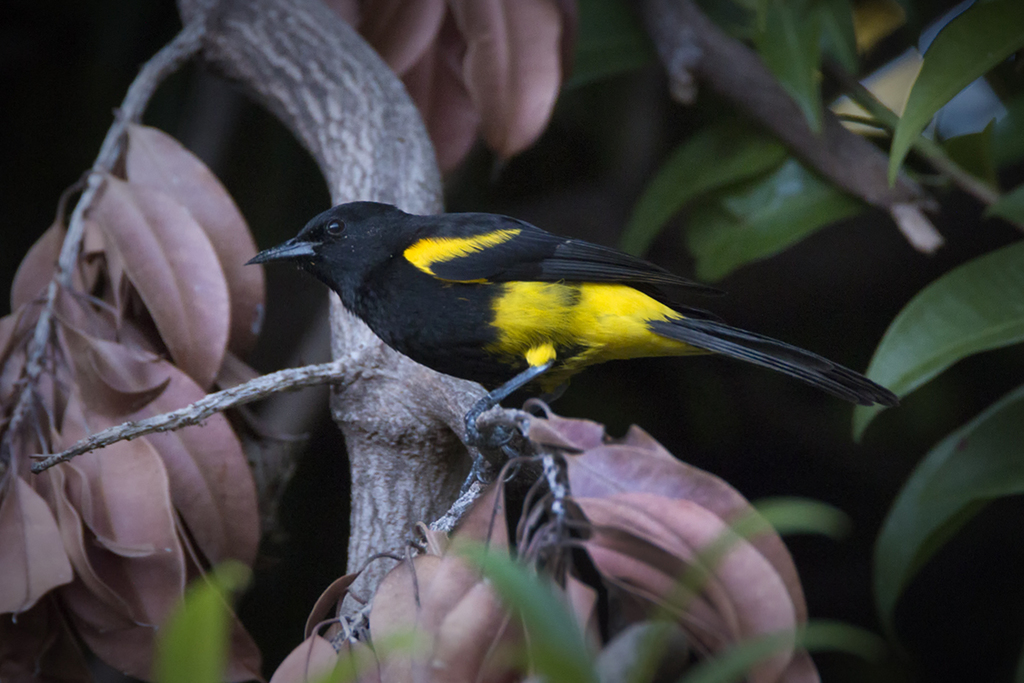
The Hispaniolan oriole is a slender-billed black and yellow oriole that lacks white markings on the wings. It shows more yellow than most Caribbean orioles, except for the Bahama oriole (Icterus northropi). The adult males and females are black overall, with distinctive yellow patches on shoulders, rump, and under-tail coverts extending to the lower breast. Like most tropical oriole species, the females are similar or identical to the males in coloring. In juvenile Hispaniolan orioles, the upper parts are mainly olive, while the underparts are dull yellow. The wings are black, and the throat is sometimes a black or reddish-brown that is not clearly demarcated. The length of the Hispaniolan oriole is an average of 20–22 cm, with males weighing 35–38 g while the females weigh 33–40 g. A similar species that is often mistaken for the Hispaniolan oriole is the yellow-shouldered blackbird (Agelaius xanthomus), which is a similar size but only has yellow patches on the shoulders.
Range & habitat
The Hispaniolan oriole is a year-round endemic to the island of Hispaniola (in both the Dominican Republic and Haiti), as well as the nearby islands of Gonâve, Saona, and Tortuga. It resides in tropical and subtropical forests, forest edges, woodlands, and gardens, from the coast to mid-elevations in mountains. However, it is not as common at higher elevations. They are commonly found where palm fronds are available for nesting, and are also found on the many shaded coffee plantations on the island. The Hispaniolan oriole seems to be rare in Hispaniolan pine (Pinus occidentalis) forests, in the highlands of the Dominican Republic; however, other species of orioles, such as the Bahama oriole, have been documented nesting in pine forests. Since there has been no published population assessment, there is a possibility that the Hispaniolan oriole can be found nesting in pine forests.
Wikipedia: “Habitat”
What it does
The diet of the Hispaniolan oriole consists of fruits, insects, flowers, and nectar. They often consume the nectar of the Erythrina plant. The orioles can hang upside-down to reach foods or insects on the underside of leaves. They are often found foraging in dense vegetation.
Wikipedia: “Feeding”
Listen
Looking for field recordings…
Where it lives
Recorded sightings
—
geo-referenced records in GBIF, from museums, herbaria and field observers.
Drag the globe to turn it. Dots are where records exist, not a range map; darker means more records.
In the stacks
Searching the stacks…
Every page naming Icterus dominicensis in the Biodiversity Heritage Library →
This page is assembled live from iNaturalist, GBIF, Wikipedia, the Source Library and the Internet Archive. It is not yet part of the hand-edited codex. iNaturalist taxon 9326.