On eBird ↗
Orchard Oriole
Live sightings near you, the range map, bar charts of when it is seen, and Macaulay Library photos and recordings.
Orchard Oriole
Icterus spurius
The orchard oriole (Icterus spurius) is the smallest species of icterid. The subspecies of the Caribbean coast of Mexico, I. s. fuertesi, is sometimes considered a separate species, the ochre oriole or Fuertes's oriole.
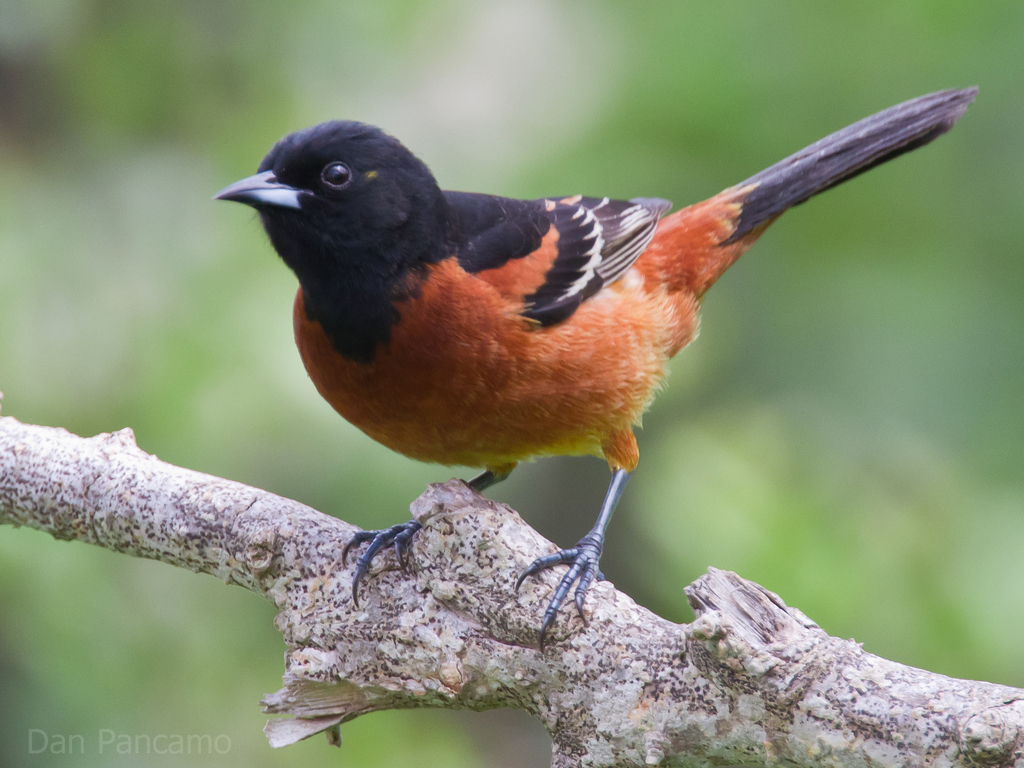
The orchard oriole is a small bird with a length of 5.9-7.1 inches, a weight of 0.6-1.0 ounces, and a wingspan of 9.8 inches. Adult males have chestnut or ochre underparts, while adult females and juveniles have olive-green upper parts and yellowish breasts and bellies. They inhabit semi-open areas with deciduous trees in eastern North America, southern Tamaulipas, and Veracruz. Their winter range extends from central Sinaloa and southern Veracruz to northern Colombia and northwestern Venezuela.
From the article Orchard oriole on Wikipedia (CC BY-SA), quoted section by section
Description
Measurements:
Length: 5.9–7.1 in (15–18 cm) Weight: 0.6–1.0 oz (16–28 g) Wingspan: 9.8 in (25 cm) The bill is pointed and black with some blue-gray at the base of the lower mandible. The adult male of the nominate subspecies has chestnut on the underparts, shoulder, and rump, with the rest of the plumage black. In the subspecies I. s. fuertesi, the chestnut is replaced with ochre. The adult female and the juvenile of both subspecies have olive-green on the upper parts and yellowish on the breast and belly. All adults have pointed bills and white wing bars. (Orchard orioles are considered to be adults after their second year.) One-year-old males are yellow-greenish with black lores and bib.
Range & habitat
The breeding habitat is semi-open areas with deciduous trees. I. s. spurius breeds in spring across eastern North America from near the Canada–United States border south to central Mexico. A 2009 study also found breeding in the thorn forest of Baja California Sur and the coast of Sinaloa during the summer "monsoon"; this region had previously been thought to be only a migratory stopover. I. s. fuertesi breeds from southern Tamaulipas to Veracruz. There is a record of a specimen of fuertesi from Cameron County, Texas. These birds prefer living in shaded trees within parks along lakes and streams. The nest is a tightly woven pouch attached to a fork on a horizontal branch. Their nests tend to sit close together. The nominate subspecies' winter range extends from the coastal lowlands of central Sinaloa and southern Veracruz south to northern Colombia and northwestern Venezuela (Scharf and Kren 1996). The ochre subspecies has been observed in winter on the Pacific slope of Mexico. Nominate orchard orioles depart from their winter habitats in March and April and arrive in their breeding habitats from late April to late May. Usually, they leave their breeding territories in late July and early August and arrive on their winter territories in mid August. These birds are nocturnal migrants.
Wikipedia: “Habitat and range”
What it does
While in breeding season, they eat insects and spiders. When the season changes, their diet also includes ripe fruit, which quickly passes through their digestive tract. During the winter, their diet consists of fruit, nectar, insects and seeds.
Wikipedia: “Diet”
In human culture
The specific name spurius refers to the original misidentification of the male as a female Baltimore oriole. These birds are sometimes mistakenly identified as New World warblers.
Wikipedia: “Etymology”
Listen
Looking for field recordings…
Where it lives
Recorded sightings
—
geo-referenced records in GBIF, from museums, herbaria and field observers.
Drag the globe to turn it. Dots are where records exist, not a range map; darker means more records.
In the old herbals & bestiaries

In the stacks
Searching the stacks…
Every page naming Icterus spurius in the Biodiversity Heritage Library →
This page is assembled live from iNaturalist, GBIF, Wikipedia, the Source Library and the Internet Archive. It is not yet part of the hand-edited codex. iNaturalist taxon 9325.