- Animals
- ›Chordates
- ›Vertebrates
- ›Ray-finned Fishes
- ›Carps, Characins, Catfishes and Allies
- ›Minnows, Suckers, Carps, and Loaches
- ›Carps and Minnows
- ›True Minnows
- ›Old World Minnows
- ›Achondrostoma
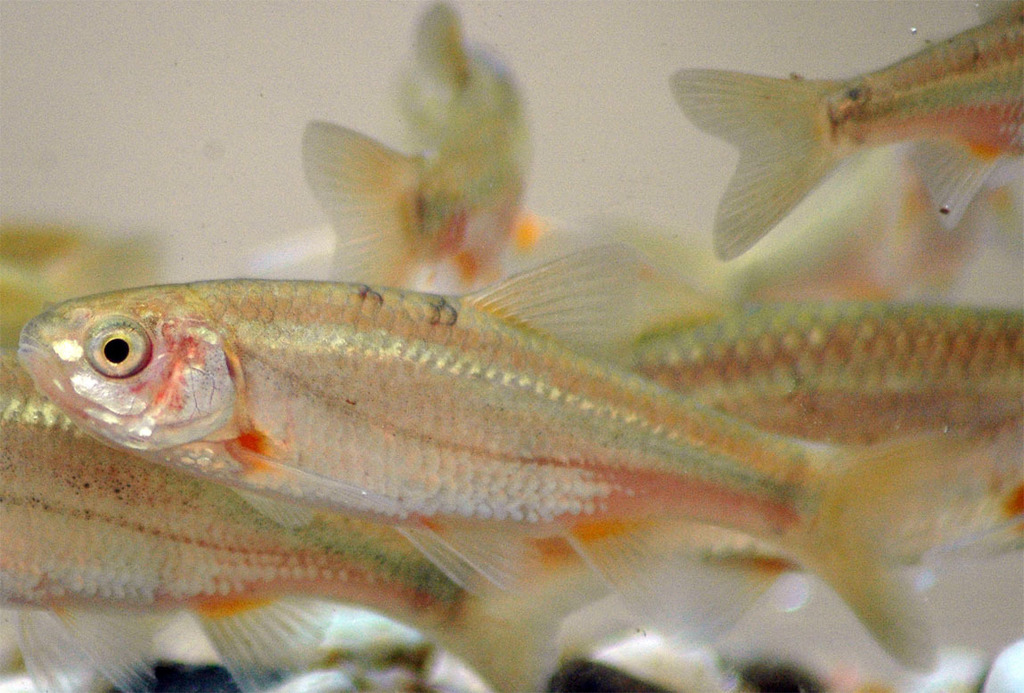
Ruivaco
Achondrostoma oligolepis
Achondrostoma oligolepis is a species of cyprinid fish. It is endemic to central and northern Portugal and known from between Limia and Tornada drainages, south of Douro. It occurs in the lower stretches of rivers and streams. It can grow to 25 cm (9.8 in) total length, although it typically measures about 15 cm (5.9 in) TL.
From the article Achondrostoma oligolepis on Wikipedia (CC BY-SA), quoted section by section
Description
Achondrostoma oligolepis differs from other species in its genus by having between 30 and 38 scales in its lateral line; 3 or 4 scale rows are found between the lateral line and the origin of the pelvic fin; the caudal peduncle has 11 or 12 rows of scales around it; the diameter of the eye diameter is smaller than the length of the snout, which is rounded and obtuse; and the ventral profile of head has a marked angle at the articulation of the lower jaw. The ruivaco has a maximum total length of 25 cm (9.8 in), although 15 cm (5.9 in) is more typical.
Range & habitat
Achondrostoma oligolepis is endemic to Portugal, where it is found in the Âncora River system south to the Arnoia and Real rivers, both of which drain into the Óbidos coastal lagoon system to the north of Lisbon. The ruivaco is a habitat generalist and inhabits slow-moving, low-lying rivers and streams which have aquatic vegetation and substrates of sand or gravel.
== References ==
Wikipedia: “Distribution and habitat”
In human culture
Achondrostoma oligolepis belongs to the genus Achondrostoma. This name places the prefix a-, meaning "without", in front of the genus name Chondrostoma, which is a combination of chondros, a word meaning "gristle" or "cartilage", and stoma, meaning "mouth". This is an allusion to the lack of the horny plates in the mouths of these fishes, which are present in Chondrostoma. The specific name, oligolepis, combines oligo, meaning "few", and lepis, which means "scale", a reference to the larger and, therefore, fewer scales.
Wikipedia: “Etymology”
Where it lives
Recorded sightings
—
geo-referenced records in GBIF, from museums, herbaria and field observers.
Drag the globe to turn it. Dots are where records exist, not a range map; darker means more records.
In the stacks
Searching the stacks…
Every page naming Achondrostoma oligolepis in the Biodiversity Heritage Library →
This page is assembled live from iNaturalist, GBIF, Wikipedia, the Source Library and the Internet Archive. It is not yet part of the hand-edited codex. iNaturalist taxon 93140.