On eBird ↗
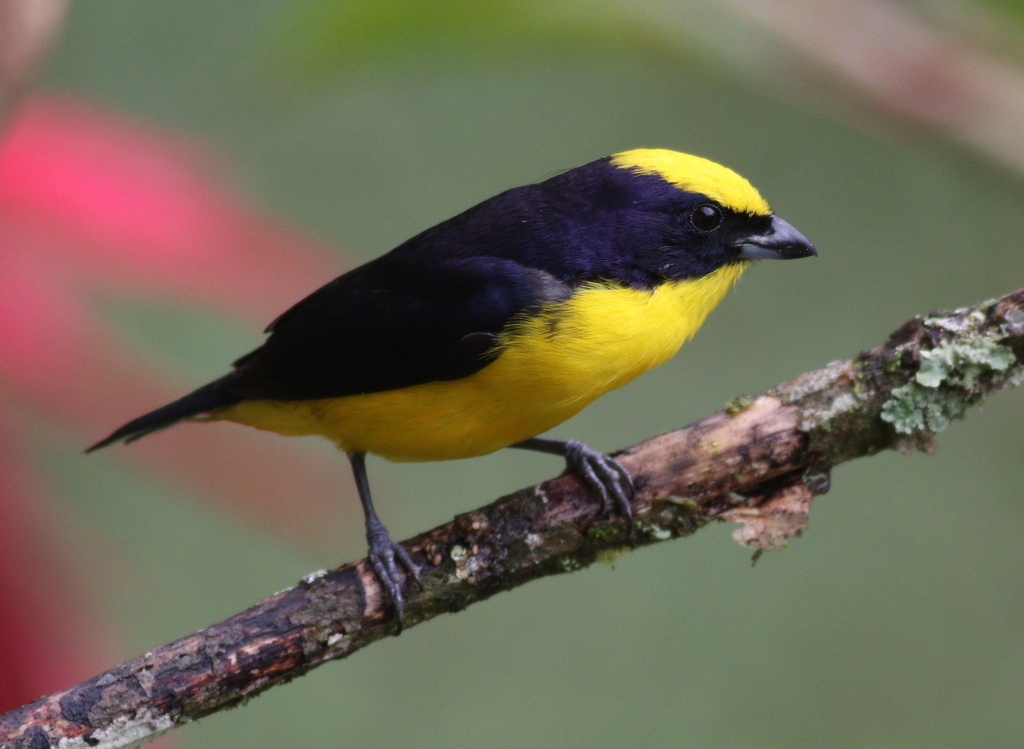
Thick-billed Euphonia
Live sightings near you, the range map, bar charts of when it is seen, and Macaulay Library photos and recordings.
Thick-billed Euphonia
Euphonia laniirostris
The thick-billed euphonia (Euphonia laniirostris) is a species of bird in the family Fringillidae, the finches and euphonias. It is found in Bolivia, Brazil, Colombia, Costa Rica, Ecuador, Panama, Peru, and Venezuela.
From the article Thick-billed euphonia on Wikipedia (CC BY-SA), quoted section by section
Description
The thick-billed euphonia is about 10 cm (3.9 in) long and weighs 13 to 16.5 g (0.46 to 0.58 oz). It is a small euphonia with one of the thicker bills of all euphonias, though it is not dramatically larger than the others'. The species is sexually dimorphic. Adult males of the nominate subspecies E. l. laniirostris have a bright yellow forehead; the patch extends slightly past the eye. The rest of their crown and their face, nape, and upperparts are glossy blue-black. Their upperwing coverts and flight feathers are dusky with a dark blue tinge. Their tail's upper surface is dark blue and its underside dark gray with white inner webs on the underside of the outer three pairs of feathers. Their throat and underparts are bright yellow. Adult females have a yellowish olive-green head, upperparts, wings, and tail. Their underparts are greenish yellow that is lightest on the undertail coverts. The other subspecies of the thick-billed euphonia differ from the nominate and each other thus:
E. l. crassirostris: male like nominate but with yellow extending further back on the crown E. l. melanura: male has darker orange-yellow underparts than nominate with no white on the undertail; female has darker underparts than nominate E. l. hypoxantha: male has entirely lemon-yellow crown and lighter, brighter yellow, underparts E. l. …
Range & habitat
The thick-billed euphonia has a disjunct distribution. The subspecies are found thus:
E. l. crassirostris: Pacific slope from central Puntarenas and San José provinces in Costa Rica south to Panama's Veraguas Province; on both slopes of Panama from there and south on Colombia's Pacific slope to central Chocó Department; across northern Colombia and south in the valleys of the Cauca and Magdalena rivers, and continuing east across northeastern Venezuela to western Sucre (state) E. l. melanura: from much of southeastern Colombia south through eastern Ecuador and eastern Peru to Pasco Department; from there east across Amazonian Brazil south of the Amazon River to western Pará E. l. hypoxantha: Pacific slope of Ecuador from about the Colombian border south into Peru to southern Cajamarca Department E. l. zopholega: Junín and Cuzco departments in east-central Peru E. l. laniirostris: southeastern Peru and northern and central Bolivia and east into southern Amazonian Brazil to Mato Grosso and southwestern Goiás The thick-billed euphonia inhabits a wide variety of somewhat open landscapes in the tropical and subtropical zones. In Central America, northern Colombia, and Venezuela it is found in dry to humid areas on the edges and in clearings of forest, gallery forest, woodlots, cultivated areas, and gardens and trees around human habitations. …
Wikipedia: “Distribution and habitat”
What it does
The thick-billed euphonia feeds primarily on the fruits of mistletoe (Loranthaceae) and other small fruits, and also includes small numbers of insects in its diet. It mostly forages in pairs and in small groups and often associates with mixed-species feeding flocks. In the forest it forages primarily in the canopy and occasionally lower at the forest edge.
Wikipedia: “Feeding”
Listen
Looking for field recordings…
Where it lives
Recorded sightings
—
geo-referenced records in GBIF, from museums, herbaria and field observers.
Drag the globe to turn it. Dots are where records exist, not a range map; darker means more records.
In the stacks
Searching the stacks…
Every page naming Euphonia laniirostris in the Biodiversity Heritage Library →
This page is assembled live from iNaturalist, GBIF, Wikipedia, the Source Library and the Internet Archive. It is not yet part of the hand-edited codex. iNaturalist taxon 9308.