On eBird ↗
Trinidad Euphonia
Live sightings near you, the range map, bar charts of when it is seen, and Macaulay Library photos and recordings.
Trinidad Euphonia
Euphonia trinitatis
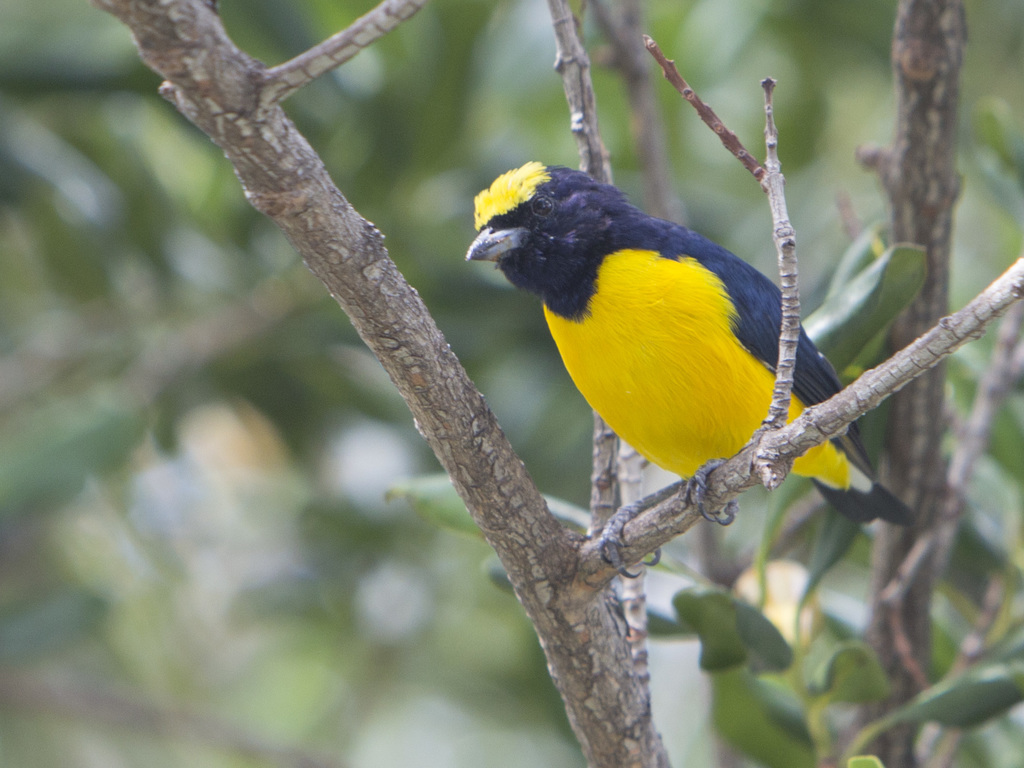
The Trinidad euphonia (Euphonia trinitatis) is a species of bird in the family Fringillidae. It is common in northern Colombia and northern Venezuela and uncommon to rare on the Caribbean island of Trinidad. Like all euphonias, it is small, stocky, and short-tailed; unlike some, it is sexually dimorphic. The male is glossy blue-black on the head, back, throat, and upper breast, with a bright yellow forehead and crown, and bright yellow underparts. The female is olive-green above and yellow-olive below, with a grayer patch running down the center of her breast and abdomen, and bright yellow undertail coverts. Its calls are high-pitched, plaintive whistles: the two most common are a single-pitched, double-noted "pee pee" or "tee dee", or a rising, double-noted "puwee", "cooleee" or "duu dee". Its song is a short, jumbled mix of musical and nonmusical notes.
It is primarily a fruit-eater, specializing on mistletoe berries, but also eating other fruits, as well as occasional seeds and invertebrates. Pairs are monogamous, and stay together year round. Both parents build a globular nest of dried grass and stems, lined with finer material and with a side entrance. The female lays three to four cream-colored, brown-splotched eggs, which she alone incubates. Both parents feed the hatched chicks. English ornithologist Hugh Edwin Strickland first described the Trinidad euphonia in 1851. It has no subspecies. Across its range, it is considered a species of least concern, though it is rare on Trinidad due to overtrapping for the caged bird trade.
From the article Trinidad euphonia on Wikipedia (CC BY-SA), quoted section by section
Description
The Trinidad euphonia is a small, stout, short-tailed passerine, measuring 9.7–11 cm (3.8–4.3 in) in length and weighing 8.8–14 g (0.31–0.49 oz). It is sexually dimorphic in plumage. The male is glossy blue-black on the head, back, chin, and throat, with a bright yellow forehead and crown, and bright yellow underparts. The basal half of his rectrices are white, as are his underwing coverts; the latter results in a white stripe on his underwing when he flies. He also has white on the inner webs of the outer two to three tail feathers; this appears as two large white ovals on the undertail. The yellow on his crown extends well behind his eyes. The female is olive-green above and yellow-olive below, with a grayer patch running down the center of her breast and abdomen, and bright yellow undertail coverts. Both sexes have dark brown irises, and gray legs and feet. The bill is black with a white base to the lower mandible.
Vocalizations. A "notably vocal" species, the Trinidad euphonia has whistled calls that are high-pitched, plaintive, and hard to locate. The male typically sits at or near the top of a tree to call, often sitting on a semi-exposed or bare branch. One regular call, variously transcribed as "pee", "tee", or "dee", is typically doubled, though sometimes it is repeated 3–5 times, and exceptionally up to 20. …
Range & habitat
The Trinidad euphonia is found in northern Colombia, northern Venezuela, and Trinidad. A single Tobago record is regarded as a probable escaped cage bird. On Trinidad, it is found primarily in second growth and hill forest near mistletoe and in cultivated areas with large trees, though on the west coast it is also found in mangroves. On the mainland, it occurs in the tropical zone at elevations up to 1,100 m (3,600 ft), and is especially common in arid regions. Habitats include dry forest, the edges of moist forest, light woodland, scrub, and cultivated areas. In moister forest, it is replaced by the purple-throated euphonia. There have been several exceptionally high sight-only (i.e. undocumented) records in Venezuela: one at 1,200 m (3,900 ft) and another at 1,450 m (4,760 ft).
Wikipedia: “Distribution and habitat”
What it does
The Trinidad euphonia spends much of its time in the treetops. It is typically found in pairs or groups of up to eight. Although it seldom joins mixed-species flocks, it readily joins mobs that are harassing snakes, owls, or other predators. It is known to wander widely.
Breeding and nesting. The Trinidad euphonia is monogamous, with pairs remaining together year-round. The breeding season runs from January to April in Trinidad, but is generally restricted to April in Colombia and Venezuela. The pair court by flicking their wings and twitching from side to side, bowing low, with the male displaying his bright crown. Both sexes build the nest, which is a round ball of dried grass and stems. It has a circular entrance in the side and is lined with finer material. This can be located from 1.4 to 12 m (4 ft 7 in to 39 ft 4 in) off the ground, and may be built in a variety of locations. Sometimes they are tucked into large bromeliads and occasionally they are hung from the end of a branch. One has been found in a hollow stump. The female lays 3–4 eggs, which are white or cream with irregular dark brown splotches and measure 17.7 mm × 12.9 mm (0.70 in × 0.51 in). Only she incubates them, but both parents feed the hatched youngsters. The generation length is estimated to be 3.5 years.
Feeding. …
Wikipedia: “Behavior and ecology”
Listen
Looking for field recordings…
Where it lives
Recorded sightings
—
geo-referenced records in GBIF, from museums, herbaria and field observers.
Drag the globe to turn it. Dots are where records exist, not a range map; darker means more records.
In the stacks
Searching the stacks…
Every page naming Euphonia trinitatis in the Biodiversity Heritage Library →
This page is assembled live from iNaturalist, GBIF, Wikipedia, the Source Library and the Internet Archive. It is not yet part of the hand-edited codex. iNaturalist taxon 9305.