On eBird ↗
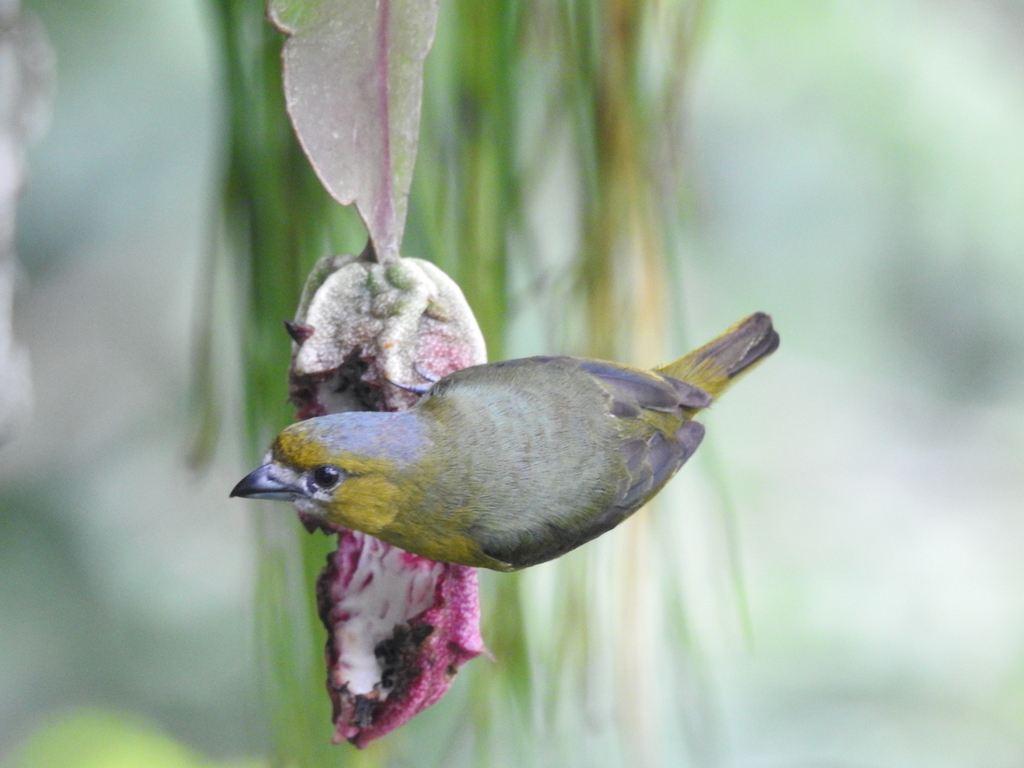
Golden-bellied Euphonia
Live sightings near you, the range map, bar charts of when it is seen, and Macaulay Library photos and recordings.
Golden-bellied Euphonia
Euphonia chrysopasta
The white-lored euphonia or golden-bellied euphonia (Euphonia chrysopasta) is a species of bird in the family Fringillidae, the finches and euphonias. It is found in every mainland South American country except Argentina, Chile, Paraguay, and Uruguay.
From the article White-lored euphonia on Wikipedia (CC BY-SA), quoted section by section
Description
The white-lored euphonia is 9 to 10 cm (3.5 to 3.9 in) long and weighs about 11 to 16 g (0.39 to 0.56 oz). It has a thick bill. The species is sexually dimorphic but not dramatically so. Adult males of the nominate subspecies have an olive forecrown with a thin dusky front border and a grayish crown and nape. Their lores, chin, and cheeks are ashy whitish gray and the rest of their face is olive-green. Their upperparts are mostly olive-green with a bluish gray gloss and paler uppertail coverts. The upper side of their tail is olive and the lower side grayish. Their flight feathers are dusky with olive-green edges and tips. Their underparts are mostly yellow with faint olive mottling, a slight olive tinge on the flanks, a clear yellow center of the belly, and clear yellow undertail coverts. Adult females are overall duller than males. They have less white on their face. Their upperparts, wings, and tail are like the male's. Their underparts are mostly gray with olive-yellow sides, flanks, and undertail coverts. Subspecies E. c. nitida is slightly smaller than the nominate. Males have less gray on their crown and nape and slightly duller underparts. Females are like the nominate. Both sexes of both subspecies have a dark brown iris, a blackish bill with a grayish base to the mandible, and horn-gray legs and feet.
Range & habitat
The nominate subspecies of the white-lored euphonia is the more westerly and southerly of the two. It is found from southeastern Colombia south through eastern Ecuador and eastern Peru into northern Bolivia and east across Amazonian Brazil south of the Amazon river to the Xingu and Tocantins rivers. Subspecies E. c. nitida is found from extreme eastern Colombia east across Venezuela's Amazonas, Bolívar, and southern Delta Amacuro states. Its range continues to the Atlantic across the Guianas and Brazil north of the Amazon. The white-lored euphonia inhabits the canopy and edges of humid várzea and terra firme forests and also shady clearings with trees and mature secondary forest. In elevation it reaches 1,200 m (3,900 ft) in Colombia and Peru, 600 m (2,000 ft) in Ecuador, and 900 m (3,000 ft) in Venezuela and Brazil.
Wikipedia: “Distribution and habitat”
What it does
The white-lored euphonia feeds primarily on the fruits of mistletoe (Loranthaceae) and other small fruits, and also includes small numbers of insects in its diet. It forages mostly in pairs, less often singly or in small groups, and sometimes joins mixed-species feeding flocks. In forest it forages primarily in the canopy but feeds lower in shrubs and small trees at its edges and in clearings.
Wikipedia: “Feeding”
Listen
Looking for field recordings…
Where it lives
Recorded sightings
—
geo-referenced records in GBIF, from museums, herbaria and field observers.
Drag the globe to turn it. Dots are where records exist, not a range map; darker means more records.
In the stacks
Searching the stacks…
Every page naming Euphonia chrysopasta in the Biodiversity Heritage Library →
This page is assembled live from iNaturalist, GBIF, Wikipedia, the Source Library and the Internet Archive. It is not yet part of the hand-edited codex. iNaturalist taxon 9295.