On eBird ↗
White-vented Euphonia
Live sightings near you, the range map, bar charts of when it is seen, and Macaulay Library photos and recordings.
White-vented Euphonia
Euphonia minuta
The white-vented euphonia (Euphonia minuta) is a species of bird in the Fringillidae family. It is found in Belize, Bolivia, Brazil, Colombia, Costa Rica, Ecuador, French Guiana, Guatemala, Guyana, Honduras, Mexico, Nicaragua, Panama, Peru, Suriname, and Venezuela. Its natural habitats are subtropical or tropical moist lowland forests and heavily degraded former forest.
From the article White-vented euphonia on Wikipedia (CC BY-SA), quoted section by section
Description
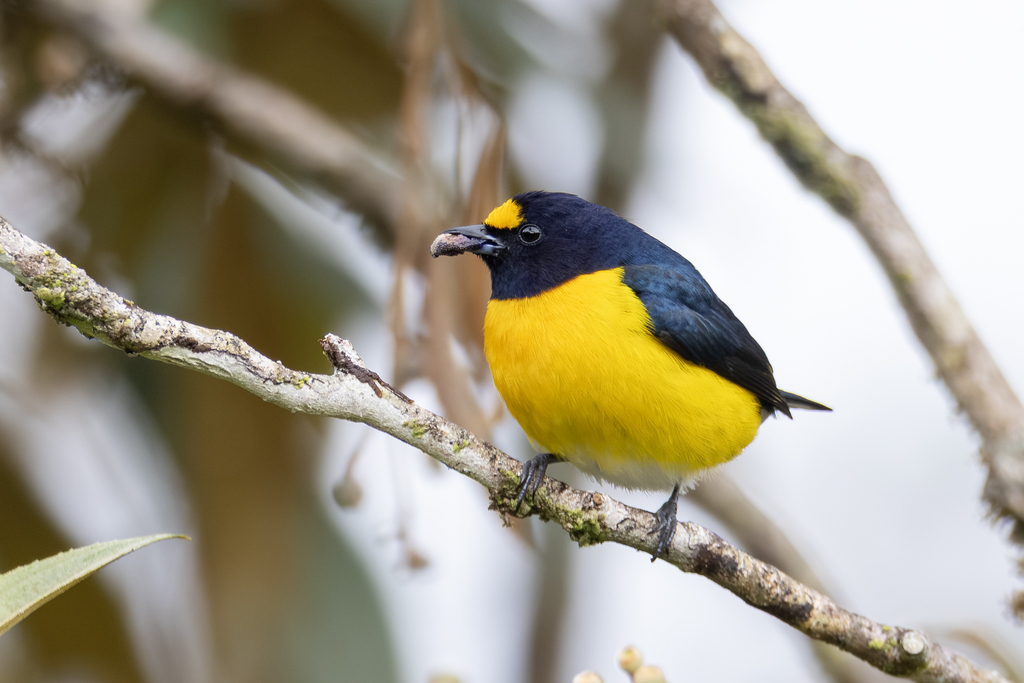
The white-vented euphonia is about 9 cm (3.5 in) long and weighs about 8 to 11.5 g (0.28 to 0.41 oz). It is a very small euphonia with a short thick bill. The species is sexually dimorphic. Adult males of the nominate subspecies have a small bright yellow forehead; the patch does not reach the eye. The rest of their head, their neck, and their upperparts are glossy blue-black with a purplish gloss on the head and nape. Their flight feathers are dusky with dark blue edges. Their tail is mostly glossy blue-black with white inner webs on the underside of the outer three pairs of feathers. Their breast and belly are bright yellow with sometimes some dusky mottling on the flanks. The middle of their belly and their undertail coverts are white. Adult females have an olive head, upperparts, wings, and tail. Their throat is dingy grayish white, their upper breast, sides and flanks are olive-yellow, and the center of their lower breast, belly, and undertail coverts are white. Males of subspecies E. m. humilis have a larger yellow forehead patch and a slightly darker and richer yellow upper breast than the nominate. Both sexes of both subspecies have a dark brown iris, a black bill with a blue-gray base to the mandible, and dark gray legs and feet.
Range & habitat
The white-vented euphonia has a disjunct distribution. Subspecies E. m. humilis is the more northerly of the two and itself occurs in three separate ranges. One population is found from Chiapas in far southeastern Mexico, in scattered locations across Belize, Guatemala, and Honduras, and more nearly continuously on the Caribbean slope through Nicaragua and Costa Rica to central Panama. A second population is found on the Pacific slope from central Puntarenas and San José provinces in Costa Rica south to Panama's Veraguas Province. The third is found from extreme eastern Panama into western Colombia and south to northwestern Ecuador's Santo Domingo de los Tsáchilas Province. In Colombia it also extends east into the valley of the Magdalena River. The nominate subspecies of the white-vented euphonia has a mostly contiguous range in northwestern and northern South America. It is found from much of southeastern Colombia south through eastern Ecuador and eastern Peru to central Bolivia. In the north its range continues in Colombia in a thin band northeast along the Eastern Andes slightly into northwestern Venezuela's Táchira, and from southeastern Colombia across much of southern and far eastern Venezuela. From Venezuela its range crosses the Guianas and Brazil north of the Amazon to the Atlantic in Amapá. …
Wikipedia: “Distribution and habitat”
What it does
The white-vented euphonia feeds primarily on the fruits of mistletoe (Loranthaceae) and other small fruits, and also includes small numbers of insects in its diet. It mostly forages singly and in pairs though sometimes in small groups. It often associates with other euphonias and regularly joins mixed-species feeding flocks. In the forest it forages primarily in the canopy. It almost continuously wags its tail while foraging.
Wikipedia: “Feeding”
Listen
Looking for field recordings…
Where it lives
Recorded sightings
—
geo-referenced records in GBIF, from museums, herbaria and field observers.
Drag the globe to turn it. Dots are where records exist, not a range map; darker means more records.
In the stacks
Searching the stacks…
Every page naming Euphonia minuta in the Biodiversity Heritage Library →
This page is assembled live from iNaturalist, GBIF, Wikipedia, the Source Library and the Internet Archive. It is not yet part of the hand-edited codex. iNaturalist taxon 9293.