On eBird ↗
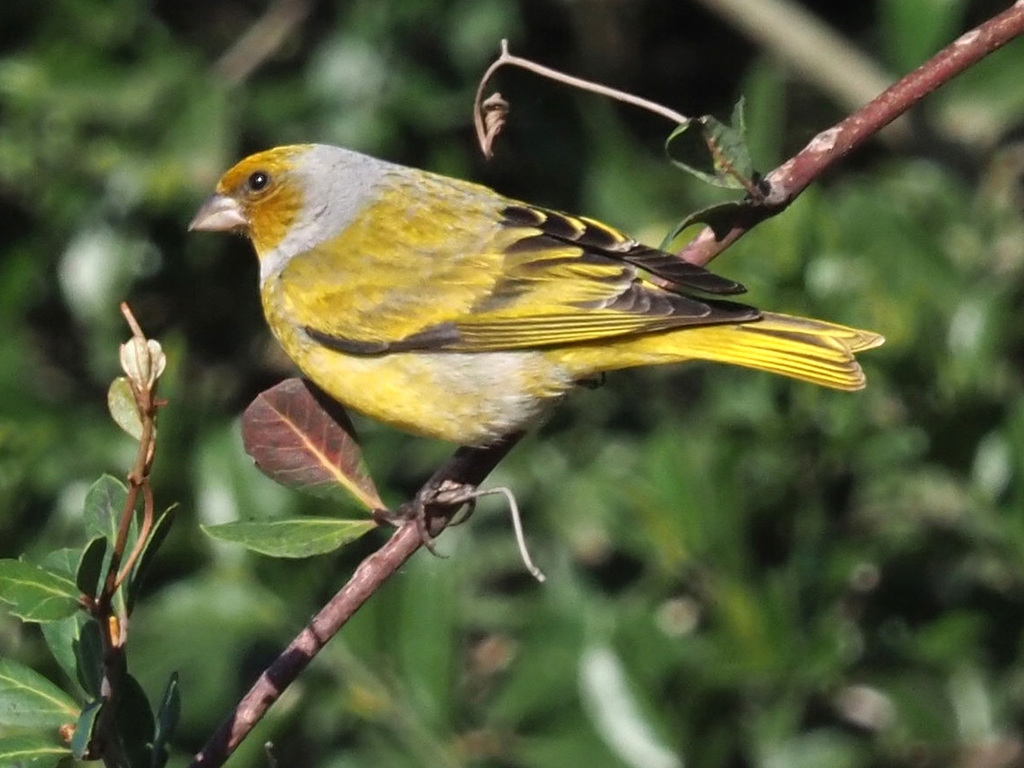
Cape Canary
Live sightings near you, the range map, bar charts of when it is seen, and Macaulay Library photos and recordings.
Cape Canary
Serinus canicollis
The Cape canary (Serinus canicollis) is a small passerine bird in the finch family. It is a resident breeder in southern Africa and has been introduced to Mauritius and Réunion. It is a residential bird but shows seasonal and altitudinal movements, sometimes forming large flocks outside the breeding season.
Its habitat is fynbos, grassland and gardens, preferably in highland areas. It builds a compact cup nest in a scrub. It inhabits a variety of terrestrial habitats, from forest edges to montane areas, foraging mainly on seeds in pairs or flocks. Breeding occurs from August to February. Nest are built by females and both parents feed chicks, which typically fledge in 2-3 weeks.
From the article Cape canary on Wikipedia (CC BY-SA), quoted section by section
Range & habitat
The Cape canary occupies a wide range of habitats. It is commonly found along the edges and clearings of lowland and lower montane forests, including areas with African juniper and Podocarpus trees. Cape canaries mostly feed on soft green seeds. They forage among low vegetation within reach of flowers and shrubs, taking seeds directly from the ground or flower heads. They forage in pairs and flocks of up to 50 birds during breeding season. In non-breeding seasons they join other flocks to forage with up to 500 birds.
Wikipedia: “Habitat and Foraging”
Listen
Looking for field recordings…
Where it lives
Recorded sightings
—
geo-referenced records in GBIF, from museums, herbaria and field observers.
Drag the globe to turn it. Dots are where records exist, not a range map; darker means more records.
In the stacks
Searching the stacks…
Every page naming Serinus canicollis in the Biodiversity Heritage Library →
This page is assembled live from iNaturalist, GBIF, Wikipedia, the Source Library and the Internet Archive. It is not yet part of the hand-edited codex. iNaturalist taxon 9271.