- Animals
- ›Chordates
- ›Vertebrates
- ›Mammals
- ›Therians
- ›Placental Mammals
- ›Ungulates, Carnivorans, and Allies
- ›Carnivorans
- ›Mongooses
- ›Solitary Mongooses
- ›Urva
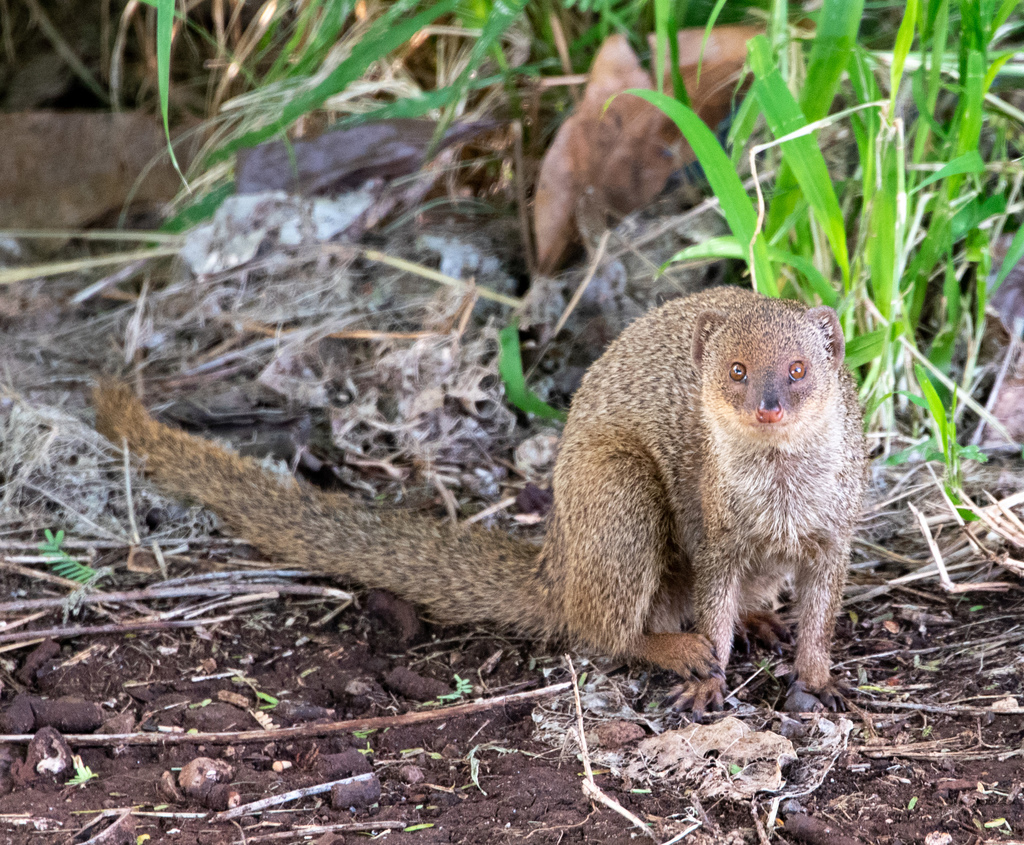
Small Indian Mongoose
Urva auropunctata
The Javan mongoose (Herpestes javanicus) is a species of mongoose found in the wild in South and Southeast Asia. It has also been introduced to Hawaii, the Bahamas, Cuba, Croatia, Jamaica, Hispaniola, Puerto Rico, the Lesser Antilles, Belize, Honduras, Panama, Trinidad and Tobago, Colombia, Suriname, Venezuela, Guyana and Mafia Island. The western subspecies group is sometimes treated as a separate species, the Indian mongoose or small Indian mongoose (Herpestes auropunctatus).
From the article Javan mongoose on Wikipedia (CC BY-SA), quoted section by section
Description
The Javan mongoose's fur is ferruginous to sepia and rich tawny brown on the back. It has short hairs on the ears. Its tail is tapering.
Range & habitat
The Javan mongoose is native to Myanmar, Thailand, Cambodia, Vietnam, Laos, Peninsular Malaysia and the Indonesian islands of Sumatra and Java, where it lives up to an elevation of 1,800 m (5,900 ft). Its presence is uncertain in China. In Thailand, the Javan mongoose was photographed by camera traps in a variety of habitats, including degraded mixed deciduous forest, dry evergreen and dry dipterocarp forests, as well as in abandoned plantations and pineapple fields.
Invasive species. In Europe, this species has been included since 2016 in the list of invasive alien species of Union concern. This means that this species cannot be imported, bred, transported, commercialized, or intentionally released into the environment in the whole of the European Union.
Wikipedia: “Distribution and habitat”
What it does
The Javan mongoose is mostly solitary; males sometimes form social groups and share burrows. Females are pregnant for up to 49 days and give birth to a litter of 2–5 young. Males can potentially become sexually mature at the age of 4 months. Javan mongooses eat mostly insects but are opportunistic feeders and will eat crabs, frogs, spiders, scorpions, snakes, small mammals, birds, and eggs.
Wikipedia: “Behaviour and ecology”
Listen
Looking for field recordings…
Where it lives
Recorded sightings
—
geo-referenced records in GBIF, from museums, herbaria and field observers.
Drag the globe to turn it. Dots are where records exist, not a range map; darker means more records.
In the stacks
Searching the stacks…
Every page naming Urva auropunctata in the Biodiversity Heritage Library →
This page is assembled live from iNaturalist, GBIF, Wikipedia, the Source Library and the Internet Archive. It is not yet part of the hand-edited codex. iNaturalist taxon 925979.